
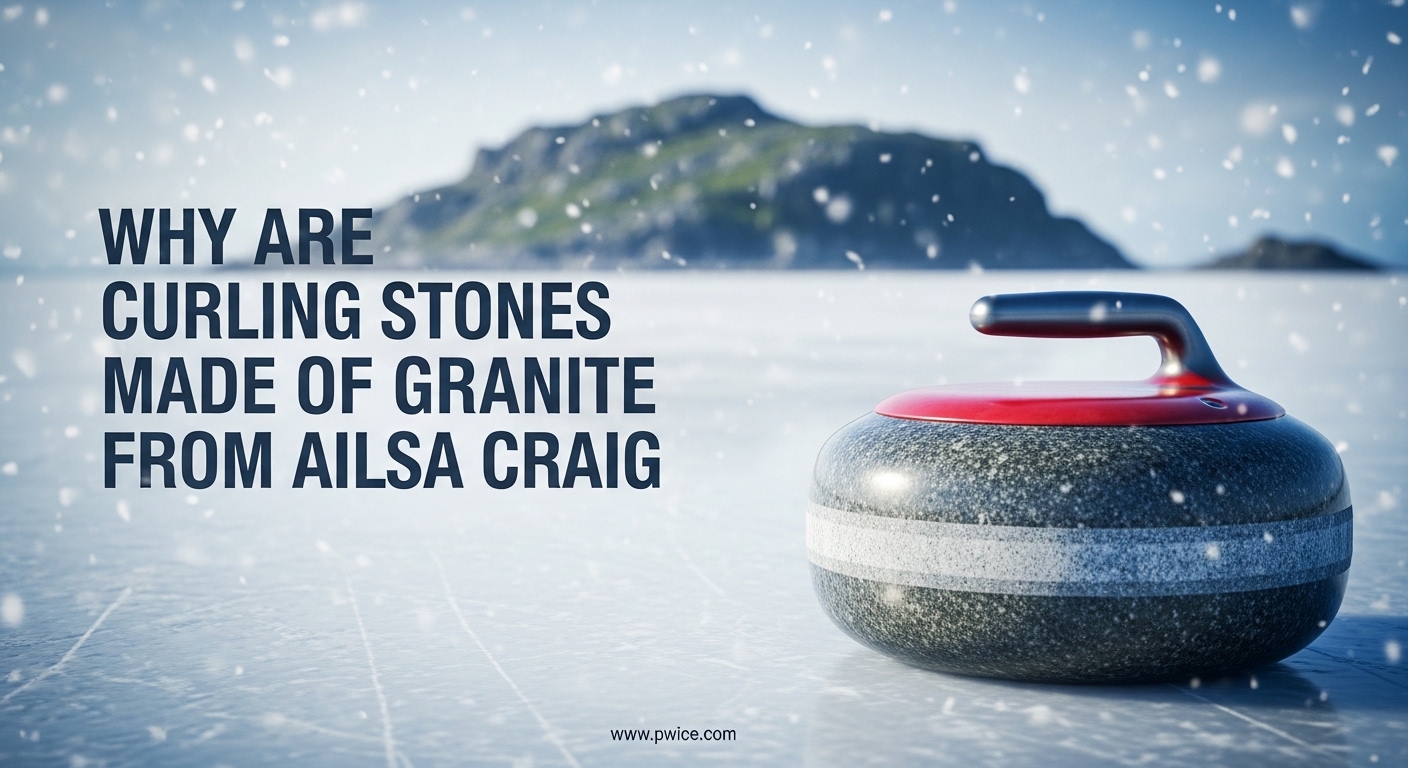
Curling stones are made from Ailsa Craig granite because it is some of the hardest and purest granite found anywhere on Earth. The stone’s unique combination of extreme hardness, exceptionally low water absorption, and fine-grained uniform structure makes it perfectly suited for the demanding conditions of curling. No other granite in the world possesses this specific blend of properties that allows a 42-pound stone to glide smoothly across pebbled ice while resisting chipping and moisture damage.
Every Olympic curling stone since the inaugural Winter Games in 1924 has originated from this tiny volcanic island located 10 miles off Scotland’s Ayrshire coast. The island rises dramatically from the Firth of Clyde, a 1,100-foot remnant of volcanic activity that occurred when the supercontinent joining North America, Greenland, and Europe began breaking apart. What nature created 60 million years ago continues to define the sport of curling at its highest level today.
The connection between Ailsa Craig and curling runs deeper than geology. Scottish curlers have long considered the island almost mystical in its significance to their sport. The Royal Caledonian Curling Club recognized the superiority of Ailsa Craig granite as far back as 1838, establishing a tradition that has remained unbroken for nearly two centuries.
Table of Contents
Why Are Curling Stones Made of Granite from Ailsa Craig?
The answer lies in a remarkable set of physical properties that exist together in this single location and nowhere else. Understanding these properties reveals why manufacturers have never found a suitable substitute despite searching across five continents.
The Unique Hardness and Purity of Ailsa Craig Granite
Ailsa Craig granite is classified as microgranite, a fine-grained igneous rock formed when magma cooled rapidly under specific geological conditions. The minerals within this granite are arranged in an extraordinarily tight interlocking pattern that knits them together with remarkable density. This microscopic structure gives the stone its exceptional resilience against the repeated collisions that occur during curling matches.
The hardness of Ailsa Craig granite rates among the highest of any commercial stone. When two curling stones collide on the ice, they experience tremendous impact forces. Softer granites would chip, crack, or deform under these stresses, permanently altering the stone’s shape and affecting its trajectory. Ailsa Craig granite absorbs these impacts without losing its precisely machined geometry, maintaining consistent performance across decades of use.
Purity matters equally for Olympic-level competition. Impurities in lesser granites create weak points and irregular densities that cause unpredictable behavior on the ice. The uniformity of Ailsa Craig granite ensures that every stone performs identically, a requirement for fair competition at the highest levels of the sport.
Low Water Absorption: The Critical Property
Perhaps the most scientifically important property of Ailsa Craig granite is its extraordinarily low water absorption rate. This characteristic matters because curling ice is not smooth; it is deliberately textured with tiny water droplets frozen to the surface in a process called “pebbling.” These microscopic bumps reduce friction and allow the stone to glide while creating the characteristic curl that gives the sport its name.
When curling stones slide across this pebbled surface, moisture constantly contacts the stone’s running band. Normal stone would absorb this water, which would then freeze within the material during temperature changes. Repeated freeze-thaw cycles would gradually erode and destroy the stone’s carefully polished surface. Ailsa Craig granite’s near-zero porosity prevents this destructive process entirely.
The low water absorption also means the stone’s weight remains constant regardless of ice conditions. A stone that absorbed moisture would become heavier during play, altering its momentum and trajectory. Competitive curling demands precision to the millimeter, making this stability essential.
Rare Minerals Found Nowhere Else
Beyond its physical structure, Ailsa Craig granite contains a unique assemblage of rare minerals that contribute to its distinctive properties. The island’s granite features arfvedsonite, aegirine, and aenigmatite, minerals rich in sodium and iron that are found in significant quantities in very few locations worldwide.
These uncommon minerals formed during the specific chemical conditions of Ailsa Craig’s volcanic creation. The low aluminum content in the original magma allowed these sodium-rich minerals to crystallize instead of the more common feldspar varieties found in typical granite. This distinctive mineralogy contributes to the stone’s density and mechanical properties.
Geologists have identified Ailsa Craig granite in boulders transported by ancient glaciers to Wales and Ireland, proving the stone’s uniqueness extends beyond the island itself. Yet no natural deposit matching the island’s granite has ever been found elsewhere, despite extensive geological surveys across the British Isles and beyond.
The 60 Million Year Formation of Ailsa Craig Granite
Understanding why Ailsa Craig granite is unique requires looking back 60 million years to a period of intense volcanic activity that shaped the modern North Atlantic. The story of this stone is written in the geological record of a transforming planet.
A Volcanic Origin Story
Around 60 million years ago, the supercontinent that joined North America, Greenland, and Europe began breaking apart. Massive volcanic eruptions occurred along the rift zone as magma pushed toward the surface, creating the foundation of what would become the Atlantic Ocean. Ailsa Craig formed during this period as a volcanic plug, the solidified remnant of magma that once fed ancient eruptions.
The island’s granite formed from the slow cooling and solidifying of this magma deep beneath the surface. Unlike surface lava that cools quickly into glassy or coarse rocks, the insulated conditions underground allowed crystals to form in a fine, uniform pattern. Around the same time, a huge volcano was active on the nearby island of Arran, part of the same geological system that created this region’s distinctive landscape.
Over millions of years, erosion stripped away the surrounding volcanic material, leaving only the hardened granite plug standing in isolation. This erosion-resistant core now rises from the sea as Ailsa Craig, its distinctive conical shape visible for miles along the Scottish coast.
What Makes Microgranite Different
Microgranite differs from ordinary granite in its crystal size and formation conditions. While typical granite features visible crystals that give it a speckled appearance, microgranite crystals are microscopic, creating a uniform texture without visible grain. This fine crystallization results from the specific cooling rate and chemical composition of the original magma.
The columnar jointing visible in Ailsa Craig’s rock faces formed as the granite contracted during cooling. These natural fractures actually aided early quarrying operations, allowing workers to extract usable stone with less effort than would be required with solid rock. The joint pattern creates distinctive hexagonal columns similar to those found at the Giant’s Causeway in Northern Ireland.
The density of Ailsa Craig granite, approximately 2.65 grams per cubic centimeter, provides the mass needed for curling stones to maintain momentum on ice while remaining manageable for players to deliver. This density results from the tight packing of minerals in the microgranite structure, a physical characteristic that no synthetic material has successfully replicated.
Why Alternatives Cannot Compare to Ailsa Craig Granite
Given the limited supply from a single island, manufacturers have repeatedly sought alternatives to Ailsa Craig granite. These efforts have consistently failed to produce stones matching the performance of the Scottish microgranite.
Welsh Trefor granite, quarried from the Llŷn Peninsula, represents the most notable alternative. Trefor granite shares some visual similarities with Ailsa Craig stone and has been used for curling stones in Canada and other regions. However, detailed testing reveals significant differences in performance. Trefor granite lacks the fine-grained uniformity and specific mineral composition that gives Ailsa Craig stone its unique “springy” collision properties.
Some manufacturers have experimented with ceramic and composite materials, hoping modern engineering could surpass natural stone. Dr. Derek Leung of the University of Regina conducted comparative studies showing that ceramic stones, while more uniform in manufacturing, lack the specific mechanical properties that curlers depend on for precise shot-making. The way Ailsa Craig granite interacts with pebbled ice during sweeping cannot be duplicated with synthetic materials.
Even other Scottish granites have proven inadequate. Extensive testing of granites from across the Highlands and Islands failed to identify any with the complete combination of hardness, density, and moisture resistance found on Ailsa Craig. The specific geological conditions that created this stone were unique to that single location and that specific moment in Earth’s history.
The Three Types of Ailsa Craig Granite (2026)
Not all Ailsa Craig granite is identical. The island produces three distinct varieties, each with specific properties that determine their use in curling stone construction. Understanding these types explains why a single curling stone may contain multiple granite varieties.
| Granite Type | Color | Relative Abundance | Primary Use | Key Properties |
|---|---|---|---|---|
| Common Green | Greenish-grey | Most abundant (80%) | Stone body and striking band | Hard, durable, good impact resistance |
| Blue Hone | Blue-grey | Rare (15%) | Running band (insert plug) | Extremely fine-grained, low porosity, polishes perfectly |
| Red Hone | Reddish-brown | Extremely rare (5%) | Specialty stones | Similar to Blue Hone with distinctive coloration |
Common Green Granite
Common Green granite makes up approximately 80 percent of the quarried material from Ailsa Craig. Its greenish-grey coloration comes from the specific mineral composition, particularly the presence of the rare minerals that characterize the island’s stone. This granite forms the main body of most curling stones and the striking band that contacts other stones during play.
The abundance of Common Green makes it suitable for the structural portions of curling stones where hardness and durability matter most. When two stones collide during play, the impact occurs on the striking band, making Common Green’s impact resistance essential for the stone’s longevity.
Blue Hone Granite
Blue Hone represents the premium variety of Ailsa Craig granite, comprising only about 15 percent of quarry output. Its distinctive blue-grey color indicates the finest grain structure and lowest porosity of the three types. This is the granite used for the running band, the narrow polished ring that actually contacts the ice during play.
The running band requires the absolute smoothest possible surface to glide consistently across pebbled ice. Blue Hone’s extreme fine-grained structure allows it to take a polish unmatched by any other granite, creating the friction characteristics that elite curlers depend upon. The stone’s near-zero water absorption prevents the moisture damage that would destroy this precision surface over time.
Because of its scarcity and superior properties, Blue Hone commands premium value and is reserved for competition-level stones. A curling stone with a Blue Hone insert in the running band represents the pinnacle of the craft, offering performance that no other material can match.
Red Hone Granite
Red Hone is the rarest variety of Ailsa Craig granite, representing perhaps 5 percent of total quarry production. Its reddish-brown coloration distinguishes it visually from the other types, though it shares the fine-grained properties of Blue Hone. Red Hone occasionally appears in specialty stones or as a decorative element, though its scarcity limits widespread use.
The existence of three distinct granite types on a single small island is itself geologically unusual. The variation likely results from slight differences in cooling rates and chemical composition within different portions of the original magma chamber. This geological lottery has given curlers a range of stone qualities that enhance the sport’s equipment options.
Kays of Scotland: The Exclusive Manufacturer
The story of Ailsa Craig granite extends beyond geology into manufacturing tradition. For over 150 years, one company has held exclusive rights to transform this remarkable stone into the world’s finest curling equipment.
Handcrafted Production Process
Kays of Scotland, based in Mauchline, Ayrshire, has manufactured curling stones from Ailsa Craig granite since 1851. The company holds exclusive rights to the island’s granite, a monopoly that ensures quality control while creating supply limitations that concern the curling community. Each stone is handcrafted through a process that combines traditional techniques with modern precision engineering.
Production is limited by both granite availability and manufacturing capacity. Kays produces approximately 2,000 to 2,500 stones annually, a figure that has remained relatively stable for decades. Of these, only about 80 stones meet the strict quality standards for Olympic competition. For the 2026 Winter Olympics in Milano Cortina, Kays crafted 80 stones from which 66 were selected for actual competition use.
The selection process for Olympic stones is rigorous. Each candidate stone undergoes testing for weight uniformity, balance, running surface consistency, and performance characteristics. Only stones that perform identically to the reference standard are approved for Olympic play, ensuring fair competition where equipment differences do not influence results.
Do Curling Stones Still Come from Ailsa Craig?
Yes, curling stones continue to be manufactured from Ailsa Craig granite, though the quarrying process has evolved. The island is a protected bird sanctuary, home to important seabird colonies including gannets and puffins. Quarrying operations are restricted to specific periods and limited in scope to minimize environmental impact.
The future supply of Ailsa Craig granite generates ongoing discussion within the curling community. The island contains finite reserves, and extraction is environmentally constrained. While current stocks are believed sufficient for several more decades of production at current rates, the sport faces a long-term question about what happens when this unique resource is exhausted.
Some curling historians note that the 1924 Winter Olympics in Chamonix may have used stones from sources other than Ailsa Craig, making it the only exception in Olympic history. This historical footnote underscores both the tradition’s strength and the challenges faced when alternatives were attempted.
Frequently Asked Questions
Why is Ailsa Craig granite so good?
Ailsa Craig granite combines extreme hardness, exceptionally low water absorption, and fine-grained uniform structure in ways no other granite does. The stone resists chipping during collisions, prevents moisture damage on ice, and maintains consistent performance for decades.
Do curling stones still come from Ailsa Craig?
Yes, Kays of Scotland continues to quarry granite from Ailsa Craig and manufacture curling stones from it. However, extraction is limited due to the island’s protected bird sanctuary status and finite granite reserves.
What is the best curling stone ever made?
Stones crafted from Blue Hone granite by Kays of Scotland are considered the finest ever made. Blue Hone’s extremely fine grain structure and low porosity create the perfect running surface for Olympic-level competition.
How expensive is an Olympic curling stone?
Olympic-quality curling stones are premium products due to exclusive manufacturing rights, limited granite supply, and rigorous quality selection. Each Olympic stone represents the top selection from approximately 80 crafted stones.
How long do curling stones last?
With proper care, curling stones can last for decades. Many vintage stones from the mid-20th century remain in active use. The durability of Ailsa Craig granite means stones often outlast the players who originally purchased them.
The Irreplaceable Legacy of Ailsa Craig Granite
Curling stones are made of granite from Ailsa Craig because no other material on Earth possesses the unique combination of properties this stone provides. The 60 million year geological process that created this microgranite cannot be replicated, and decades of searching have found no adequate substitute.
The three types of Ailsa Craig granite, Common Green, Blue Hone, and Red Hone, each contribute specific characteristics that make Olympic-level curling possible. Kays of Scotland’s exclusive manufacturing rights and handcrafted production process ensure that every stone meets the standards that elite competition demands.
As curling continues to grow globally, the finite supply of Ailsa Craig granite presents both a practical challenge and a connection to history. Each stone carries within it a fragment of geological time, formed when the continents were breaking apart and the Atlantic Ocean was just beginning to form. That ancient legacy continues to slide across the ice in competitions around the world, a testament to nature’s ability to create perfection in a single, unrepeatable place.