
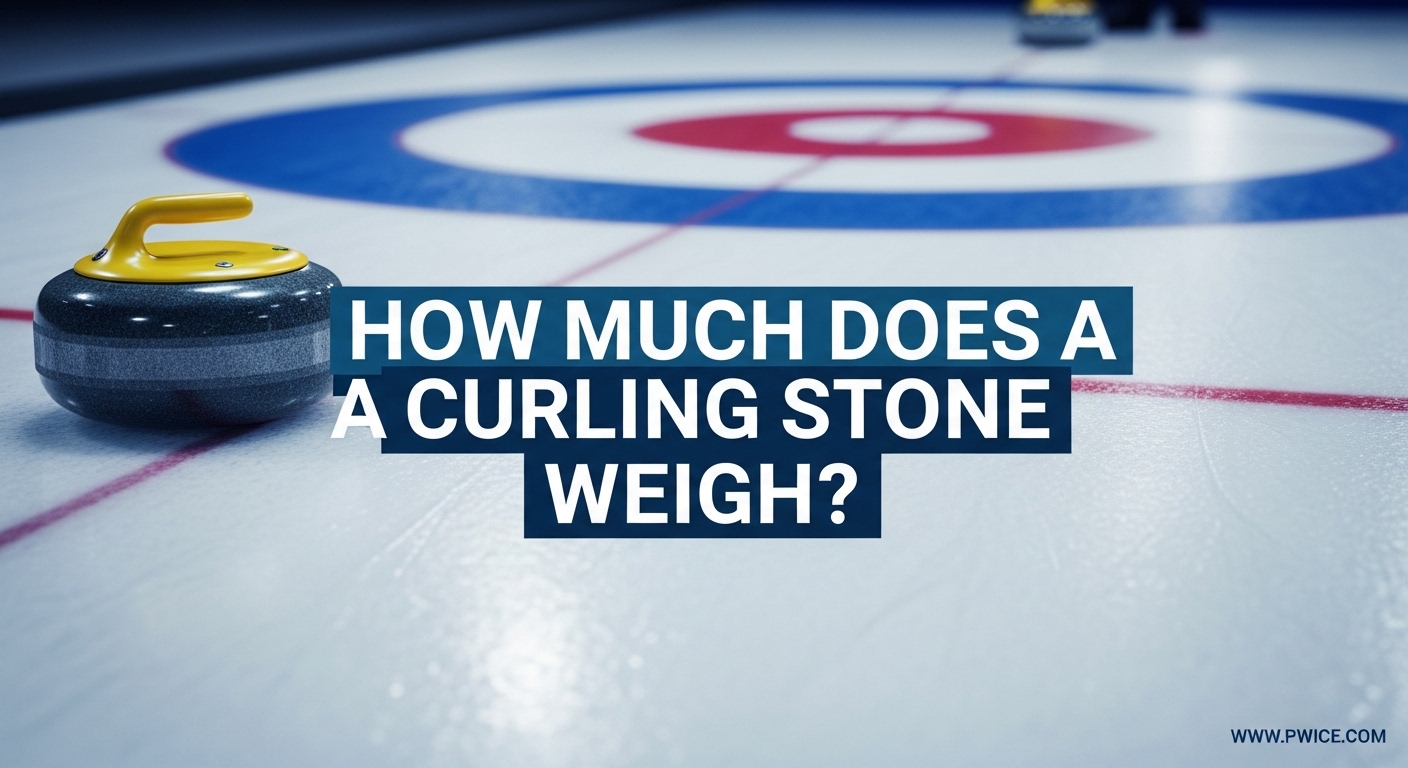
If you’ve ever watched curling during the Winter Olympics and wondered about those granite stones sliding across the ice, you’re not alone. Regulation curling stones weigh between 38 and 44 pounds, with 42 pounds (19.1 kg) being the standard weight used in most competitions. This specific weight range has been refined over centuries to create the perfect balance of momentum and control on the ice.
The weight of a curling stone might seem like a simple detail, but it’s fundamental to how the sport works. From the stone’s ability to travel 150 feet down the sheet to its characteristic curl (curve), every aspect of gameplay depends on this carefully calibrated mass. Let me break down everything you need to know about curling stone weight and why it matters.
Table of Contents
How Much Does a Curling Stone Weigh?
Official curling stones weigh between 38 and 44 pounds (17.2-20 kg), with most competition stones coming in at the standard 42 pounds (19.1 kg). This weight range isn’t arbitrary—it’s established by the World Curling Federation (WCF) and applies to all levels of competitive play, from local clubs to the Olympics.
To put this in perspective, a single curling stone weighs roughly the same as 131 baseballs or 101 softballs. That’s substantial mass, which is exactly what curlers need when they’re trying to slide a stone 150 feet down a sheet of ice while maintaining enough control to land it precisely where they want.
The 38-44 pound range allows for some variation between stones while ensuring fair competition. Stones at the heavier end of the range (44 pounds) carry more momentum but can be harder to control, while lighter stones (38 pounds) offer more finesse but may not travel as far on faster ice conditions.
Curling Stone Weight Specifications
The World Curling Federation sets strict standards for curling stone weight to ensure consistency across the sport. According to WCF regulations, no stone can exceed 44 pounds (19.96 kg) or weigh less than 38 pounds (17.24 kg). This means every stone in competition falls within this carefully calibrated range.
For Olympic competition, the specifications are even more precise. Olympic stones typically weigh exactly 19.1 kg (42.1 pounds), with all stones in a set matched to within a few ounces of each other. This consistency matters because curlers develop a feel for how much force is needed to deliver a stone a specific distance.
Interestingly, the weight specifications include the stone’s handle. That means the granite body plus the attached handle must fall within the 38-44 pound range. Most of the weight comes from the granite itself, with the handle adding only about half a pound to the total.
Weight isn’t the only specification that matters. Regulation stones must also have a maximum circumference of 36 inches (91.44 cm) and a minimum height of 4.5 inches (11.43 cm). These dimensions, combined with the weight requirements, create the standard curling stone you see in competition.
Weight Conversions at a Glance
- Minimum weight: 38 pounds (17.24 kg)
- Maximum weight: 44 pounds (19.96 kg)
- Standard competition weight: 42 pounds (19.1 kg)
- Olympic standard: 19.1 kg (42.1 pounds)
Why Curling Stone Weight Matters for Gameplay
The 42-pound standard exists for good reason—it creates the perfect balance between momentum and control. When a curler releases a stone, they’re not just pushing weight across ice; they’re managing energy transfer, friction, and trajectory all at once.
Here’s why the weight matters so much: the stone needs enough mass to travel 150 feet down the ice while maintaining enough curl (curve) to reach strategic positions. A heavier stone carries more momentum, which helps it maintain speed through the pebbled ice surface. However, too much weight makes it difficult to control and reduces the stone’s ability to curl.
The weight also affects different types of shots. For draw shots (where the goal is to stop the stone in a specific location), curlers need precise weight control to land the stone exactly where they want. For takeout shots (where the goal is to knock another stone out of play), the stone’s mass is crucial for generating enough force to move the target stone.
Ice conditions interact with stone weight too. On “faster” ice (with less friction), a stone will travel farther with the same delivery force compared to “slower” ice. Experienced curlers adjust their delivery weight based on ice conditions, but the stone’s physical weight remains constant.
The weight also affects sweeping. When sweepers brush the ice in front of a moving stone, they’re reducing friction to help the stone travel farther and straighter. The stone’s mass determines how much effect sweeping has—heavier stones require more sweeping effort to achieve the same outcome.
What Are Curling Stones Made Of?
It’s not just the weight that makes curling stones special—it’s what they’re made of. Most high-quality curling stones are crafted from granite extracted from Ailsa Craig, a small island off the coast of Scotland. This granite is uniquely dense and non-porous, making it ideal for the sport.
There are two main types of granite used in curling stones: blue hone granite and common green granite. Blue hone granite is particularly prized for its ability to absorb water without becoming porous, which prevents the stone from picking up debris from the ice. Common green granite is used for the stone’s body, while blue hone is often used for the running band (the concave ring on the stone’s bottom that contacts the ice).
Kays of Scotland, based in Mauchline, Ayrshire, has been making curling stones since 1851 and is the primary supplier for Olympic competition. The company uses Ailsa Craig granite exclusively, and their stones can last for decades with proper maintenance. In fact, many curling clubs use stones that are 30-50 years old and still perform well.
The granite’s density is what gives curling stones their weight. A single cubic foot of Ailsa Craig granite weighs roughly 168 pounds, which explains how a stone that’s only about a foot in diameter can tip the scales at 42 pounds. This density, combined with the precise shape of the running band, creates the stone’s unique sliding and curling properties.
How Much Do Curling Stones Cost?
If you’re thinking about buying your own curling stone, be prepared for some sticker shock. A single new curling stone costs between $500 and $900, with Olympic-quality stones at the higher end of that range. Since a full set requires 16 stones, you’re looking at $8,000 to $15,000 for a complete set.
The high cost comes from several factors. First, there’s the rarity of the granite—Ailsa Craig stone can only be sourced from one location in Scotland. Second, the manufacturing process is labor-intensive, with each stone requiring precision shaping and polishing. Finally, the stones are matched within a set to ensure consistent weight and performance.
Fortunately, most curlers don’t need to buy their own stones. Curling clubs typically provide stones as part of membership, and Olympic stones are supplied by the host venue. If you’re looking for a more affordable option, refurbished or used stones are available for $200-400 each, though they may not have the consistent performance of new stones.
The investment is worthwhile for clubs because quality stones can last for decades. With proper maintenance (including periodic resurfacing of the running band), a set of curling stones can provide 50+ years of service, making the per-use cost quite reasonable over time.
Frequently Asked Questions
Are all curling stones the same weight?
No, curling stones can vary between 38 and 44 pounds within WCF regulations. However, stones within a set are matched to within ounces of each other for consistency. Most competition stones are 42 pounds (19.1 kg), which is considered the standard.
Do Olympic curlers use their own stones?
No, Olympic curlers do not bring their own stones to the Olympics. The host venue provides all stones used in competition. This ensures fairness and eliminates any home-field advantage from using familiar equipment. The stones are typically supplied by Kays of Scotland and meet exact WCF specifications.
What is the ideal weight for a curling stone?
The ideal weight is 42 pounds (19.1 kg), which is the standard for most competitive play. This weight provides the best balance of momentum and control. Heavier stones (up to 44 pounds) carry more momentum but are harder to control, while lighter stones (down to 38 pounds) offer more finesse but may not travel as far.
How much does an Olympic curling stone cost?
A single Olympic-quality curling stone costs between $600 and $900. Since a full set requires 16 stones, a complete Olympic set costs approximately $10,000-15,000. The high cost reflects the rare Ailsa Craig granite, precision manufacturing, and strict quality standards.
Why do curling stones weigh 42 pounds?
The 42-pound standard emerged through centuries of trial and error. This weight provides enough momentum to travel 150 feet down the ice while maintaining enough curl for strategic shots. The weight allows for both power (takeout shots) and finesse (draw shots), making it versatile for all aspects of the game.
What is the 3 rock rule in curling?
The 3-rock rule (also known as the free guard zone) states that no stones in the free guard zone (the area between the hog line and the house) can be removed from play until the first four stones (two per team) have been thrown. This rule prevents teams from immediately clearing guards, which leads to more strategic and interesting games.
Conclusion
Understanding curling stone weight is essential for anyone interested in the sport, whether you’re a casual viewer or an aspiring player. The 38-44 pound range (with 42 pounds as standard) represents centuries of refinement to create the perfect balance of momentum, control, and strategic possibility.
From the rare Ailsa Craig granite that gives the stones their mass to the precise WCF regulations that ensure fair competition, every detail of curling stone weight has been carefully considered. Next time you watch curling, you’ll appreciate the physics behind those 42-pound stones sliding across the ice—and why their weight makes all the difference in the game.