
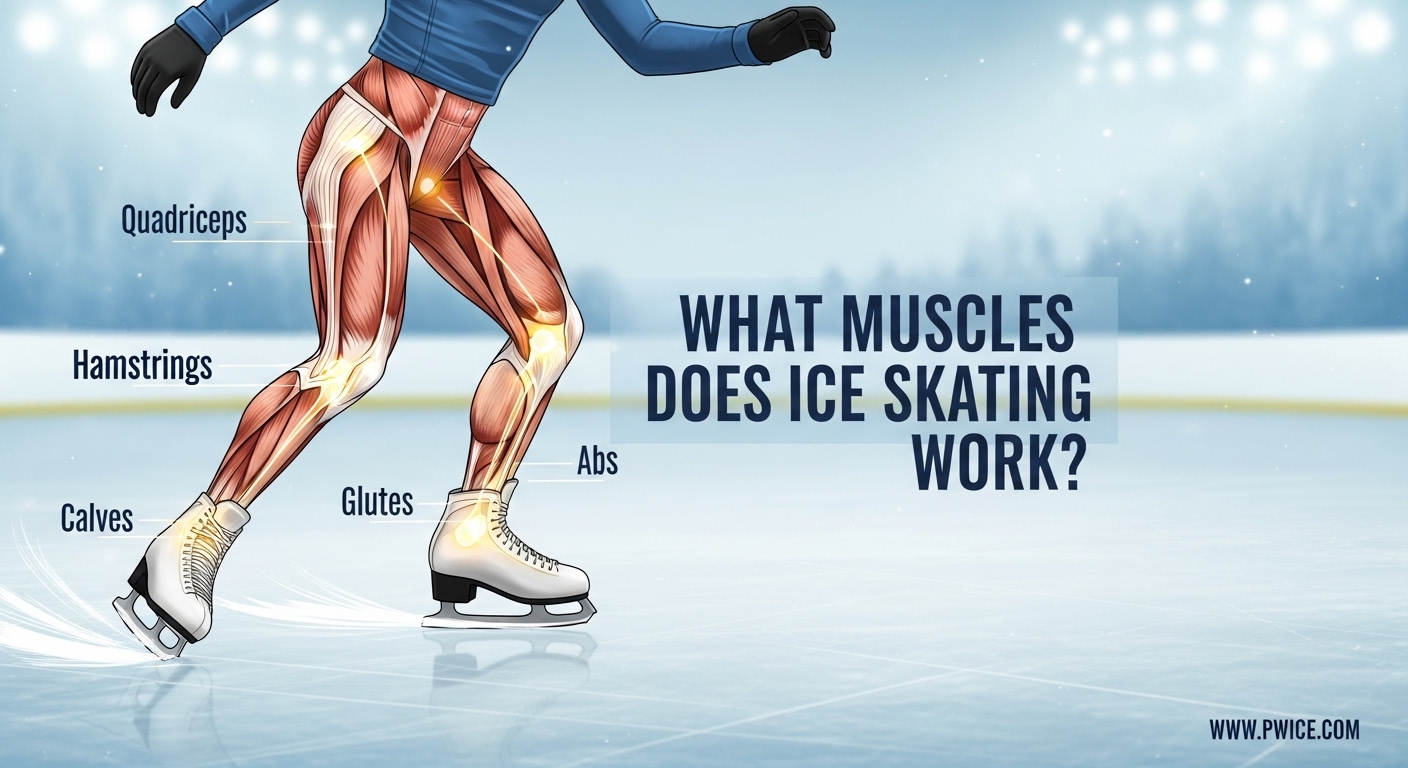
Ice skating is a full-body workout that primarily engages your lower body muscles while simultaneously activating your core and stabilizer muscles for balance. If you have ever wondered what muscles does ice skating work, the answer covers nearly every major muscle group in your body with special emphasis on your legs, glutes, and core. I have spent years analyzing fitness activities, and ice skating consistently ranks as one of the most effective low-impact workouts for building functional strength and endurance.
When you glide across the ice, your body recruits multiple muscle groups to maintain stability, generate power, and control your movements. The continuous push-off and glide motion creates a unique resistance training effect that tones muscles without the harsh impact of running or jumping. Understanding which muscles ice skating works can help you target your training, prevent injuries, and maximize the fitness benefits of every session on the ice.
In this guide, I will break down exactly which muscle groups activate during different skating movements. You will learn how recreational skating compares to figure skating and hockey in terms of muscle recruitment. I will also share practical off-ice exercises to strengthen the specific muscles that skating demands, based on insights from experienced skaters and exercise science research.
Table of Contents
What Muscles Does Ice Skating Work?
Ice skating works your quadriceps, hamstrings, glutes, calves, core muscles, and stabilizers throughout your body. The primary muscles engaged during skating include:
- Quadriceps: The front thigh muscles that power your push-off and control knee extension
- Hamstrings: The back thigh muscles that flex your knee and extend your hip during the glide phase
- Gluteus muscles: Your gluteus maximus, medius, and minimus that drive hip extension and provide lateral stability
- Calf muscles: The gastrocnemius and soleus that generate push-off power and stabilize your ankles
- Core muscles: Your abdominals, obliques, and lower back that maintain balance and posture
- Hip adductors and abductors: The inner and outer thigh muscles that control leg movement and edging
According to a NIH study on neuromuscular responses in elite skaters, researchers found significant activation in the gastrocnemius medialis, rectus femoris, biceps femoris, and adductor muscles during various skating movements. This scientific validation confirms what experienced skaters have known for generations: ice skating delivers a comprehensive lower body workout.
The beauty of ice skating muscles engagement lies in its functional nature. Unlike isolated gym exercises, skating requires coordinated muscle activation across multiple joints and planes of motion. Your muscles work together synergistically, which builds practical strength that transfers to daily activities and other sports.
Lower Body Muscles: The Powerhouse of Skating
Your lower body does the majority of the work when you skate, generating power for movement and providing the stability needed to stay upright on thin blades. Let me break down each major muscle group and explain exactly how skating activates them.
Quadriceps (Front Thigh Muscles)
Your quadriceps, or quads, represent the primary muscle group driving your forward motion on ice. This muscle group includes four distinct muscles: the rectus femoris, vastus lateralis, vastus medialis, and vastus intermedius. Together, these muscles extend your knee and provide the explosive power needed for each push-off.
During the push-off phase of skating, your quadriceps contract forcefully to straighten your knee and drive your blade into the ice. The rectus femoris also assists with hip flexion, helping you bring your leg forward for the next stroke. Skaters often report feeling a significant quad burn after intense sessions, especially when learning new skills that require deeper knee bends.
The vastus medialis deserves special mention for figure skaters. This teardrop-shaped muscle on the inner front of your thigh plays a critical role in controlling your knee position during takeoffs and landings. Strong vastus medialis muscles help prevent knee valgus collapse, a common cause of injury in jumping sports.
Hamstrings (Back Thigh Muscles)
Your hamstrings work in opposition to your quadriceps, providing the control and stability necessary for smooth skating. This muscle group comprises the biceps femoris, semitendinosus, and semimembranosus. These muscles run along the back of your thigh and handle knee flexion and hip extension.
During the glide phase of skating, your hamstrings engage isometrically to maintain knee flexion and control your leg position. As you prepare for the next push-off, they eccentrically lengthen to decelerate your leg before concentrically contracting to help extend your hip. This combination of isometric, eccentric, and concentric work creates comprehensive hamstring development.
Many beginner skaters experience hamstring soreness because these muscles work overtime to compensate for balance challenges. As one Reddit user in r/FigureSkating noted after four months of serious skating: “I feel like I am waking up muscles all over my legs.” The hamstrings often dominate this sensation because they remain engaged throughout every phase of the skating stroke.
Glutes and Hip Muscles
Your gluteal muscles serve as the engine room for powerful skating, driving hip extension and providing lateral stability for edge work. The gluteus maximus, the largest muscle in your body, generates the primary force for backward skating and contributes significantly to forward stroking power.
The gluteus medius and minimus work as stabilizers, preventing your hips from dropping during single-leg glides and controlling your leg position during crossovers. These muscles also enable hip abduction, the movement that lifts your leg away from your body midline, which is essential for creating the scissoring motion in crossovers.
Your hip adductors (inner thigh muscles) and abductors (outer hip muscles) control the precise positioning of your blades on the ice. The adductor magnus and related muscles pull your legs together, while the tensor fasciae latae and other abductors control outward movement. This constant interplay between adduction and abduction creates the characteristic inner and outer thigh workout that skaters report.
As one experienced skater shared on Reddit: “The glutes are used when skating backwards, the quads for skating forwards.” This simple observation captures the directional muscle recruitment pattern that makes ice skating such a balanced lower body workout.
Calves and Lower Leg Muscles
Your calf muscles and lower leg stabilizers provide the final link in the power chain, transferring force from your thighs to the ice and maintaining ankle stability. The gastrocnemius and soleus form your primary calf muscles, while the tibialis anterior runs along your shin and controls ankle dorsiflexion.
During the push-off phase, your calf muscles contract isometrically to maintain a strong ankle position as you drive into the ice. The gastrocnemius also assists with knee flexion, working alongside your hamstrings to control leg bend. The tibialis anterior maintains your ankle angle and prevents your toes from dropping, which is crucial for proper blade alignment.
Many new skaters discover muscles in their feet and lower legs they never knew existed. As one Reddit user observed: “For me it is the ones in the arches of my feet.” The intrinsic foot muscles work constantly to maintain balance and control blade edges, especially during turns and transitions. This unique foot muscle activation distinguishes skating from many other cardio activities.
Core Muscles: Your Stabilization Center
Your core muscles serve as the command center for ice skating, maintaining your posture, controlling your balance, and transferring power between your upper and lower body. Without a strong core, the powerful leg muscles we discussed cannot function effectively on ice.
Abdominals and Obliques
Your rectus abdominis (the six-pack muscle) and obliques work together to maintain an upright torso position while skating. These muscles prevent excessive forward or backward lean, keeping your center of gravity aligned over your blades. The obliques also enable the subtle torso rotation that accompanies proper stroking technique.
During jumps and spins, your abdominal muscles contract forcefully to create the tight body position necessary for rotational speed. Even during basic skating, these muscles engage continuously to make micro-adjustments that keep you balanced. This constant low-level activation builds excellent muscle endurance over time.
The transverse abdominis, your deepest core muscle, deserves special recognition for its role in skating. This muscle acts like a corset, compressing your abdominal contents and creating a stable base for limb movement. Conscious engagement of this muscle improves balance and reduces energy waste through unnecessary body sway.
Lower Back and Spinal Muscles
Your erector spinae muscles run along your spine and work antagonistically with your abdominals to maintain proper posture. These muscles prevent the rounded back that beginners often adopt when feeling unstable. Strong spinal extensors allow you to maintain the upright, athletic position that efficient skating requires.
The multifidus and other deep spinal stabilizers provide segmental control of your vertebrae, making the fine adjustments necessary for balance. These muscles work automatically below your conscious awareness, firing in response to signals from your vestibular system and proprioceptive nerves in your feet and ankles.
Pelvic Floor Muscles
Your pelvic floor muscles contribute to core stability in ways that many skaters do not initially recognize. These muscles form the bottom of your core cylinder, working with your diaphragm and abdominal muscles to regulate intra-abdominal pressure. Proper breathing coordination with pelvic floor engagement improves both stability and endurance.
Research cited by skating health resources indicates that activities like ice skating can help address urinary stress incontinence through pelvic floor strengthening. The constant micro-adjustments required for balance provide gentle, sustained activation of these often-neglected muscles.
Upper Body Engagement
While ice skating primarily works your lower body and core, your upper body muscles play important supporting roles. Your shoulders, arms, and back muscles contribute to balance, generate momentum, and maintain proper arm positions.
Your latissimus dorsi, rhomboids, and trapezius muscles stabilize your shoulder girdle and control arm position. In figure skating, specific arm positions are essential for balance and rotational control. Even recreational skaters use their arms for counterbalancing during turns and transitions.
Your deltoids and rotator cuff muscles position your arms and absorb forces transmitted through your upper body. When you fall and catch yourself, these muscles protect your shoulder joints. During normal skating, they maintain the arm positions that facilitate proper weight distribution.
Hockey players develop particularly strong upper bodies because stick handling and shooting require significant arm and shoulder strength. The activation pattern differs from figure skating, but both disciplines benefit from functional upper body strength that supports rather than dominates the movement.
Muscle Activation by Skating Move
Different skating movements recruit muscle groups in varying proportions. Understanding these patterns helps you appreciate why specific skills feel challenging and how to train for them off the ice.
Forward Stroking
Forward stroking emphasizes your quadriceps and hip flexors during the push-off phase. As you extend your leg backward against the ice, your rectus femoris and vastus muscles generate the primary force. Your gluteus maximus contributes hip extension power, while your core maintains upright posture throughout the movement.
The recovery phase, bringing your leg back forward for the next stroke, engages your hip flexors and rectus femoris eccentrically. Your hamstrings control the speed of recovery, preventing your leg from swinging forward uncontrollably. This alternating push and recovery creates the rhythmic muscle activation that makes skating such effective endurance training.
Backward Skating
Backward skating shifts the emphasis toward your hamstrings and gluteus maximus. When you push off backward, these muscles extend your hip and drive power into the ice. Your quadriceps work more in a stabilizing capacity, maintaining knee position rather than generating primary power.
Your core works harder during backward skating because you lack the visual reference points that help with forward balance. The increased demand on your spinal stabilizers and obliques explains why backward skating often feels more tiring despite slower speeds. Your calf muscles also engage more intensely to maintain proper blade angle when skating backward.
Crossovers
Crossovers represent one of the most comprehensive lower body exercises in skating, engaging your adductors, abductors, glutes, and quads simultaneously. As you cross one leg over the other during a turn, your adductor magnus and related inner thigh muscles pull your crossing leg inward.
Simultaneously, your gluteus medius on the supporting leg prevents hip drop, while your quadriceps maintain knee bend and power generation. The scissoring motion creates unique demands on your hip rotators, including the piriformis and gemelli muscles that control external and internal rotation.
Many skaters first discover their adductor muscles during crossover practice. These muscles, often neglected in standard gym workouts, become prominent after several skating sessions. The burning sensation in your inner thighs during extended crossover practice indicates effective muscle recruitment.
Jumps and Spins
Jumps and spins demand explosive full-body muscle activation unlike any other skating element. The takeoff phase requires rapid, forceful extension of your legs and hips, recruiting your quadriceps, hamstrings, and glutes maximally. Your core muscles must stabilize your torso while your limbs generate power.
During the air phase, your abdominal and back muscles create the tight body position necessary for rotation. Your hip flexors and adductors control your leg position, while your shoulder and arm muscles help generate and control rotational speed. The landing phase demands eccentric control from your entire lower body to absorb impact forces.
Spins emphasize sustained isometric core engagement and precise lower body control. Your muscles work continuously to maintain position against the centrifugal forces trying to pull your limbs outward. This sustained tension builds exceptional muscle endurance and control.
Beginner vs Advanced Skater Muscle Development
Muscle recruitment patterns change significantly as you progress from beginner to advanced skating levels. Beginners often experience rapid fatigue because their muscles work inefficiently, making unnecessary adjustments and fighting against poor technique.
New skaters typically report quad and calf soreness first, as these muscles handle the primary demands of basic balance and forward stroking. Your core muscles also fatigue quickly as they compensate for balance deficiencies. Many beginners mention that their feet and ankle muscles tire fastest, reflecting the unique demands of blade control.
As you advance, your muscle activation becomes more refined and efficient. You learn to relax muscles that do not need to work for a particular movement, conserving energy for essential actions. Your stabilizer muscles develop better endurance, allowing longer sessions without fatigue.
Advanced skaters develop more balanced muscle development across all the groups we have discussed. Figure skaters often show exceptional glute and core development from jump training. Hockey players develop powerful quads and hip flexors from aggressive acceleration patterns. Both disciplines create functional strength that serves skaters well in other activities.
Forum discussions reveal a common progression: initial soreness in obvious muscles like quads, followed by discovery of deeper stabilizers as technique improves. As one skater noted: “Your core is not in hockey shape and you will want to focus on that.” This observation captures the realization that skating fitness extends beyond the obvious leg muscles.
Off-Ice Exercises to Strengthen Skating Muscles
Targeted off-ice training accelerates your skating progress and reduces injury risk. The following exercises specifically strengthen the muscle groups that skating demands most.
Squats and variations: Barbell squats, goblet squats, and single-leg squats develop your quadriceps, hamstrings, and glutes. Front squats particularly emphasize the quad development that skating requires. Single-leg variations improve the unilateral strength necessary for one-leg glides.
Lunges: Forward, reverse, and lateral lunges target your skating muscles while improving hip mobility and balance. Walking lunges with torso rotation mimic the cross-body pattern of skating strokes. Adductor lunges, stepping sideways into a lunge position, specifically target your inner thigh muscles.
Calf raises: Standing and seated calf raises develop your gastrocnemius and soleus muscles. Single-leg calf raises improve the ankle stability essential for edge control. Performing calf raises on an elevated surface increases range of motion and ankle flexibility.
Core exercises: Planks, side planks, and Pallof presses build the core endurance skating requires. Dead bugs and bird dogs improve the cross-body stabilization pattern used during stroking. Medicine ball rotational throws develop the power needed for jump takeoffs.
Balance training: Single-leg balance work on unstable surfaces develops proprioception and stabilizer strength. BOSU ball or balance board exercises prepare your muscles for the constant adjustments skating requires. These exercises particularly benefit your feet, ankles, and hip stabilizers.
Experienced skaters recommend combining strength training with plyometric exercises for jump development. Box jumps, broad jumps, and lateral bounds build the explosive power that advanced skating demands. Hill sprints develop the anaerobic capacity needed for hockey-style skating.
The Benefits of Ice Skating for Muscle Development
Ice skating offers unique muscle development benefits that distinguish it from other forms of exercise. Understanding these benefits helps you appreciate why skating deserves a place in your fitness routine.
Low-impact muscle building: Unlike running or plyometric training, skating builds muscle without pounding your joints. The gliding motion eliminates the impact forces that often cause overuse injuries in other activities. You can train longer and more frequently while reducing injury risk.
Functional strength development: Skating builds strength through natural movement patterns rather than isolated exercises. Your muscles learn to work together synergistically, creating practical strength that improves daily function and athletic performance in other sports.
Muscle endurance and toning: The sustained moderate-intensity nature of skating develops exceptional muscle endurance. Rather than building bulky muscle mass, skating typically creates lean, defined muscles with excellent stamina. This endurance translates to better performance in any activity requiring sustained effort.
Joint flexibility and range of motion: The deep knee bend position required for proper skating technique improves hip, knee, and ankle flexibility. This increased range of motion benefits your joints and reduces injury risk in daily activities. Regular skaters often maintain better mobility as they age.
Calorie burn and body composition: An hour of moderate ice skating burns 300-600 calories depending on your body weight and intensity level. This calorie expenditure, combined with muscle development, supports healthy body composition changes. Consistent skating often produces visible toning within weeks.
Bone density benefits: The weight-bearing nature of skating stimulates bone formation, particularly in your hips and legs. This benefit proves especially valuable for women concerned about osteoporosis. The jumping involved in figure skating amplifies this bone-building effect.
Frequently Asked Questions
Does ice skating help build muscle?
Yes, ice skating helps build muscle, particularly in your lower body and core. The resistance created by pushing against the ice, combined with the balance demands, creates an effective strength training stimulus. Skating primarily builds muscle endurance and tone rather than bulky mass, creating lean, functional muscles. Consistent skating 2-3 times per week produces noticeable strength improvements within 4-8 weeks.
What muscles do you use while ice skating?
You use your quadriceps, hamstrings, glutes, calves, core muscles, hip adductors, and hip abductors while ice skating. Your quadriceps and glutes generate power for movement. Your hamstrings and calves control the glide phase. Your core muscles maintain balance and posture. Your hip muscles control leg position and edging. Even your upper body contributes through arm positioning and momentum generation.
How many times a week should you ice skate?
For fitness and muscle development, aim to ice skate 2-3 times per week with rest days between sessions. This frequency allows adequate recovery while providing consistent training stimulus. Beginners should start with 1-2 sessions weekly, gradually increasing as muscles adapt. Advanced skaters training for competition may skate 4-6 times weekly, but this requires careful attention to recovery and injury prevention.
Does ice skating work your abs?
Yes, ice skating works your abs and entire core continuously. Your abdominal muscles, including the rectus abdominis and obliques, engage constantly to maintain upright posture and balance. Without core engagement, you cannot stay upright on the thin blades. Advanced moves like jumps and spins require even more explosive core strength. Many skaters report improved core definition as one of the first visible results from regular skating.
Is ice skating good for toning legs?
Yes, ice skating is excellent for toning legs. The continuous push-glide motion creates sustained resistance that targets your quadriceps, hamstrings, glutes, and calves. Unlike gym machines that isolate muscles, skating engages all leg muscles simultaneously, creating balanced, functional development. The endurance nature of skating promotes lean muscle definition rather than bulk. Many skaters notice improved leg tone within weeks of starting regular skating sessions.
Conclusion
Ice skating works virtually every major muscle group in your body, with particular emphasis on your quadriceps, hamstrings, glutes, calves, and core. This full-body engagement makes skating one of the most effective and enjoyable low-impact workouts available. Whether you skate recreationally, pursue figure skating, or play hockey, the muscle benefits remain substantial and scientifically validated.
Now that you understand what muscles does ice skating work, you can approach your time on the ice with greater awareness and purpose. Pay attention to how different movements feel in your body, and use this knowledge to guide your off-ice training. The combination of on-ice practice and targeted strength work will accelerate your progress and reduce injury risk.
If you are new to skating, expect some initial muscle soreness as your body adapts to these unique demands. Stay consistent, prioritize proper technique over speed, and celebrate the gradual awakening of muscles you never knew you had. The fitness benefits of ice skating reward those who embrace the learning process and make skating a regular part of their active lifestyle.