
Curling is often called chess on ice, and for good reason. Behind every stone sliding down the sheet lies a complex web of strategy, precision, and split-second decisions. Whether you are watching the Winter Olympics or stepping onto the ice for your first learn-to-curl session, understanding curling strategy and shot types explained properly transforms how you experience this fascinating sport.
In this complete guide, I will break down everything you need to know about curling tactics. You will learn the fundamental shot types, understand team roles, discover when to play offensively versus defensively, and grasp the subtle rules that shape every game. By the end, you will watch curling with the eyes of a strategist, not just a spectator.
Table of Contents
Understanding the Basics of Curling
The objective of curling is deceptively simple: get your stones closer to the center of the target than your opponent. That target is called the house, a series of concentric circles painted on the ice at each end of the sheet. The very center is the button, and the team with stones closest to the button scores points at the end of each end.
An end is like an inning in baseball, with both teams throwing eight stones each. After sixteen stones are delivered, the team with the stone closest to the button scores one point, plus additional points for every other stone closer to the center than the opponent’s nearest stone. A game typically lasts eight or ten ends, though extra ends may be played if tied.
The sheet itself is 146 to 150 feet long and 14 to 16 feet wide. Key markings include the hog line 21 feet from each house, which stones must completely cross to remain in play, and the tee line running through the center of the house. The hack, a foothold at each end, is where players push off to deliver their stones. Understanding this layout is essential before diving into shot strategy.
The Three Main Shot Categories
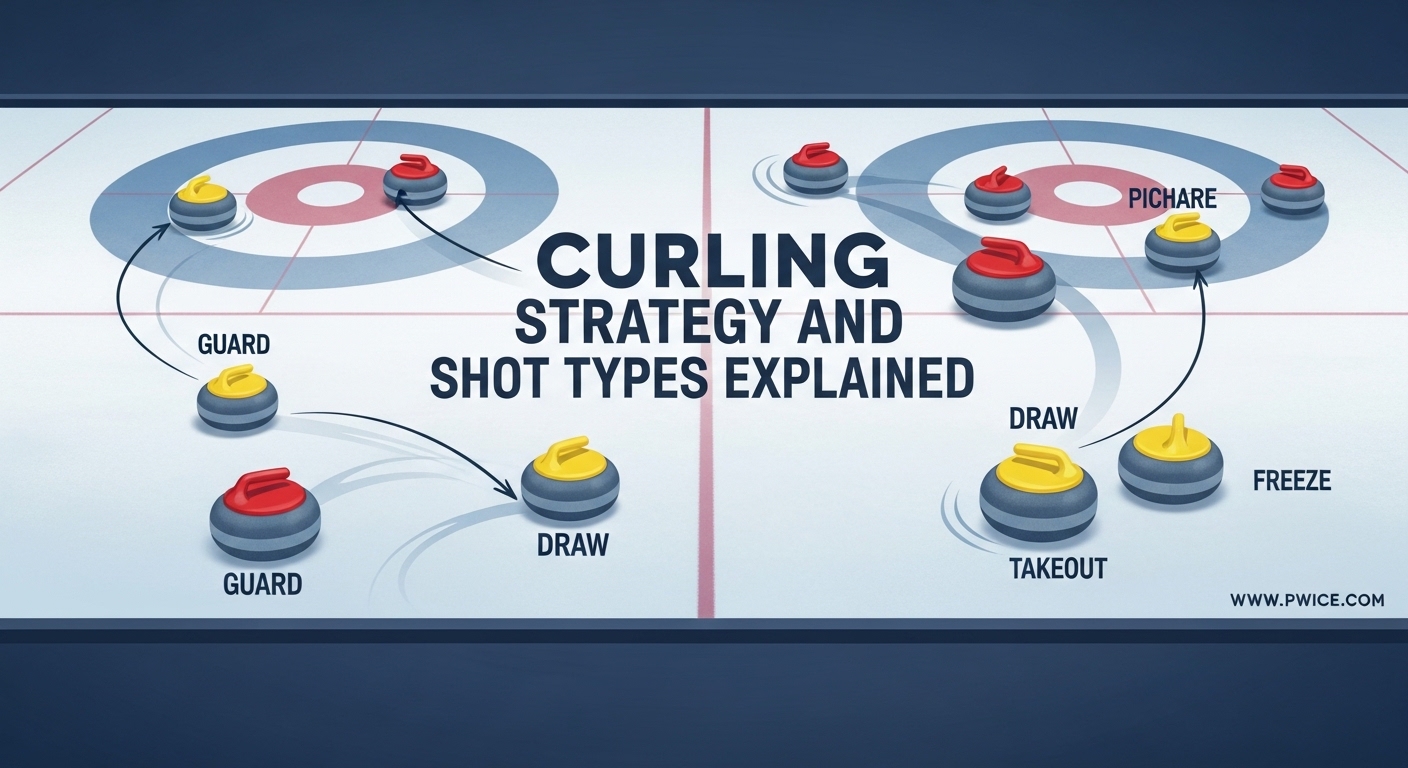
Every curling shot falls into one of three fundamental categories: guards, draws, or takeouts. These categories form the foundation of all curling strategy, and mastering when to use each separates beginners from experienced players. Let me break down what makes each category unique.
Guards: Protecting Your Position
Guards are shots thrown short of the house, positioned to block the path to stones already sitting in scoring position. A well-placed guard forces your opponent to either curl around it or remove it before accessing your scoring stones. Guards are the backbone of defensive strategy and essential for protecting leads.
There are two primary guard positions: center guards sit on the center line directly in front of the house, while corner guards are positioned off to either side. Center guards are harder to navigate around but easier to hit, while corner guards create complex angles that can be both shielded from and used for come-around shots. Smart teams often build multiple guards to create layers of protection.
Draws: Precision Placement
Draw shots are designed to come to rest somewhere in the house or very close to it without touching other stones. These shots demand precise weight judgment and line control, making them among the most technically challenging to execute. A perfectly executed draw can sit frozen to the button or nestle behind a guard where it is nearly impossible to remove.
The key to successful draws is reading the ice correctly. Ice conditions change throughout a game as stones polish the surface and temperature shifts affect how stones curl. Experienced players adjust their draw weight constantly, sometimes throwing what feels like completely different shots to achieve the same result as conditions evolve.
Takeouts: Removing Opposition
Takeout shots are thrown with enough weight to hit an opponent’s stone and remove it from play. The hitting stone can either roll to a new position or stay where it makes contact, depending on the type of takeout called. These aggressive shots open up the house and eliminate protected enemy stones.
Takeout weight varies significantly based on what needs to happen after impact. A hit-and-roll requires enough momentum to move both stones, while a hit-and-stick stops dead on contact. Peel shots use extreme weight to blast through guards entirely, sending multiple stones out of play. Choosing the right takeout weight is a critical strategic decision.
Curling Strategy and Shot Types Explained: The Complete Guide
Now that you understand the three main categories, let me walk you through the specific shot types that make up a curler’s toolkit. Each shot has a unique purpose, and knowing when to call each one is what makes strategy so compelling.
Draw Shots
The basic draw is any shot intended to stop in the house without touching other stones. This is the fundamental scoring shot in curling, and every player must master it. Draws are called with specific targets in mind: the four-foot circle, the eight-foot circle, the button, or even specific edges of the house depending on what the strategy demands.
A come-around draw curls around an existing guard and comes to rest in the house behind it. This shot combines the precision of a draw with the protection of a guard, making it extremely valuable. Come-arounds are difficult because the curler must judge both the correct line to miss the guard and the perfect weight to stop in the desired position.
Freeze Shots
A freeze is a special type of draw where your stone stops touching an opponent’s stone while staying in play. The stones are essentially frozen together, making the opponent’s stone extremely difficult to hit without also removing your stone. Freezes are among the most defensively powerful shots in curling.
Freezing to the button against an opponent’s stone is often called a perfect freeze, and it can completely change the scoring dynamic of an end. When executed properly, a freeze forces your opponent into difficult decisions: try a risky double-takeout, attempt a equally precise raise, or settle for giving up the point. Elite teams practice freezes constantly because they win championships.
Guard Shots
Beyond basic guards, experienced teams employ tactical guarding to control the sheet. A tight guard sits close enough to the house that it effectively extends the protected area, while a high guard sits further out, controlling access to the entire front of the house. Teams often throw multiple guards to build defensive fortresses around their scoring stones.
The positioning of guards matters enormously. A guard too close to the house can be easily tapped back into play by a delicate takeout. A guard too far out can be curled around without difficulty. Finding the sweet spot, typically 4 to 8 feet in front of the house, is an art that develops with experience and ice reading skill.
Hit and Roll
A hit-and-roll is a takeout where your stone hits an opponent’s stone and then rolls to a new, more advantageous position. This shot combines aggression with positional improvement, making it one of the most versatile in the game. A well-executed hit-and-roll can remove an opponent’s stone and replace it with yours in scoring position.
The roll direction depends on the angle of contact and the rotation of the hitting stone. Right-handed in-turn hits tend to roll one direction, while out-turn hits roll another. Skips must visualize not just the hit but where the stone will roll after impact, considering both the angle and how sweeping might affect the final position.
Peel Shots
Peels are high-weight takeouts designed to remove a guard and continue traveling, often removing multiple stones or at least getting the hitting stone out of play. These shots sacrifice finesse for power, blasting through defensive positions to open up the house. Peels are common late in ends when teams need to clear cluttered situations.
The risk of peels is the high weight required. A misjudged peel can crash on the guard, roll into an unexpected position, or even burn a stone by sliding too far. However, when a team trails by multiple points, peels become essential for generating scoring opportunities that simply do not exist in guarded positions.
Raise Shots
A raise is a shot where your stone hits another stone in play, promoting that stone forward while your stone either rolls away or follows behind. Raises can be straight raises directly behind another stone, or angle raises that hit a stone from the side and send it at an angle. Double and triple raises hit multiple stones in sequence.
Raises are among the most spectacular shots in curling when they work, but they are also high-risk. The angles must be precise, and weight judgment is critical because too little weight fails to move the target stone, while too much sends everything scattering unpredictably. Championship teams practice raises extensively for clutch situations where no other shot exists.
Takeout Shots
The basic takeout hits an opponent’s stone and removes it from play. Unlike a hit-and-roll, the primary goal is simply elimination rather than repositioning. Takeouts come in various weights: normal takeouts use moderate weight for controlled results, while heavy takeouts blast through with momentum to spare.
Double takeouts remove two opponent stones with one shot, typically by hitting one stone into another. These require precise angles and weight, making them advanced shots. Triple takeouts, removing three stones, are rare and celebrated when they succeed. The ability to execute takeouts consistently separates recreational players from competitive ones.
Team Roles and Responsibilities (2026)
A traditional curling team has four players, each with specific responsibilities that evolve throughout a game. Understanding these roles helps explain why teams are structured the way they are and how strategy flows from the skip through the entire lineup.
The Lead: Setting the Foundation
The lead throws the first two stones for their team in each end. Traditionally, leads focus on throwing guards and draws with exceptional consistency rather than attempting difficult takeouts. Their primary job is establishing the initial positioning that the rest of the end builds upon.
Leads also sweep the third and fourth stones thrown by their teammates, meaning they do more sweeping than throwing in many ends. Good leads have excellent stamina and sweeping technique. Their shooting percentage matters enormously because early misses compound into strategic disasters later in the end.
The Second: Building the House
The second throws the third and fourth stones for their team. Seconds typically handle a mix of draws, guards, and straightforward takeouts, building on the foundation the lead established. This position requires versatility and the ability to adapt to whatever situation the lead stones created.
Seconds sweep the first two stones of their teammates, making their sweeping equally important to their throwing. Many seconds develop into future skips because the position teaches both throwing variety and strategic thinking. The second’s stones often determine whether an end becomes offensive or defensive.
The Third: Strategic Support
The third, also called the vice-skip or mate, throws the fifth and sixth stones. This position carries significant strategic weight because thirds often call the early ends when the skip is throwing. They handle complex draws, delicate freezes, and crucial takeouts that set up the end’s conclusion.
When the skip throws, the third stands in the house and helps determine shot calls. They also sweep the final stones of teammates, meaning they must maintain energy for the most critical deliveries. Thirds typically have the highest shooting percentages on competitive teams because their shots are so consequential.
The Skip: The Team Captain
The skip is the team captain, strategist, and final stone thrower. They stand in the house directing every shot call, reading the ice, and determining the overall game plan. When they throw the final two stones, called the hammer stones, they execute under maximum pressure with the game’s outcome often on the line.
Skips must master every aspect of curling: technical throwing, strategic thinking, ice reading, and team management. They decide whether to play aggressively or conservatively, when to blank an end, and how to adapt strategy based on score and ice conditions. The best skips make their entire team better through clear communication and confident decision-making.
The Hammer and Last Stone Advantage
The hammer is the last stone advantage in an end, and it is the single most important strategic factor in curling. The team with hammer has the final say in the end’s outcome, making scoring multiple points significantly easier. Understanding how to play with and without hammer separates good teams from great ones.
Having hammer means your team throws the last stone. If the end is blanked, meaning no points are scored, the hammer carries over to the next end. This creates strategic tension: a team with hammer can try to score two or more points, but if the situation turns bad, they may deliberately blank to keep the advantage for another try.
Without hammer, a team’s goal shifts to preventing big scores and trying to steal. A steal means scoring when you do not have hammer, which is difficult but enormously valuable because you gain points while keeping your opponent from using their advantage. Teams without hammer often play more defensively, cluttering the house with guards to limit scoring opportunities.
The hammer also influences which end you want to score in. Early in games, teams with hammer want to score multiples and build leads. Late in games, the strategy shifts dramatically based on the score. A team trailing by two with hammer in the final end wants to score exactly two to force extra ends. A team leading by one without hammer wants to force the opponent to take one, keeping the lead intact.
Offensive vs Defensive Strategy
Curling strategy broadly divides into offensive and defensive approaches, though the best teams fluidly switch between them based on game situation. Understanding when to employ each style is fundamental to winning consistently.
Offensive strategy, also called the draw game, emphasizes guards, draws, and freezes to build complex scoring positions. Teams playing offensively want multiple stones in the house, protected by guards, creating opportunities for big ends. This approach risks giving up steals if shots miss, but the upside is scoring deuces, treys, or even four-point ends.
Defensive strategy, or the hit game, focuses on takeouts, peels, and keeping the house clean. Teams playing defensively try to limit scoring to one point or force blanks, particularly when protecting a lead. This conservative approach reduces variance and relies on shot-making consistency rather than complex positional play.
The score largely determines which strategy to use. Teams with significant leads typically play defense to protect their advantage. Teams trailing by multiple points must play offense, accepting risk to generate big scoring opportunities. The hammer status matters too: teams with hammer can play offense more confidently, while teams without hammer often need defensive play to survive.
Ice conditions also influence strategy choice. On swingy ice where stones curl significantly, come-arounds and freezes are easier, favoring offense. On straight ice with minimal curl, takeouts become more reliable, favoring defense. Smart skips adjust their entire game plan based on how the ice behaves in the first few ends.
The Free Guard Zone Rule
The free guard zone rule fundamentally shaped modern curling strategy. Before this rule, teams could remove guards immediately, leading to quick takeout exchanges that eliminated the complex positional play that makes curling interesting. The five-rock rule, the current standard, transformed how the sport is played.
Under the free guard zone rule, stones positioned between the hog line and the house, excluding the center line, cannot be removed from play until five stones have been thrown in the end. This means the first four stones, typically the lead stones, are protected from immediate takeouts. Teams must work around guards rather than simply blasting them away.
This protection creates offensive opportunities that did not exist under old rules. Teams can build guard positions early, forcing opponents into difficult decisions about whether to play around guards or risk falling behind by playing defensive takeouts that only limit damage. The rule rewards precise drawing and punishes teams that cannot execute come-arounds.
The five-rock version, implemented in 2026, extends protection further than previous four-rock versions. Elite teams have adapted by developing even more complex guard strategies, sometimes throwing multiple center guards to create nearly impenetrable defensive walls. Understanding how to exploit and counter free guard zone situations is now essential at every competitive level.
Sweeping Basics and Impact on Shots
Sweeping might look like simple cleaning, but it is actually sophisticated technique that significantly affects stone behavior. Good sweepers can extend a stone’s travel by several feet or hold it straighter than its natural curl, effectively changing the shot after release. This makes sweepers active participants in shot execution, not just passive helpers.
Friction reduction is sweeping’s primary mechanism. The broom heads slightly melt the ice surface, reducing friction and allowing the stone to travel further with less deceleration. This effect, called keeping the stone alive, can add significant distance to a shot that would otherwise die before reaching its target.
Directional sweeping, developed and refined in the 2010s, adds curl control to distance extension. By sweeping on one side of the stone or the other, sweepers can influence how much the stone curls. Press sweeping, where sweepers apply downward pressure while sweeping, increases friction reduction for maximum effect on heavy weight shots.
Communication between the skip and sweepers is critical. The skip watches the stone’s line and weight, calling sweep instructions based on what they see. Sweepers must trust these calls and react instantly, as delays of even a fraction of a second can mean missed shots. The best sweeping partnerships develop over years of playing together, building the默契 needed for championship-level performance.
Team Communication and Weight Calling
Curling teams use a standardized communication system to convey how hard to throw each shot. The weight calling system uses numbers to represent different speeds, allowing precise instructions that translate across teams and regions. Understanding this system is essential for following curling strategy discussions.
The basic system runs from 1 to 10, with higher numbers representing heavier, faster throws. A hack weight, the slowest meaningful shot, might be called as a 1 or 2. Normal draw weight typically falls around 4 or 5. Normal takeout weight sits at 6 or 7. Peel weight, the heaviest common shot, is an 8 or 9. A 10 represents maximum controlled weight.
Some teams add granularity with half-numbers or descriptive modifiers. A 4.5 might indicate something between normal draw and heavy draw. Back four or front eight describe target positions in the house that translate to specific weights based on ice conditions. The exact numbers matter less than consistency within a team.
Line calling accompanies weight calling. The skip indicates where to aim using the broom as a reference point, with instructions like half a broom left or tight to the brush. Combined with weight, these instructions give the thrower everything needed to execute the called shot. Good skips adjust their calls based on ice conditions and individual thrower tendencies.
Mixed Doubles Curling Strategy
Mixed doubles curling, added to the Olympics in 2018, condenses traditional four-person curling into a two-person format with modified rules. This format requires entirely different strategic thinking, with games typically faster and higher-scoring than traditional curling.
Each mixed doubles team has one male and one female player. Teams throw five stones each rather than eight, and there is no sweeping between the tee lines except by the non-throwing player on their own team’s stones. Two stones, one per team, are pre-positioned before each end begins, guaranteeing immediate scoring tension.
The power play adds another strategic layer. Once per game, each team can call a power play that places their positioned stones on the side of the sheet rather than the center. This creates easier paths to the button and enables aggressive scoring strategies. Knowing when to use the power play, typically when trailing late or needing a big end, is a key strategic decision.
Shot selection in mixed doubles emphasizes draws and freezes because takeouts are harder to execute effectively with only one sweeper. Games often become shootouts where the team making the last draw wins. The format rewards shot-making precision over complex tactical maneuvering, making it exciting for spectators and challenging for players.
Beginner Mistakes to Avoid
New curlers make predictable errors that slow their development and frustrate their teammates. Learning to recognize and avoid these mistakes accelerates progress and makes the game more enjoyable for everyone involved. Here are the most common pitfalls I see in learn-to-curl programs.
Overthrowing weight is the most frequent technical error. Beginners naturally throw too hard, sending stones through the house or crashing into guards. Learning to trust that less effort produces better results takes time. Practicing draw weight specifically, rather than just throwing stones, builds the feel necessary for proper delivery.
Ignoring line in favor of weight is another common mistake. New curlers focus entirely on how hard to throw while paying little attention to where they are aiming. Both matter equally. A perfectly weighted shot misses completely if the line is wrong, while a correctly lined shot can often be saved by sweeping even with imperfect weight.
Calling takeouts when draws are needed hurts new teams strategically. Takeouts feel more decisive and satisfying, but draws win games at every level. Beginners should practice draws extensively before focusing on hitting, developing the touch that underlies every other shot in curling.
Failing to watch other stones is a strategic error beginners make constantly. Every stone changes the ice slightly, affecting how subsequent stones behave. Stones also reveal ice conditions, showing how much curl to expect and how fast the sheet plays. Watching carefully and adjusting based on what you see is fundamental to improvement.
Curling Etiquette and the Spirit of the Game
Curling maintains traditions of sportsmanship that set it apart from many competitive sports. The spirit of curling emphasizes honesty, respect, and self-policing that creates a unique atmosphere whether you are playing recreationally or competing for championships.
Teams call their own fouls. If a player touches a stone with their broom, called a burned stone, they immediately declare it even if no one else noticed. This self-reporting honesty extends to judging whether stones are in play, whether hog line violations occurred, and whether sweeping was proper. Officials at major events resolve disputes, but the expectation is that players act with integrity.
Handshake tradition begins and ends every game. Teams shake hands and wish each other good curling before the first end, then shake again after the final stone regardless of the outcome. During games, social conversation between opponents is common and expected, particularly in club play where the social aspect matters as much as competition.
Pace of play etiquette keeps games moving. Teams should be ready to throw when their turn arrives, with the skip calling shots promptly and sweepers positioned appropriately. Delays frustrate opponents and throw off rhythm. At the championship level, timing rules enforce this, but even in casual play, respecting everyone’s time matters.
Frequently Asked Questions
What is the basic strategy in curling?
The basic strategy in curling involves positioning your stones in the house to score points while preventing opponents from doing the same. Teams alternate between offensive play, using guards and draws to build scoring opportunities, and defensive play, using takeouts to remove opponent stones and limit scoring. The skip calls each shot based on the current stone positions, score differential, and whether the team has the hammer (last stone advantage).
What’s the most important position in curling?
The skip is generally considered the most important position because they act as team captain, strategist, and shot-caller for every stone. Skips determine the overall game plan, read the ice conditions, and throw the final two stones under maximum pressure. However, every position matters enormously, and championship teams require excellence from all four players. A weak lead or second can undermine even the best skip’s strategy.
How to speed up a curling game?
To speed up a curling game, teams should be ready to deliver when their turn arrives, with the skip having decided the shot call beforehand. Sweepers should position themselves promptly, and players should retrieve stones from the house efficiently. Avoid excessive discussions between shots, keep practice slides minimal, and ensure all team members understand their roles. Most clubs aim for approximately 15 minutes per end in social play. Championship games use timing systems to enforce pace.
Is it better to go first or second in curling?
Going second is generally better in curling because it means having the hammer (last stone advantage). The team with hammer can always score at least one point if they execute properly, and they have the final say in the end’s outcome. However, having hammer also means your opponent gets to throw the first stone and set the initial guard positions. If the score is tied in the final end, the team that scored last gives up hammer, creating strategic trade-offs throughout the game.
Getting Started with Curling
Curling strategy and shot types explained thoroughly reveals why this sport captivates millions of players and spectators worldwide. The combination of physical skill, tactical depth, and sportsmanship creates an experience unlike any other winter sport. Whether you aspire to compete at the club level or simply want to understand what is happening during the next Olympic broadcast, mastering these fundamentals opens up curling’s full richness.
The best way to learn curling is to try it. Most clubs offer learn-to-curl sessions where beginners can get on the ice, throw stones, and experience the game’s unique feel firsthand. Equipment is typically provided, and experienced curlers are genuinely enthusiastic about welcoming newcomers. You do not need to know everything in this guide before your first session, but having this foundation will help you progress faster.
As you develop, remember that curling rewards patience and practice. The pros make shots look effortless because they have thrown thousands of stones over many years. Your draws will miss, your takeouts will roll wrong, and your strategy calls will backfire occasionally. That is part of the sport. What matters is learning from every shot, adjusting to ice conditions, and enjoying the journey from beginner to experienced curler. Welcome to chess on ice.