
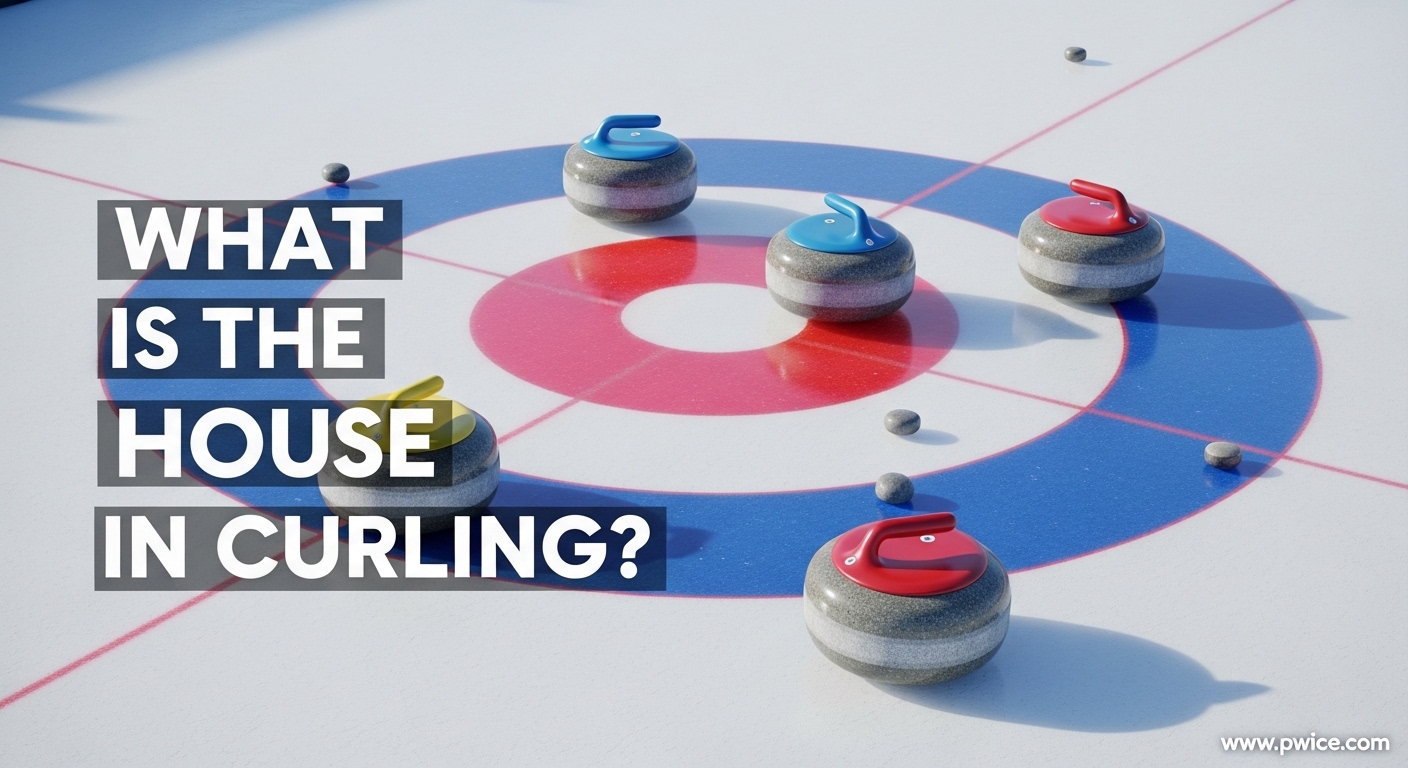
The house in curling is the circular target zone at each end of the ice sheet where all scoring happens. Think of it like the bullseye in darts, but with four concentric rings instead of one. Each house consists of four circles: the outer 12-foot circle, the 8-foot circle, the 4-foot circle, and the button at the very center.
Teams take turns sliding 42-pound granite stones toward the house. After all 16 stones are delivered, officials measure which stones sit closest to the button to determine points. The team with stones closest to the center scores one point for each stone closer than their opponent’s nearest stone.
Table of Contents
What Is the House in Curling?
The house serves as the scoring zone in curling, marked by four concentric circles painted or embedded beneath the ice surface. Each curling sheet has two houses, one at each end, allowing teams to play in both directions during a match. The term “house” describes both the physical markings and the strategic target area teams aim for with every shot.
Curlers also use several other names for the house depending on context. You might hear it called “the rings,” “the head,” or simply “the target.” In Canada and Scotland, “the head” remains a traditional term passed down through generations of curlers. “The rings” has become more common in international broadcasts because it clearly describes the visual appearance of four circles within circles.
The house matters because every strategic decision in curling connects back to it. Skip and players constantly calculate how to get stones into the house while preventing opponents from doing the same. Without understanding the house, you cannot follow curling strategy, appreciate shot difficulty, or know why teams celebrate certain shots.
House Dimensions and Structure
The World Curling Federation sets precise measurements for competition houses that apply at every level from local clubs to the Winter Olympics. Understanding these dimensions helps you appreciate the precision required in a sport where millimeters can determine victory or defeat.
The Four Concentric Circles
The house contains four circles measured by their radius from the center point called the tee. The outermost circle spans 12 feet in diameter (6-foot radius), creating the official scoring boundary. The next circle inward measures 8 feet in diameter (4-foot radius). The inner circle spans 4 feet in diameter (2-foot radius). At the very center sits the button, a circle just 1 foot in diameter (6-inch radius).
In metric measurements, the 12-foot circle has a radius of 1.829 meters, the 8-foot circle 1.219 meters, the 4-foot circle 0.610 meters, and the button 0.152 meters. The 12-foot measurement comes from the outer edge of the outer circle, meaning the entire scoring zone extends 6 feet in every direction from center. Any stone touching or inside this 12-foot boundary counts as “in the house” for scoring purposes.
The circles appear colored for visibility, typically with red and blue alternating rings, though some clubs use other color schemes. These colors help players, officials, and spectators quickly judge stone positions during play. The contrast against the white ice makes it easier to see when stones lie partially covering different circles.
The Button and Tee
The button marks the absolute center of the house and represents the perfect target for every shot. Curlers refer to “drawing to the button” when attempting to place a stone directly at the center. In competitive play, games often come down to which team can position stones closest to this tiny 1-foot circle.
The tee sits at the mathematical center point where the button, tee line, and center line all intersect. While “button” describes the circle itself, “tee” refers to the exact center point. The tee line runs horizontally through the house, dividing it into front and back halves, and plays a crucial role in sweeping rules.
The back line runs through the back of the button, 6 feet behind the tee line. Any stone completely crossing this back line gets removed from play immediately. This rule prevents teams from simply sliding stones far behind the house to block access.
How Scoring Works in the House In 2026?
Each round of curling, called an “end,” concludes with scoring based on stone positions within the house. Only one team can score per end, making every shot potentially decisive for that round’s points. Games typically last 8 or 10 ends, with the team scoring the most total points declared the winner.
The Scoring Process
After all 16 stones have been thrown (8 by each team), officials or players measure distances from the button to determine scoring. The vice-skip from each team typically handles measuring and agreeing on scores, embodying the Spirit of Curling through honest self-officiating. They use specialized measuring devices to determine which stones sit closer when visual inspection proves difficult.
The team with the stone closest to the button scores one point. They score additional points for every other stone closer to the button than the opponent’s nearest stone. For example, if Team Red has three stones closer to the button than Team Yellow’s closest stone, Team Red scores three points. If Team Yellow’s closest stone sits nearer than any Team Red stones, Team Yellow scores and Team Red gets zero.
A “blank end” occurs when no stones remain in the house at the conclusion of an end. Neither team scores, but the team that had the hammer (last stone advantage) retains it for the next end. Teams sometimes intentionally blank ends when they cannot score multiple points and want to keep the strategic advantage of throwing last.
The Hammer Advantage
The hammer represents the last stone advantage in an end, giving that team the final opportunity to score or prevent scoring. The team without hammer throws first, establishing initial house position, while the team with hammer responds and finishes. This advantage proves so valuable that teams often sacrifice points in one end to secure hammer in the next.
In championship matches, the hammer often determines entire games. With the final stone, a skilled skip can draw perfectly to the button for one point, or execute a takeout to remove an opponent’s scoring stone and steal the end. The pressure of delivering with hammer falls on the skip, who typically throws the team’s final two stones.
House Position Terminology
Curlers use specific terms to describe stone positions within the house that help communicate strategy quickly. Understanding this vocabulary transforms watching curling from confusion into appreciation of the tactical conversations happening between players.
Back of the House vs Top of the House
The “back of the house” refers to stones positioned behind the tee line, closer to the back line. These stones prove valuable because they sit protected from simple takeout shots from the front. A well-placed back-house stone often requires opponents to play difficult angle shots or delicate draws around guards.
The “top of the house” or “front of the house” describes stones sitting between the hog line and the tee line, closer to where stones enter the scoring zone. These stones sit more exposed to takeouts but can serve as effective guards for stones behind them. Top-house stones also create traffic that makes drawing to the button more challenging.
When announcers say a stone “bites the 4-foot,” they mean it sits on the edge of the 4-foot circle, partially covering that ring. “Biting” any circle indicates the stone touches that circle’s edge, making it closer to center than stones outside that ring. These millimeter differences determine scoring and create the dramatic measurements you see in televised matches.
In the Rings and Sitting Stones
Being “in the rings” or “in the house” means a stone sits at least partially touching or inside the 12-foot circle. Only stones meeting this criteria can score at the end of an end. Stones outside the 12-foot circle get removed before scoring begins, regardless of how close they sit to the house edge.
“Sitting one in the house” means a team has one stone positioned as a scoring stone, meaning closer to the button than any opponent stones. “Sitting two” or “sitting three” indicates multiple scoring stones. When you hear “they’re sitting two,” that team currently holds two stones closer to the button than their opponents’ best stone.
A “guard” sits outside the house, in front of the scoring zone, protecting stones behind it. Guards cannot score points but serve crucial strategic roles by blocking opponent paths to the button. The free guard zone rule protects guards played early in an end from being removed immediately, encouraging tactical complexity.
Sweeping Rules in the House
Sweeping follows different rules depending on where stones travel relative to the tee line, creating important strategic considerations. The tee line divides the house into distinct zones with unique sweeping regulations that every curler must understand.
Front of the Tee Line Rules
When a stone sits completely in front of the tee line, any player from either team may sweep it. This rule allows the delivering team to sweep their own stone to maximize distance and curl. The opposing team may also sweep a stone in this zone, but only behind the tee line, and typically only to make the stone travel further straight rather than curling.
Front-of-house sweeping creates intense moments as sweepers furiously work to guide stones into perfect position. You’ll see two sweepers racing alongside their stone, brushes pounding the ice, trying to keep it straight enough to hit the intended target. The friction from sweeping momentarily melts the ice surface, reducing curl and adding distance.
Behind the Tee Line Restrictions
Once any part of a stone crosses the tee line, sweeping restrictions change dramatically. Only one player from each team may sweep behind the tee line at any time. This rule prevents teams from overwhelming a stone with multiple sweepers to unfairly influence its final position.
The delivering team’s skip (or vice-skip if the skip delivered) holds exclusive sweeping rights for their stone behind the tee line. The opposing skip (or designated player) may also sweep behind the tee line under specific circumstances, typically only to clear debris or make the stone travel further. These restrictions prevent defensive sweeping that could distort fair stone placement.
Touching a moving stone with a broom, foot, or any equipment results in immediate removal of that stone from play. The Spirit of Curling expects players to honestly report such violations even when unnoticed by opponents. This self-officiating tradition separates curling from most competitive sports and builds remarkable trust between competitors.
House Etiquette and Best Practices
Beyond official rules, curling maintains strong etiquette traditions around the house that new players should learn. The Spirit of Curling philosophy emphasizes sportsmanship, honesty, and respect above winning at all costs.
Players should stand quietly at the backboards when not delivering, avoiding distraction for opponents throwing their stones. Standing on the backboards behind the house remains common, but curlers should stay still during opponent deliveries. Movement, noise, or sudden gestures can break a player’s concentration during the delicate sliding motion.
Never touch stones in the house unless you delivered them or are specifically measuring. Even accidental contact can shift stone positions and create scoring disputes. If you accidentally disturb a stone, immediately alert the opposing skip and discuss appropriate remedies, typically replacing the stone to its original position if possible.
Beginners should ask experienced curlers about club-specific house etiquette. Some clubs prefer certain standing positions, have traditions about entering the house during play, or maintain specific customs about acknowledging good shots from opponents. These social norms help curling maintain its reputation as a friendly, welcoming sport for participants of all ages and skill levels.
Frequently Asked Questions
What does the house mean in curling?
The house is the circular scoring zone at each end of a curling sheet, consisting of four concentric rings (12-foot, 8-foot, 4-foot, and button). Teams slide stones toward the house, and after all 16 stones are thrown, scoring depends on which stones sit closest to the button at the center. The term can also refer to the entire target area concept or specifically to the rings painted beneath the ice surface.
Who can sweep in the house in curling?
Sweeping rules in the house depend on the stone’s position relative to the tee line. In front of the tee line, any player may sweep. Behind the tee line, only one player from each team may sweep at a time. The delivering team’s skip (or vice-skip) sweeps their own stone behind the tee line. The opposing skip may also sweep behind the tee line under limited circumstances, typically to clear debris or extend distance.
Do curlers get paid?
Most curlers do not get paid and play as amateurs in club leagues and bonspiels (tournaments). Professional curling exists at the highest levels, with top teams earning prize money from major championships and sponsorship deals. Elite Canadian teams and some European squads can make comfortable livings through winnings, endorsements, and coaching. However, the vast majority of curlers worldwide participate purely for love of the sport without financial compensation.
Is there a house in curling?
Yes, curling has two houses on every sheet of ice, one at each end. This dual-house design allows teams to play ends in both directions, switching directions after each completed end. Each house serves as the target and scoring zone for stones delivered from the opposite end. The two-house system distinguishes curling from target sports like archery or darts that use a single target.
Conclusion
The house in curling serves as the fundamental scoring zone that transforms a simple ice sliding activity into one of the world’s most strategic sports. Understanding the four concentric circles, the button at center, and the terminology surrounding house position opens up curling’s tactical depth for viewers and players alike.
Whether you are watching the Winter Olympics 2026, attending a local bonspiel, or considering trying curling yourself, the house remains the central focus of every strategic decision. From the precision required to draw to the button to the sweeping rules that govern play within the rings, the house defines how curling operates at every level.
Now that you understand what the house is in curling, you can follow games with greater appreciation for the skill involved in placing stones exactly where intended. The next time you watch curlers delivering toward the rings, you’ll recognize the back of the house from the top, understand why that guard matters, and appreciate the pressure of throwing with hammer to score in the house.