
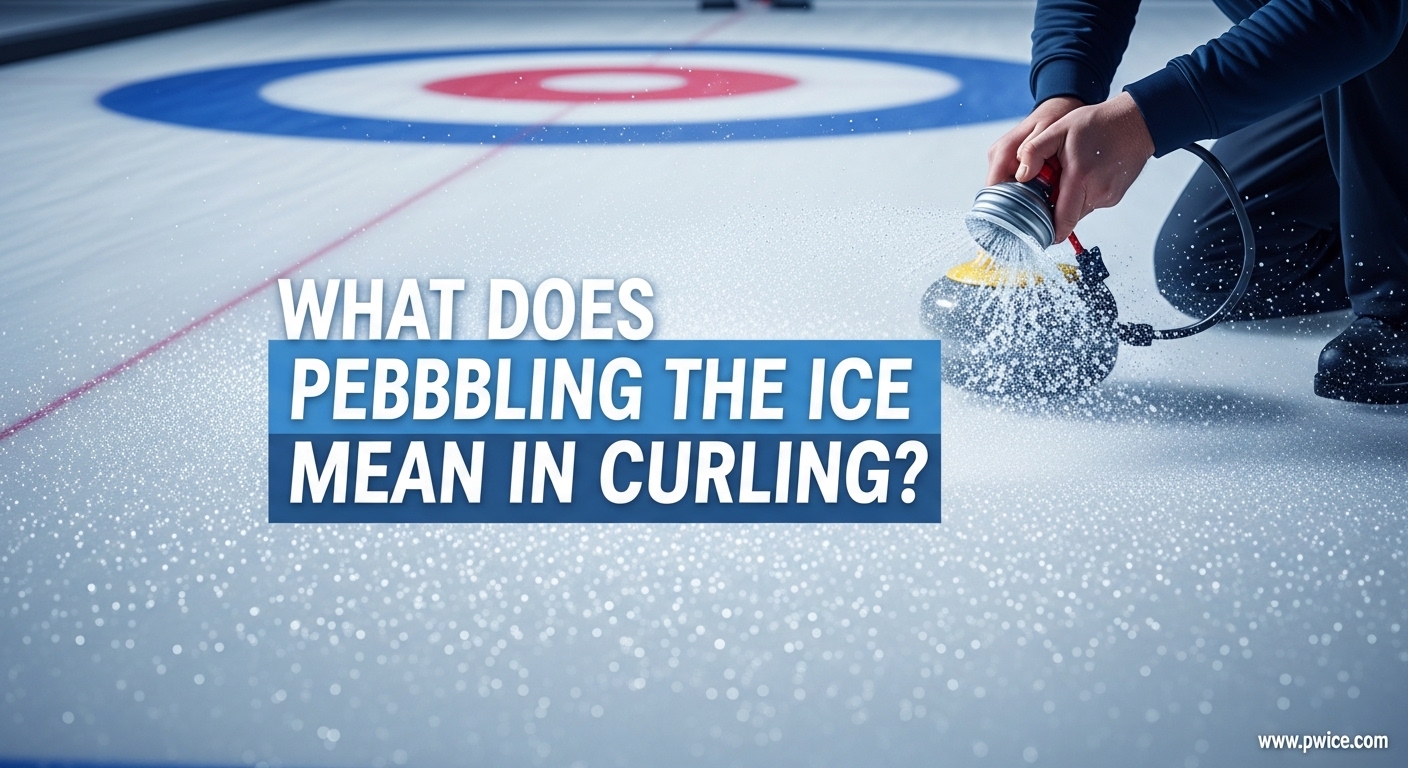
Pebbling the ice in curling is the process of spraying fine water droplets onto the playing surface that freeze into tiny bumps, creating a textured layer that allows curling stones to glide smoothly and curl predictably. This technique transforms a flat sheet of ice into the unique playing surface that makes the sport possible. Understanding what does pebbling the ice mean in curling reveals why this 500-year-old sport relies on a delicate balance between friction and momentum.
If you have ever watched Olympic curling and wondered why the ice looks dimpled rather than glass-smooth like a hockey rink, you are about to discover one of the most fascinating technical secrets in winter sports. The pebbled surface is not a byproduct or an accident. It is a carefully engineered feature that makes the entire game possible.
In this guide, I will explain exactly how pebbling works, why it is essential for the game, and the fascinating physics behind stone movement on pebbled ice. You will learn about the equipment ice technicians use, how often they repebble during competitions, and the surprising origin story of this technique that dates back to Scotland in the 1500s.
Table of Contents
Why Do They Pebble Curling Ice?
Curling ice is pebbled to reduce friction and enable the characteristic curl that gives the sport its name. Without pebbling, a 44-pound granite stone placed on flat ice would encounter too much resistance and would not travel the full 150 feet to the target area known as the house.
The pebbled surface creates thousands of tiny contact points between the stone and ice. This reduces the overall surface area touching the ice, which dramatically decreases friction while still providing enough grip for the stone to respond to rotation. The result is a stone that glides 120 to 150 feet while still being able to curve 6 to 12 feet sideways as it travels down the sheet.
Flat ice presents another significant problem: it creates a suction effect. The concave running surface on the bottom of a curling stone can create a vacuum seal against smooth ice, causing the stone to stop unpredictably or even stick to the surface entirely. The pebble breaks this seal by allowing air underneath the stone, ensuring consistent and predictable movement.
Flat Ice vs Pebbled Ice: The Critical Difference
Understanding the difference between flat ice and pebbled ice helps explain why this technique matters so much for the sport. Here is how the two surfaces compare in terms of playability:
| Characteristic | Flat Ice (Not Pebbled) | Pebbled Ice |
|---|---|---|
| Stone Travel Distance | 30-50 feet maximum | 120-150 feet standard |
| Friction Level | Very high – stone grips surface | Reduced – stone glides on pebble tops |
| Curl Capability | Minimal to none | Controlled 6-12 feet of curl |
| Stone Movement | Grinding, chattering, unpredictable | Smooth, gliding, predictable |
| Playability | Poor, nearly impossible for regulation play | Ideal for strategy and skill development |
Professional ice technicians use laser levels and precise measurements to ensure the base ice is perfectly flat before pebbling begins. The pebbling itself is what transforms that flat sheet into a playable surface where champions are made.
What Does Pebbling the Ice Mean in Curling? The Complete Definition
Pebbling is the systematic application of fine water droplets onto a prepared ice sheet using specialized equipment. When these droplets freeze, they create thousands of tiny bumps across the playing surface, giving the ice an orange peel-like texture that reduces friction and enables the stone curl that defines the sport.
The term comes from the visual resemblance of the frozen droplets to small pebbles scattered across the ice surface. Each pebble is actually a frozen water droplet that stands approximately 1 to 2 millimeters above the base ice surface, creating a dimpled, irregular texture that looks nothing like the smooth ice you see in hockey or figure skating rinks.
The pebble layer is remarkably thin, typically adding only a fraction of an inch to the ice surface, yet this micro-layer makes the difference between a stone that glides gracefully to its target and one that grinds to an awkward halt after just a few feet.
The Orange Peel Texture Explained
Experienced curlers and ice technicians often describe properly pebbled ice as having an orange peel texture. If you look closely at the skin of an orange or a lemon, you see a consistent pattern of tiny bumps and dimples covering the entire surface.
That is exactly what pebbled ice looks like under good lighting conditions. The frozen water droplets create this bumpy pattern across the entire 150-foot length of a curling sheet. When light hits the surface at certain angles, the pebbles catch the light and create a distinctive sparkling effect that experienced curlers recognize immediately as quality ice.
How Pebbling Affects Stone Movement
The bottom of a curling stone is not flat. It has a concave running surface, meaning the center of its bottom is slightly raised while only a thin ring around the outer edge actually touches the ice. When this concave bottom meets the pebbled surface, something fascinating happens at the physics level.
As the stone travels over the pebbles, the tiny bumps create microscopic points of contact. The friction at these contact points generates heat through wet friction, which melts a thin film of water beneath the stone. This micro-layer of water acts as a lubricant, allowing the stone to glide almost frictionlessly across the tops of the pebbles.
The concave shape also creates a partial vacuum effect. As the stone moves forward, air gets trapped under the concave center, reducing the effective weight pressing down on the pebble contact points. This further reduces friction and allows the stone to travel farther with less initial weight on the throw.
Why Stones Curl on Pebbled Ice
The curl, or sideways curve of the stone, happens because of how the stone interacts with the pebble when spinning. Curlers deliver stones with rotation, typically between 2 and 4 full rotations from release to the house at the far end of the sheet.
When a stone rotates clockwise, the leading edge encounters pebbles at a slightly different angle than the trailing edge. This asymmetric interaction creates slightly different friction forces on each side of the stone, causing it to drift sideways in the direction of rotation. A clockwise rotation produces a curl to the right, while counterclockwise rotation curls left.
On flat ice, this asymmetric friction would not exist in any predictable pattern. The stone would either travel completely straight or behave unpredictably. The regular pattern of pebble bumps makes the curl consistent and controllable, which is exactly what makes curling a game of strategy and skill rather than random chance.
The Relationship Between Sweeping and Pebble
Sweeping plays a critical role in the stone-pebble interaction. When players sweep vigorously in front of a moving stone, the friction from the brooms briefly melts the tops of the pebble bumps. This creates a thin micro-layer of water that further reduces friction, allowing the stone to travel farther and straighter than it would on untouched pebble.
As experienced curlers have noted, aggressive sweeping smooths and even melts the pebbles down so the stone can skate on a film of water. This is why you see sweepers working furiously on certain shots and not at all on others. The decision to sweep depends entirely on how the skip wants the stone to interact with the pebble.
How Do You Pebble Curling Ice?
The pebbling process requires specialized equipment and careful technique to create consistent playing conditions across the entire sheet. Ice technicians follow a precise procedure to ensure every sheet meets competitive standards for championship events.
Step 1: Prepare the base ice. The ice maker first ensures the sheet is level using laser-guided equipment, creating a perfectly flat frozen surface at approximately 23 degrees Fahrenheit. Any imperfections in the base ice will be magnified by the pebbling process.
Step 2: Purify the water. Pebbling requires highly purified water with specific pH levels and minimal dissolved solids. Most professional facilities use carbon filtration and reverse osmosis systems to achieve the exact water quality needed for consistent pebble formation.
Step 3: Load the pebble can. Technicians fill a pebble can, a specialized backpack sprayer, with temperature-controlled water heated to around 100 to 120 degrees Fahrenheit for optimal droplet formation.
Step 4: Apply the first coat. Walking backward to avoid stepping on fresh pebble, the technician sprays a fine mist of water droplets across the entire sheet in overlapping passes. This creates the foundation texture.
Step 5: Wait for freezing. The droplets freeze within seconds of hitting the cold ice surface, forming the initial pebble layer. Timing is crucial as droplets must freeze completely before applying additional coats.
Step 6: Apply the second coat. For competition ice, technicians apply a second lighter coat perpendicular to the first. This creates a more uniform texture and seals the base pebble for optimal stone movement.
Step 7: Inspect and adjust. The ice technician inspects the sheet for consistency, sometimes using scrapers to remove any overspray or irregular pebble formations that could affect gameplay.
The Art of the Swing
Experienced ice makers develop a distinctive walking pattern and arm swing to ensure even coverage. They walk backward so they do not step on freshly pebbled ice, and they swing the can rhythmically to create consistent droplet size and spacing across all lanes of the sheet.
Too large a droplet creates a tall pebble that stones will hit too hard, creating unpredictable movement. Too small a droplet might not create enough texture to provide proper glide. The best ice makers can feel when conditions change and adjust their technique accordingly without missing a beat.
Olympic-level ice technicians may spend several hours preparing a single sheet before major competitions. The water droplet size, spraying distance, and walking speed all affect the final pebble quality and must be adjusted based on humidity and air temperature.
How Often Is the Ice Re-Pebble?
Ice technicians perform full pebbling before each game or draw at curling clubs and competitions. For major tournaments like the World Championships or Olympic Games, the ice receives fresh pebble at the start of every match to ensure absolutely consistent conditions for all competing teams.
During a game, the pebble wears down gradually as stones pass over it and players sweep vigorously. By the end of an eight to ten end match, the pebble has flattened significantly, particularly in high-traffic areas like the house and along common draw paths. This wear affects how stones behave, making late ends play differently from early ends.
Between Ends: Nipping vs Pebbling
Between games, technicians often perform nipping rather than full pebbling. Nipping involves using a specialized blade to shave down the tops of worn pebble bumps, creating a fresh surface for the next match without building up excessive pebble layers. Think of it like mowing a lawn versus replanting grass entirely.
Nipping is faster than full pebbling and is sufficient when the base pebble layer is still adequate. However, when the pebble has worn down too much or conditions require a completely fresh surface, full repebbling is performed instead.
At the Olympic level, ice crews may repebble between certain ends during long competitions to maintain optimal playing conditions. The decision to repebble depends on ice conditions, humidity levels in the arena, and the specific requirements of the event organizers.
Pebble Wear Throughout a Match
As a match progresses, the pebble gradually wears down in predictable patterns. The middle of the sheet, where most stones travel during typical gameplay, wears faster than the sides. This changing surface becomes part of curling strategy.
Experienced teams read the ice conditions and adjust their weight and line calls accordingly. A draw played in the first end might need different weight than the same draw played in the eighth end because the pebble has worn down and the ice has become faster or keener.
When pebble wears too thin, the ice becomes keen, meaning stones travel farther with less throw weight. Teams must recognize these changes and call their shots with increasing weight as the game progresses to compensate for the changing surface.
The History and Origin of Ice Pebbling
The origin of pebbling traces back to Scotland in the 1500s, where curling began on frozen ponds and lochs during winter months. According to curling historians and oral tradition passed down through generations, the technique was discovered accidentally when light rain fell on a frozen pond where curlers were playing.
The water droplets froze into bumps on the ice surface, and players immediately noticed that stones traveled farther and more predictably on this textured surface compared to smooth natural ice. Before this discovery, curlers played on whatever natural ice conditions existed, with snow that had to be cleared and uneven surfaces that made every shot an adventure.
The rainfall discovery transformed the sport by showing that controlled water application could create ideal playing conditions consistently. Early pebbling was done using simple methods like splashing water with brooms or using leather pouches with small holes punched in them to sprinkle water across the playing area.
By the 1800s, dedicated curling clubs began developing specialized equipment for ice preparation. The modern pebble can with its backpack design and fine spray nozzles evolved throughout the 20th century as the sport grew internationally.
Today, ice technicians at events like the Winter Olympics use sophisticated equipment including laser leveling systems, water purification plants, and precision pebbling wands. The science of ice making has become so advanced that different competitions can specify exact pebble heights and water quality standards to ensure consistency across venues worldwide.
Related Curling Concepts to Know
Understanding pebbling opens the door to appreciating several related aspects of curling that work together to create the strategic depth that makes this sport so fascinating to watch and play. These concepts are essential for anyone who wants to follow curling at a deeper level.
Sweeping and Its Effect on Pebble
Sweeping serves two main purposes: it makes stones travel farther and it reduces how much a stone curls. When players sweep in front of a moving stone, the friction from their brooms momentarily melts the tops of the pebbles.
This melting creates a thin film of water that reduces friction, allowing the stone to glide farther than it would on untouched pebble. The sweeping also warms the ice along the stone’s path, creating a temporary smooth track that affects both distance and curl.
Keen Ice vs Heavy Ice
Keen ice refers to ice that is running fast, usually because the pebble is worn down or the ice temperature is optimal for low friction. Heavy ice is slow ice, often fresh after pebbling or in humid conditions that create more friction.
Ice technicians can adjust pebble size and ice temperature to create different playing conditions. Championship events often feature keen ice that rewards precise weight judgment and punishes even small errors in stone delivery.
Nipping Explained
Nipping is the process of shaving down pebble between games or ends using a specialized blade scraper. Unlike pebbling, which adds material to the ice, nipping removes the tops of worn pebbles to create a fresh, uniform surface without adding new droplets.
Ice makers must decide whether to nip, re-pebble, or leave the ice alone based on current conditions. This decision affects how the game will play and requires expert judgment developed over years of experience.
Other Key Terms
Sheet: The entire playing surface including the hack, lines, and houses is called a sheet. A standard curling rink contains multiple sheets side by side, each requiring individual pebbling and maintenance.
The Hammer: This term refers to the advantage of throwing the last stone in an end. The condition of the pebble affects how teams use the hammer, as worn ice late in an end may require different strategies than fresh pebble at the beginning.
The House: The target area at each end of the sheet where stones are delivered. The pebble condition around the house is critical as it affects how stones behave in the final moments of their journey down the ice.
Frequently Asked Questions About Pebbling
How do you pebble curling ice?
Ice technicians use a backpack sprayer called a pebble can to distribute fine water droplets across the ice sheet. They walk backward in overlapping passes, spraying temperature-controlled purified water that freezes instantly on contact. A two-coat technique creates the optimal texture for curling stone movement.
What is pebbling at curling?
Pebbling is the process of spraying water droplets onto a curling ice sheet that freeze into small bumps. These frozen droplets create a textured surface that allows curling stones to glide smoothly while enabling the characteristic curl that gives the sport its name.
Why do they pebble curling ice?
Curling ice is pebbled to reduce friction and prevent stones from sticking to the surface. The pebble allows stones to travel the full 150-foot length of the sheet while enabling the curl effect through differential friction on the rotating stone’s running surface.
Why is ice pebbled in curling?
Ice is pebbled because flat ice creates too much friction and suction against the concave bottom of curling stones. The pebble breaks this vacuum effect and reduces surface contact, allowing stones to glide 120 to 150 feet while maintaining predictable curl.
How often do they pebble the ice in curling?
Ice technicians perform full pebbling before each game or draw in curling competitions. During tournaments, the ice may receive fresh pebble at the start of every match. Between games, technicians often perform nipping, which shaves down worn pebble rather than adding new water droplets.
Do they repebble the ice in curling?
Yes, ice is repebbled between games and sometimes during long competitions. Full repebbling ensures consistent playing conditions for all teams. During a single game, the pebble gradually wears down from stone traffic and sweeping, affecting how stones behave in later ends.
What happens if you don’t pebble curling ice?
Without pebbling, curling stones would encounter excessive friction on flat ice and stop well short of the target area. The concave running surface of the stone would create a vacuum seal against smooth ice, causing unpredictable sticking. The sport would be essentially unplayable without pebble.
Why is curling ice dimpled?
Curling ice is dimpled through pebbling to create the texture necessary for proper stone movement. The dimpled or pebbled surface reduces friction, prevents suction effects, and enables the characteristic curl. The frozen water droplets that form these dimples function as thousands of tiny contact points.
Conclusion
Now you understand what does pebbling the ice mean in curling: it is the essential technique of spraying water droplets that freeze into tiny bumps, creating the unique surface that makes curling possible. Without pebbling, the sport would not exist as we know it today.
From its accidental discovery during a Scottish rainfall centuries ago to the precision science of modern Olympic ice making, pebbling remains one of the most fascinating aspects of this ancient sport. The next time you watch curling at the Olympics or your local club, you can appreciate the invisible layer of frozen droplets that makes every shot possible.
If this article sparked your curiosity, consider visiting a local curling club to try sliding a stone across freshly pebbled ice yourself. There is nothing quite like feeling that smooth glide as your stone rides the pebble down the sheet toward the house.