
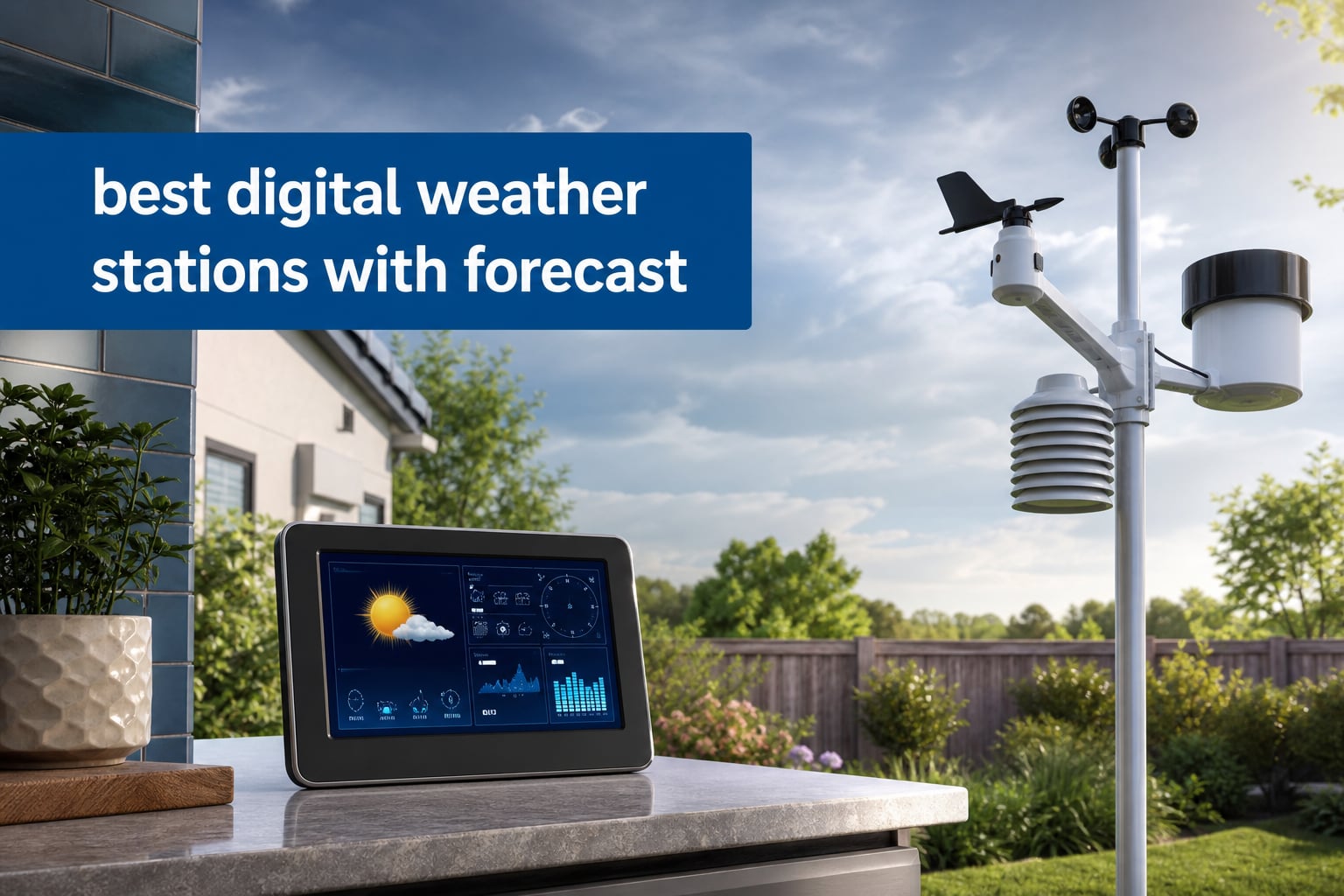
The best digital weather stations with forecast give you two useful things at once: readings from your own yard and a forward-looking weather display. A local outdoor temperature sensor can tell you what is happening at the house right now, while a forecast icon or connected service helps you plan the next few hours or days.
For this guide, we compared the 10 verified stations on display readability, confirmed sensor coverage, forecast approach, wireless range, connectivity, data handling, and practical limitations. I would separate a station that shows temperature and humidity from a full home weather station with rain, wind, and pressure monitoring; they serve different households.
A forecast icon is not a promise that rain will arrive at a particular minute. Basic stations infer short-term conditions from barometric pressure trends, whereas Wi-Fi models can also bring in online forecast data; the useful choice depends on whether you want a bedside display, garden records, storm awareness, or app alerts.
We also kept recurring owner concerns in view: wireless signals need a clear route, many connected models accept only 2.4 GHz Wi-Fi, and rain collectors need periodic cleaning. Those details matter more in daily use than a long feature list.
Table of Contents
Top 3 Picks Answer the Most Common Needs (2026)
The Sainlogic 12-in-1 is our Editor’s Choice because its confirmed sensor set includes temperature, humidity, pressure, wind, and rainfall without requiring internet access. Choose the Sainlogic Smart WiFi model when phone alerts and spreadsheet-ready history matter, or BluSon when you primarily need clear indoor/outdoor readings and a 12-hour forecast display.


For a direct answer on forecast accuracy, a station with local pressure, wind, and rain measurements gives the richest picture of conditions on your property. Connected forecasts can add wider regional context, but they are not a substitute for clean placement and a well-maintained sensor array.
All 10 Digital Weather Stations With Forecast Compared (September 2026)
This overview separates compact forecast displays from stations with outdoor wind and rainfall hardware. Ratings and review totals below are the verified product-listing figures, not results from a single lab test.
| Product | Specifications | Action |
|---|---|---|
| Sainlogic 12-in-1 |
|
Check Latest Price |
| Sainlogic Smart WiFi |
|
Check Latest Price |
| BluSon Wireless |
|
Check Latest Price |
 Sainlogic SA6 Sainlogic SA6 |
|
Check Latest Price |
 VEVOR 5-in-1 Wi-Fi VEVOR 5-in-1 Wi-Fi |
|
Check Latest Price |
 La Crosse V42-PRO La Crosse V42-PRO |
|
Check Latest Price |
 Sainlogic 14-in-1 Sainlogic 14-in-1 |
|
Check Latest Price |
 La Crosse V11-TH La Crosse V11-TH |
|
Check Latest Price |
 La Crosse 308-1415C La Crosse 308-1415C |
|
Check Latest Price |
 La Crosse L78571 La Crosse L78571 |
|
Check Latest Price |
1. Sainlogic 12-in-1 Is the Best Standalone Station for Broad Local Readings
Sainlogic 12-in-1 Wireless Weather Station, No WiFi, Indoor Outdoor, Black
Rain, wind, humidity, pressure
Solar power with backup
6.5 inch LCD
Pros
- 12-in-1 local monitoring
- Precision rain measurement
- Solar power with backup
- Large bold display
Cons
- No Wi-Fi
- AA batteries not included
The Sainlogic 12-in-1 makes sense for a household that wants local measurements to keep working without depending on an app. Its listed monitoring covers indoor and outdoor temperature, humidity, barometric pressure, wind, and rainfall, and the solar-powered outdoor unit has battery backup.
The console uses a 6.5-inch display with large fonts, which is a practical advantage when the screen sits across a room. It records indoor temperatures from 32 to 140 degrees F and outdoor temperatures from -40 to 140 degrees F, with humidity coverage from 10% to 99% and pressure from 300 to 1100 hPa.
Rain is the reason to move up from a simple digital thermometer with humidity. The listing states plus or minus 1 mm accuracy for light rain, so gardeners and anyone checking storm totals have a measurement that a compact forecast console cannot provide.
The trade-off is deliberate: this is not a Wi-Fi weather station. You will read its forecast and observations at the display rather than receiving a smartphone notification or exporting records to a spreadsheet.
Local monitoring is the main reason to choose it
This station is a strong fit for backyard monitoring where wind direction, rain accumulation, and pressure trends are more useful than a phone app. The large readout also helps in a workshop, kitchen, or covered porch where you want the current conditions in one glance.
Internet-free operation is the key limit to accept
Choose another model if remote alerts, a cloud dashboard, or historical downloads are non-negotiable. Place the outdoor assembly clear of roofs and trees, then check the rain collector after heavy storms because debris can affect any rain gauge.
2. Sainlogic Smart WiFi Is the Best Pick for Exportable Weather History
Sainlogic Smart WiFi Weather Station, Wireless Indoor Outdoor Weather Station with 24/7 Weather Forecast, Wind Speed, Rain Gauge, Alerts & 2-Year Data Export for Home Garden
Wi-Fi Weatherseed app
Two-year Excel export
Rainfall and alerts
Pros
- Phone alerts
- Two-year storage
- Excel export
- Rainfall monitoring
Cons
- 2.4 GHz Wi-Fi only
- AAA batteries not included
The Sainlogic Smart WiFi station targets the person who wants a forecast display but also wants to revisit what happened in the garden last month. Its Weatherseed app connection supports smartphone alerts, while the confirmed two-year storage and Excel export make it more useful for keeping a personal weather log.
The company describes its forecast as AI-driven and available around the clock. Treat that forecast as a planning layer beside the station’s actual observations, particularly when rain or wind at your house differs from the nearest city report.
Data export is the feature I would focus on here. Forum discussions repeatedly show that weather hobbyists get frustrated when data is locked in an app, so the explicit Excel-export capability gives this unit a clearer path for charting or saving records yourself.
Its Wi-Fi connection is limited to the 2.4 GHz band. Before mounting anything, verify that your router exposes a 2.4 GHz network and that the indoor console can maintain a dependable connection where you intend to use it.
Two-year data storage makes it useful for records
This is a sensible weather station with app alerts for gardeners comparing seasons, hobbyists collecting rainfall history, and households that want notification-based monitoring. The high-contrast display with enlarged fonts still gives you a local readout when the phone is not nearby.
Router compatibility needs checking before installation
A combined-band router can sometimes complicate onboarding for devices that only support 2.4 GHz. Set up the console near the router first, complete the app connection, and only then move to its permanent location.
3. BluSon Is the Best Simple Color Forecast Display
BluSon Weather Station Wireless Indoor Outdoor Thermometer, Atomic Clock
7.5 inch color display
Three remote sensors
12-hour forecast
Pros
- Large HD display
- Up to three sensors
- Atomic clock
- Temperature and humidity alerts
Cons
- Backlight times out on batteries
- Batteries not included
BluSon is a compact answer for people who do not need wind or rainfall hardware but want an easy-to-read home weather station. Its 7.5-inch HD color display, four adjustable brightness levels, and 12-hour forecast icon put the information that matters most on one screen.
The supplied package includes one remote sensor, while the receiver can connect with as many as three. That is useful for comparing the patio, a greenhouse, and a child’s room, provided each sensor has a realistic radio path to the main display.
The published open-area transmission distance is 328 feet, not a guarantee through brick, foil insulation, metal siding, or several interior walls. I would test the chosen outdoor location before permanently fastening the sensor.
Its WWVB atomic clock adjusts for daylight saving time automatically, and the unit has customizable temperature and humidity alerts plus dual alarms. Those are small conveniences, but they make this more than a decorative weather screen.
Multiple locations are its most practical advantage
Choose BluSon if indoor/outdoor temperature is the main goal and several zones would be helpful. The forecast is a 12-hour display feature, while the sensor system gives you the immediately useful local temperature and humidity readings.
Continuous brightness requires mains power
In battery mode, the backlight turns off after 10 seconds, according to the listing. Use the supplied power cord for a counter or bedside location where you expect the screen to stay illuminated.
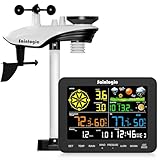
4. Sainlogic SA6 Is the Best No-Wi-Fi Alternative With a Rain Gauge
Sainlogic 12-in-1 Weather Station Wireless SA6, Weather Station with Rain Gauge, Wind Speed, Weather Forecast, Air Pressure, Humidity, Alarm Clock(No WiFi)
Rain gauge and wind
6.5 inch color LCD
Pressure and humidity
Pros
- Color LCD
- Specified rain accuracy
- Wide outdoor temperature range
- Comprehensive measurements
Cons
- No Wi-Fi
- No smart-home support
The Sainlogic SA6 is another self-contained weather station with rain gauge, but its published specifications spell out the rainfall range in more detail. It lists plus or minus 1 mm accuracy below 15 mm of rain and plus or minus 7% from 15 to 9,999 mm, alongside temperature, humidity, pressure, wind, and forecast information.
Its outdoor temperature coverage is -40 degrees C to 60 degrees C, with indoor coverage from 0 degrees C to 60 degrees C. That broad operating range makes it worth considering for places that see very cold winters or hot enclosed spaces.
The 6.5-inch HD color LCD has adjustable backlighting, so it gives more display presence than a small clock-style receiver. Like the other no-Wi-Fi Sainlogic option, it keeps the core data local instead of adding account setup and remote notifications.
That simplicity can be a benefit when the user wants a reliable display rather than another connected device. It also means there is no stated smart-home compatibility or online data archive to depend on.
Rain totals are the strongest case for this model
The SA6 is a sensible fit for a gardener who wants rainfall, pressure, and wind on the same console without Wi-Fi configuration. Use the stated rainfall tolerance as a guide to the measurement specification, not a reason to skip level mounting or cleaning.
Connected history is not part of its design
Pick a Wi-Fi model if you need alerts away from home or a downloadable record. For local use, keep the sensor level and avoid a position under a roof edge where drips create false rainfall totals.
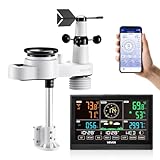
5. VEVOR 5-in-1 Is the Best Wi-Fi Choice for a Long Sensor Path
VEVOR 5-in-1 Wi-Fi Weather Station, 7.5-Inch VA Display, Wireless Solar Powered Outdoor Sensor, Rain Gauge, Indoor Outdoor for Weather Forecast, Wind Speed Direction, Temperature, Humidity, Rainfall
5-in-1 outdoor sensor
492 foot range
Smart Life app
Pros
- Long listed range
- IPX6 outdoor rating
- Solar sensor
- Wind direction measurement
Cons
- 2.4 GHz Wi-Fi only
- Smaller review sample
VEVOR’s 5-in-1 package combines outdoor temperature and humidity with rainfall, wind speed, and wind direction. It also presents dew point, moon phases, and a six- to 12-hour forecast, while the indoor display is a 7.5-inch VA unit with four brightness settings.
Its listed 492-foot transmission distance is the longest specific sensor range in this group. Open-air figures always shrink around construction materials and obstructions, but this model deserves a look for a larger lot or a detached building where the sensor cannot sit close to the console.
The outdoor sensor is solar powered with battery backup and carries an IPX6 waterproof rating. That combination addresses outdoor exposure, although seasonal inspection is still sensible for a station that measures wind and collects rain.
Smart Life app integration gives it phone-based control and observation, but it uses 2.4 GHz Wi-Fi only. The product data does not state a downloadable data-history feature, so do not assume it provides the archival tools found on the Sainlogic Wi-Fi products.
Long-distance placement is what separates it
This unit is a good candidate when the preferred mounting point is far from the display. Measure the route, avoid placing the console behind major appliances or thick masonry, and perform a signal check before drilling mounting holes.
App access does not automatically mean detailed exports
Smart Life integration can suit users who want connected monitoring, but it is different from a confirmed two-year Excel-export function. Choose based on the records you need to keep, not just the presence of an app icon.
6. La Crosse V42-PRO Is the Best for a Seven-Day Connected Forecast
La Crosse Technology Professional Smart Wi-Fi Weather Station with Remote Monitoring (400 Foot Range), Wind and Rain Gauges, Temperature and Humidity Sensors, and Forecasting – V42-PRO-INT
Wind and rain gauges
Seven-day Wi-Fi forecast
400 foot range
Pros
- Seven-day forecast
- La Crosse View alerts
- Wind and rainfall data
- 400 foot range
Cons
- Sensor batteries separate
- Setup varies by network
The La Crosse V42-PRO has the broadest clearly stated forecast window in this list: seven days when connected to Wi-Fi. It combines that incoming AccuWeather data with local wind, rainfall, temperature, and humidity measurements, making it a practical choice for users who want both local observation and a wider forecast view.
La Crosse View supplies mobile alerts and remote monitoring, while the display includes UV index plus sunrise and sunset times from the connected data. The listed wireless range is 400 feet, and the outdoor temperature range runs from -40 degrees F to 140 degrees F.
The distinction between streamed forecast data and sensor data is particularly useful here. Use the display’s rain and wind readings for what is occurring at your property, then use the seven-day forecast as context for plans later in the week.
Forum users note that La Crosse model names and variants can be confusing, so confirm the V42-PRO-INT listing and included sensor package before ordering accessories. The station’s sensors require separate AA batteries, which should be part of installation planning.
Regional forecasting is the main reason to choose it
This is a solid match for a household that values a longer connected forecast on a physical display and wants remote alerts. It is more feature-dense than a forecast clock because it also includes wind and rain hardware.
Sensor power and Wi-Fi setup need advance planning
Have the required batteries ready and connect the display to a stable home network before final mounting. A predictable setup sequence helps avoid the connectivity frustration commonly reported with wireless stations.
7. Sainlogic 14-in-1 Is the Best for UV and Sunlight Tracking
Sainlogic 14-in-1 WiFi Smart Weather Station with 24H/ 7Days Accurate Weather Forecast by Weatherseed® AI, 8.5″ Large Display,UV,Sun Light,Rain Gauge,Wind Gauge,2-Year Data Storage & Export(Only 2.4G)
7-in-1 sensor with UV
8.5 inch display
Two-year Excel export
Pros
- UV and sunlight data
- Large display
- Excel export
- Smart-home compatible
Cons
- 2.4 GHz Wi-Fi only
- AAA batteries not included
The Sainlogic 14-in-1 adds UV and sunlight measurement to temperature, humidity, rainfall, wind speed, and wind direction. That seven-in-one outdoor sensor provides a fuller set of local conditions for gardeners managing sun exposure, weather enthusiasts, or anyone who wants more than temperature and rain.
Its 8.5-inch display is the largest listed screen in this comparison, and the station updates data every five minutes. The Wi-Fi-linked Weatherseed app offers a 24-hour and seven-day AI forecast, while two-year storage and Excel export cover the historical-data side.
The listing says it is smart-home compatible, but it does not identify a particular platform or protocol. If Home Assistant is a firm requirement, validate the exact integration route and available entity support before buying instead of assuming that broad compatibility language means direct local control.
That caution matters for data-minded owners. A station can be useful in a smart home without supplying every local observation to every platform, and forum users place a high value on knowing where their data goes.
Solar and UV measurements make it useful beyond temperature
This model is the better fit when sunlight and UV data will actually guide a decision, such as plant care or sun-exposure awareness. Its large display also reduces the need to open the app merely to check the current reading.
Smart-home claims should be verified for your setup
The product is described as smart-home compatible, but the listing does not specify Home Assistant support. Check your hub, Wi-Fi band, and preferred data workflow first, especially if local access rather than cloud access is the goal.
8. La Crosse V11-TH Is the Best for an Expandable Sensor System
La Crosse Technology V11-TH Color Wireless WiFi Weather Station…
Wi-Fi La Crosse View
Expandable sensor system
400 foot range
Pros
- Expandable sensors
- Color forecast views
- App connectivity
- 0.5 C temperature accuracy
Cons
- Lower verified rating
- Sensor batteries separate
The La Crosse V11-TH is built for a household that may want to add monitoring locations over time. Its listing identifies an expandable sensor system, Wi-Fi access through the La Crosse View app, a 400-foot transmission range, and dynamic forecast information in six views.
Temperature accuracy is listed at 0.5 degrees C, and the outdoor range is -40 degrees F to 140 degrees F. Those figures give a useful baseline for ordinary outdoor monitoring, but placement still has a larger real-world effect than comparing small decimal differences between models.
This model focuses on indoor/outdoor temperature and the connected forecast display rather than including a stated rain gauge and wind array. It is therefore a cleaner choice for users prioritizing expandable temperature sensing instead of full backyard meteorology.
Its verified rating is 4.0 from 80 reviews, lower than several other products here. That does not decide the right purchase by itself, but it is a reason to read current feedback about the particular expansion sensors you expect to add.
Expansion is its decision-making feature
Choose the V11-TH when a single outdoor reading may turn into a multi-zone system for a basement, greenhouse, shed, or other indoor area. Confirm which additional sensors work with the exact console before building around it.
Rain and wind measurement require a different package
This is not the right pick when rainfall totals and wind direction are required from day one. The larger Sainlogic, VEVOR, and V42-PRO packages list those measurements explicitly.
9. La Crosse 308-1415C Is the Best for Straightforward Forecast Icons
La Crosse Technology 308-1415C Digital Multi-Color Wireless Forecast Station
Multi-color forecast icons
Temperature and humidity
Four-level backlight
Pros
- Clear color icons
- Auto-dim backlight
- Temperature and humidity alerts
- Included wireless sensor
Cons
- No rain or wind sensors
- Sensor batteries not included
The La Crosse 308-1415C keeps the focus on the forecast display. Its multi-color icons show sunny, partly cloudy, cloudy, rainy, stormy, and snowy conditions, alongside indoor and outdoor temperature plus relative humidity readings.
The 4-level backlight has an auto-dim feature, which helps a console work as a bedroom or kitchen display without being distracting at night. Users can also choose Fahrenheit or Celsius and turn on optional decimal temperature display.
The included TX141TH-B remote sensor supplies the outdoor observation. High and low temperature and humidity alerts are configurable, giving the unit practical usefulness for a cold porch, plant room, or a location where you want a heads-up about changing conditions.
This is a forecast station, not a professional weather station. It does not list rainfall, wind, online forecasting, or data export, so it is best judged as a clear basic display rather than against a multi-sensor weather array.
Readability is the reason to choose this display
The icon set makes current forecast conditions easy to scan without decoding a dense screen. It suits someone who needs indoor/outdoor temperature, humidity, and a visual forecast in a compact connected-by-radio format.
Local precipitation data is outside its scope
Move to a model with a dedicated outdoor array if storm totals, wind speed, or barometric trend analysis are important. The sensor needs two AA batteries, so include those in your initial setup checklist.
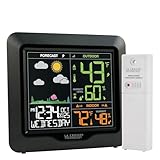
10. La Crosse L78571 Is the Best for Dew Point and Heat Index at a Glance
La Crosse Technology L78571 Wireless Color Forecast Station
Dew point and heat index
330 foot sensor range
Atomic time signal
Pros
- Dew point display
- Heat index option
- Weather-resistant sensor
- Atomic time
Cons
- No Wi-Fi
- Indoor console use only
The La Crosse L78571 adds two readings that make a basic display more useful in uncomfortable weather: heat index and dew point. Along with indoor/outdoor temperature and dynamic color forecast icons, those measurements help explain why a humid summer day feels harsher than the temperature alone suggests.
Its weather-resistant sensor is rated for a 330-foot range, and the console receives atomic time using the WWVB signal. The product data specifies indoor use for the display, so keep the receiver protected and place only the remote sensor outdoors.
Dew point is particularly useful for judging how much moisture is in the air, while heat index combines temperature and humidity to describe perceived warmth. Neither replaces a full weather station’s rain and wind data, but both add meaning to everyday temperature readings.
The L78571 does not list Wi-Fi, app functions, or history export. It is a focused choice for a person who prefers a physical display, an outdoor temperature sensor, and more context than a basic thermometer provides.
Comfort readings are the main differentiator
Pick this La Crosse display for a bedroom, office, or kitchen where heat index and dew point will be checked often. The 330-foot stated range gives flexibility, but test real signal quality before selecting a permanent sensor location.
Connected monitoring is not included
This model will not send smartphone alerts or supply a cloud record based on the verified data. If remote viewing matters, choose a Wi-Fi model; if a local forecast display is enough, its focused feature set is easier to live with.
Buying the Right Weather Station Starts With the Forecast You Need
Choose a pressure-trend forecast if you want a local indication of changing short-term conditions without internet dependence. Choose a Wi-Fi forecast if you want regional forecast information, smartphone alerts, and possibly a multi-day outlook; a connected forecast is helpful, but it should not erase the value of observing your own yard.
Sensor coverage should match the decision you make
A digital thermometer with humidity is enough for checking a room, greenhouse, or patio. For lawn care, gardening, storm tracking, or farm-style monitoring, look for a weather station with rain gauge, anemometer, wind direction, and a barometric pressure monitor.
UV and sunlight data are specialized but useful when you will act on them. Do not select a larger sensor array just because it has more fields; select it because those fields answer a question you have.
Placement determines whether readings represent your property
Mount a temperature and humidity sensor away from direct sun, exhaust vents, dryer outlets, air-conditioning discharge, and heat stored by a wall. A shaded, ventilated location is generally more representative than the hottest spot on the house.
Mount wind sensors high and clear of nearby obstructions when possible, and keep rain collectors level and out from under roof lines. Before final installation, check wireless reception at the intended console location because the stated open-area range does not account for your walls or terrain.
Accuracy is strongest when you compare like with like
Digital weather stations can be very useful, but their accuracy depends on the sensor, installation, maintenance, and the exact condition being measured. Compare outdoor readings against a nearby official observation only after allowing for elevation, shade, pavement, bodies of water, and distance; a different reading can be real rather than wrong.
For rainfall, keep the collector clean and level. For temperature, avoid judging a sensor during a sudden sunbreak or while it is mounted beside a heat source, since those conditions can skew a reading more than the published sensor tolerance.
Wi-Fi convenience depends on a stable 2.4 GHz network
Every Wi-Fi product here that specifies a band calls for 2.4 GHz rather than 5 GHz. Confirm that your network allows the device to join, and complete setup close to the router before moving the console; this simple order can prevent a lot of repeated pairing attempts.
Wi-Fi enables alerts, apps, and incoming forecast data, but a local console remains important during an internet interruption. If remote viewing is not useful to you, a radio-linked standalone unit removes one source of troubleshooting.
Data ownership matters when history is part of the goal
For casual use, a live display is often all that is needed. For amateur meteorology, garden logs, or smart-home projects, look for a stated data-export option rather than assuming an app includes a useful archive.
The Sainlogic Wi-Fi and 14-in-1 listings explicitly state two-year data storage and Excel export. The 14-in-1 is described as smart-home compatible, but confirm platform-level support before planning a Home Assistant dashboard around it.
Seasonal maintenance keeps a station useful
After high winds, inspect the mounting hardware and sensor array. After leaf fall or a dusty storm, clear the rain gauge carefully; a clogged collector can understate rainfall regardless of the console’s display quality.
Replace backup batteries on a schedule, check that the sensor stays level, and review Wi-Fi connection status after router changes. Our team’s practical rule is simple: save the installation notes and model number, because troubleshooting months later is much easier when you know exactly which sensor and console are paired.
Frequently Asked Questions Give the Short Answers
What is the most accurate weather forecast station?
A station with well-placed local temperature, humidity, pressure, wind, and rain sensors gives the fullest view of conditions at home. From the verified products here, the Sainlogic 12-in-1, VEVOR 5-in-1, La Crosse V42-PRO, and Sainlogic 14-in-1 list the broadest local sensor coverage. A connected forecast adds regional context, but clean placement and maintenance still control the quality of local observations.
Which is better, La Crosse or AcuRite?
Neither brand is automatically better for every buyer. This verified product set includes La Crosse models but no AcuRite model, so a direct product-for-product verdict would not be supported here. Choose by the measurements, Wi-Fi features, display, sensor expansion, range, and data access you need rather than brand alone.
How accurate are digital weather stations?
Digital weather stations can provide useful local readings when sensors are installed correctly. Accuracy varies by measurement and is affected by sun exposure, walls, elevation, moisture, clogged rain collectors, and wireless placement. Compare readings with a nearby official observation only after accounting for real differences in location and conditions.
Which weather app has the most accurate forecasts?
No single weather app is most accurate in every place or weather pattern. A station app is valuable because it can pair regional forecast information with your own local observations. For immediate conditions at your home, a correctly placed outdoor sensor is often more informative than a city-level forecast alone.
The Best Choice Depends on Whether You Need Sensors, History, or a Simple Display
For the best digital weather stations with forecast, start with the measurements that change your decisions. The Sainlogic 12-in-1 is the most rounded standalone option for local weather, the Sainlogic Smart WiFi adds exportable history and alerts, and BluSon is the easy choice for a large, straightforward indoor/outdoor display.
Choose a rain and wind array only when those readings will be used, and choose Wi-Fi only when remote information adds real value. In 2026, a well-placed sensor and a display you will actually look at are more useful than an overcomplicated system left half configured.