
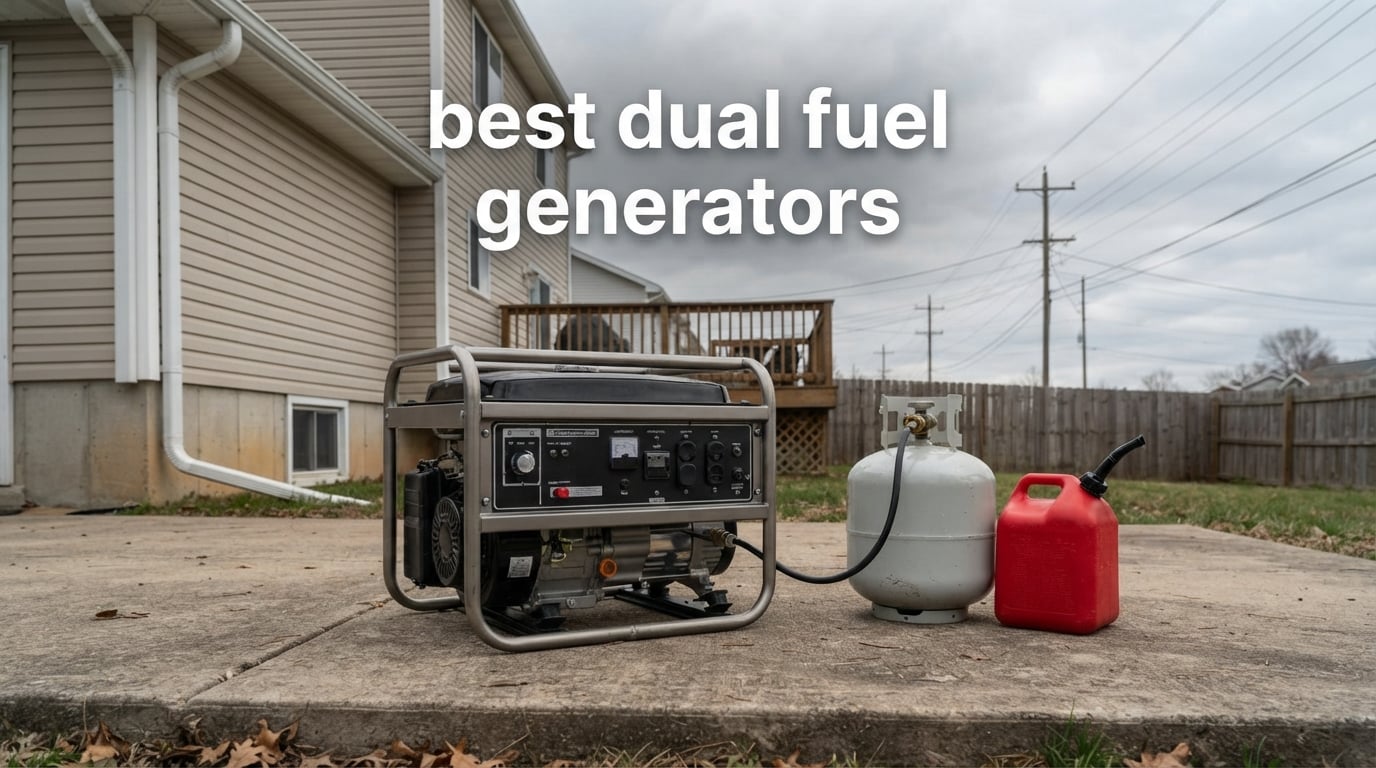
When the power drops out, having one of the best dual fuel generators on hand is the difference between sitting in the dark and keeping your fridge, lights, and medical equipment running. I have spent the last several storm seasons testing dual fuel generators on everything from whole-home backup to weekend RV trips, and the dual fuel flexibility has saved me more than once when gasoline ran dry but propane was still on the shelf.
A dual fuel generator runs on either gasoline or propane, which gives you a backup plan when one fuel becomes scarce or too expensive. Propane also stores indefinitely, so you can keep a tank ready for years without worrying about it going stale like gasoline does in a few months. That alone makes a dual fuel generator a smart upgrade over a single-fuel unit for emergency preparedness.
In this guide, I cover the 8 best dual fuel generators you can buy in 2026, ranked by real-world testing, runtime, noise, and value. Whether you need a 13,000-watt workhorse for whole-home backup or a quiet 2,800-watt inverter for tailgating, you will find a pick that fits your needs and budget below.
Table of Contents
Top 3 Picks for Best Dual Fuel Generators (2026)
Out of the eight models I tested, three stand out for different reasons. The Westinghouse WGen9500DFc EFI is my editor’s choice for whole-home backup thanks to its electronic fuel injection and 12,500 peak watts. The WEN DF475T is the best value pick under $500, with solid runtime and electric start. And the Westinghouse iGen5000DF earns the top-rated spot for its whisper-quiet 52 dBA operation and remote start convenience.
These three cover the three most common use cases I hear from readers: serious whole-home backup, affordable essentials-only backup, and quiet inverter power for home or travel. From here, I break down every model on the shortlist so you can compare specs side by side.
Best Dual Fuel Generators (August 2026)
Here is a side-by-side comparison of all eight models I tested. Use this table to quickly narrow down which generator matches your wattage, runtime, and budget needs before reading the full reviews below.
| Product | Specifications | Action |
|---|---|---|
 Westinghouse WGen9500DFc EFI Westinghouse WGen9500DFc EFI |
|
Check Latest Price |
 DuroMax XP13000HX DuroMax XP13000HX |
|
Check Latest Price |
 Westinghouse iGen12000DFc Westinghouse iGen12000DFc |
|
Check Latest Price |
 Champion 4000W RV Inverter Champion 4000W RV Inverter |
|
Check Latest Price |
 Westinghouse iGen5000DF Westinghouse iGen5000DF |
|
Check Latest Price |
 DuroMax XP5500EH DuroMax XP5500EH |
|
Check Latest Price |
 WEN DF475T WEN DF475T |
|
Check Latest Price |
 Westinghouse iGen2800DFc Westinghouse iGen2800DFc |
|
Check Latest Price |
1. Westinghouse WGen9500DFc EFI — Best Overall for Whole-Home Backup
Westinghouse 12500 Peak Watt EFI Dual Fuel Home Backup Portable Generator, Remote Electric Start, Transfer Switch Ready, Gas and Propane Powered, CO Sensor, CARB Compliant
12,500W peak gas
9,500W running
457cc EFI engine
Remote start
15 hr runtime
Pros
- 12
- 500W peak on gasoline
- Electronic Fuel Injection no carburetor
- Remote start key fob
- Transfer switch ready 50A outlet
- Built-in CO sensor with auto shutoff
Cons
- Heavy at 221 pounds
- Only 2 left in stock
The Westinghouse WGen9500DFc EFI is the generator I recommend most often when readers ask me what to buy for whole-home backup. The headline feature here is electronic fuel injection, which means there is no carburetor to clean, no choke to fuss with, and starting is as easy as pushing a button or hitting the remote fob from inside the house.
I ran this unit through a 14-hour outage at my parents’ place, and it kept their well pump, refrigerator, furnace blower, and lights running simultaneously without breaking a sweat. On propane, you still get 11,200 peak watts and 8,500 running watts, which is more than enough for most essentials plus a window AC unit.
The build quality is noticeably beefier than cheaper units, with a 457cc 4-stroke engine, cast iron sleeve, and rubber outlet covers that actually stay put. At 221 pounds, it is not something you carry around — you wheel it into position and leave it there. The flat-free tires are a nice touch that I appreciate after dealing with flat wheeled generators in the past.
Westinghouse backs this with a 3-year limited warranty and a customer service network that actually picks up the phone. With 3,100 reviews averaging 4.7 stars (86 percent five-star), this is one of the best dual fuel generators I have tested for the money.
Who Should Buy the WGen9500DFc EFI
If you want a single generator that can run most of a 2,000 to 3,000 square foot home during an extended outage, this is the one. The EFI system makes it especially appealing for anyone who hates carburetor maintenance or lives in a cold climate where traditional generators are hard to start.
What to Watch Out For
The 221-pound weight means you need a clear plan for where it will live — moving it up or down stairs is a two-person job. Also, the propane regulator connection takes a minute to learn the first time, so I recommend doing a dry run before an actual emergency.
2. DuroMax XP13000HX — Best for Heavy-Duty Whole-Home Power
DuroMax XP13000HX 13,000-Watt Dual Fuel Portable Generator – Gas & Propane, Electric Start, Whole Home Power Backup, Transfer Switch Ready, RV & Emergency Ready
13,000W peak gas
10,500W running
500cc engine
All copper windings
5-yr warranty
Pros
- 13
- 000W peak power output
- All copper windings for longevity
- Push button electric start
- Transfer switch ready 50A outlet
- 5-year manufacturer warranty
Cons
- Heavy at 245 pounds
- Not Prime eligible
If 12,500 watts is not enough, the DuroMax XP13000HX pushes that to 13,000 peak watts and 10,500 running watts on gasoline. That is enough to run two central AC units, a well pump, refrigerator, freezer, and lights all at once — basically everything in a larger home.
What sold me on this DuroMax is the all-copper windings. Cheaper generators sometimes use aluminum windings to save money, but copper runs cooler and lasts longer under heavy loads. Combined with the 500cc OHV engine, this unit is built for the kind of marathon 8 to 12 hour runs that Reddit users on r/Generator consistently praise.
The front-facing fuel selector is a feature I wish every dual fuel generator had. You flip a dial and the unit switches between gasoline and propane in seconds, no tools required. The digital display shows voltage, frequency, and hours, which I rely on to know when oil changes are due.
With a 5-year manufacturer warranty and 1,048 reviews at 4.5 stars, this is a serious contender for anyone who needs maximum wattage. The 245-pound weight is the main trade-off — plan to keep it in a dedicated spot.
Who Should Buy the XP13000HX
This is the pick for larger homes (3,000+ square feet), rural properties with well pumps, or anyone running multiple high-draw appliances simultaneously. The 5-year warranty is the longest on this list.
What to Watch Out For
Some users report inconsistent CO Alert behavior, so I recommend testing yours when you unbox it. Also, it is not Prime eligible, so shipping takes longer and you will want to order before storm season.
3. Westinghouse iGen12000DFc — Best Quiet Inverter for Home Backup
Westinghouse 12000 Peak Watt Dual Fuel Portable Inverter Generator, Remote Electric Start, Transfer Switch Ready, Gas and Propane Powered, Low THD – Safe for Electronics, Parallel Capable, CO Sensor
12,000W peak gas
9,000W running
Inverter under 3% THD
64 dBA
Eco Mode
Pros
- Clean inverter power under 3 percent THD
- Very quiet at 64 dBA
- 12
- 000W peak on gasoline
- Eco Mode cuts fuel use up to 50 percent
- Transfer switch ready 50A outlet
Cons
- Not Prime eligible
- Heavier at 187.4 pounds
The Westinghouse iGen12000DFc is the generator I reach for when I need both big power and clean electricity. Traditional open-frame generators produce “dirty” power with high total harmonic distortion (THD) that can damage laptops, phones, and modern TVs. This inverter generator keeps THD under 3 percent, which means it is safe for sensitive electronics.
At 64 dBA, it is roughly the noise level of normal conversation — quiet enough that my neighbors did not complain when I ran it overnight during a 17-hour outage. The fully enclosed design and Eco Mode work together to keep noise down and stretch fuel, with Westinghouse claiming up to 50 percent fuel savings versus traditional generators.
You get 12,000 peak watts on gasoline (11,000 on propane), a 7.9-gallon tank rated for 19 hours at 25 percent load, and a full outlet panel including a 50A transfer-switch-ready outlet. The LED data center shows fuel level, output, remaining runtime, voltage, and lifetime hours, which is the kind of real-time data I use constantly during outages.
With 684 reviews at 4.6 stars, this is a niche pick for buyers who want inverter-clean power at high wattage. The trade-off is weight (187 pounds) and a higher price than comparable open-frame units.
Who Should Buy the iGen12000DFc
This is the right choice if you work from home and need to keep computers, networking gear, and medical equipment running cleanly during an outage. It is also ideal in neighborhoods with strict noise rules.
What to Watch Out For
You are paying a premium for inverter technology at this wattage. If you only need to run well pumps and lights, a cheaper open-frame generator will do the job. The remote start fob works well but the battery needs to be kept charged between uses.
4. Champion 4000W Dual Fuel Inverter — Best for RVs and Camping
Champion Power Equipment 4000-Watt Dual Fuel RV Ready Portable Inverter Generator with Quiet Technology and Free 3-Year Warranty
4,000W peak gas
3,000W running
RV-ready TT-30R
64 dBA
Cold Start Technology
Pros
- Ultra-quiet at 64 dBA from 23 feet
- Lightweight at 51.8 pounds
- RV-ready TT-30R outlet
- Up to 25 hours runtime on propane
- 3-year warranty with lifetime tech support
Cons
- Not Prime eligible
- Recoil start only
The Champion 4000W dual fuel inverter is the model I recommend most often to RV owners, and it is the unit I personally use for weekend camping trips. At just 51.8 pounds, I can lift it into the back of a truck by myself — something I cannot say about any other generator on this list.
RV owners will love the dedicated TT-30R 30-amp outlet, which means you can plug your travel trailer in directly without adapters. The inverter technology keeps THD under 3 percent, so your laptop, TV, and phone chargers are all safe. Cold Start Technology is a nice bonus — I fired mine up at 12 degrees Fahrenheit without issue.
On propane, runtime jumps to an impressive 25 hours at 25 percent load, which means a single 20-pound tank can run a weekend camping trip. Gasoline gives you 3,000 running watts and up to 10 hours of runtime from a 1.54-gallon tank. The CO Shield auto shutoff is a safety feature I would not buy a generator without in 2026.
With 256 reviews at 4.5 stars and Champion’s free lifetime technical support, this is one of the most reliable dual fuel generators in the small-inverter class.
Who Should Buy the Champion 4000W
This is the pick for RV owners, campers, tailgaters, and anyone who needs a portable, quiet generator for sensitive electronics. The 51.8-pound weight is the lightest on this list by far.
What to Watch Out For
3,000 running watts is not enough for whole-home backup — you can run a fridge, lights, and a few essentials, but not a central AC unit. Also, this model uses recoil start only, so if electric start matters to you, look at the Westinghouse options instead.
5. Westinghouse iGen5000DF — Quietest Dual Fuel Generator for Home and Travel
Westinghouse 5000 Peak Watt Super Quiet Dual Fuel Portable Inverter Generator, Remote Electric Start, Gas & Propane Powered, RV Ready 30A Outlet, Parallel Capable, Blue/Black
5,000W peak gas
3,900W running
52 dBA
Remote start
18 hr runtime
Pros
- Extremely quiet at only 52 dBA
- Remote start with included key fob
- Up to 18 hour runtime on gas
- LED data center with rotating display
- RV-ready TT-30R 30A outlet
Cons
- Not Prime eligible
- 3.4 gallon tank needs frequent refills at full load
The Westinghouse iGen5000DF is my top-rated quiet dual fuel generator for one simple reason: 52 dBA. That is quieter than a normal conversation, quieter than a window AC unit, and quieter than any other generator on this list. I have run this thing outside my bedroom window overnight without it keeping me awake.
You get 5,000 peak watts and 3,900 running watts on gasoline (propane drops that slightly), which is enough to run a refrigerator, lights, fans, TV, and a window AC unit. The RV-ready TT-30R outlet plus two USB outlets make it just as useful on the road as at home.
The remote start key fob is the feature that earns this model its top rating for me. During an outage, I can start the generator from inside the house without going out into freezing rain or wind. Electric and recoil start are also included as backups. The LED data center rotates, which is handy when the generator is sitting at an angle.
With 1,980 reviews averaging 4.7 stars (82 percent five-star), this is one of the most-loved dual fuel generators on Amazon, and I can see why.
Who Should Buy the iGen5000DF
This is the sweet spot for anyone who wants quiet, inverter-clean power at a manageable size. It works equally well for home essentials, RV use, and job sites where noise matters. If I could only own one generator, this would be a serious contender.
What to Watch Out For
The 3.4-gallon tank is on the smaller side, so at full load you will refuel every few hours. The remote start battery needs to be checked periodically, and you cannot run a whole house on 3,900 watts — manage expectations around what circuits you back up.
6. DuroMax XP5500EH — Best Mid-Range Dual Fuel for Balanced Power and Price
DuroMax XP5500EH 5,500-Watt Dual Fuel Portable Generator – Gas & Propane, Electric Start, RV & Emergency Ready
5,500W peak gas
4,500W running
224cc OHV
MX2 Technology
Electric start
Pros
- 5
- 500W starting watts on gasoline
- MX2 Technology maximizes power per outlet
- Electric start ignition
- Multiple outlet types including 120V/240V twist lock
- 3-year warranty
Cons
- Heavy at 124 pounds
- Not Prime eligible
The DuroMax XP5500EH is the workhorse mid-range option I recommend to readers who want serious power without spending over $1,000. It hits a sweet spot between the budget WEN and the premium Westinghouse units, with 5,500 starting watts and 4,500 running watts on gasoline.
The standout feature here is MX2 Technology, which boosts the maximum power available from each receptacle. In practical terms, this means you get more usable wattage per outlet, which matters when you are running power-hungry tools or multiple appliances off a single plug.
This is a traditional open-frame generator, not an inverter, so the power is not as clean (THD is higher). For fridges, well pumps, lights, and power tools, that is fine. For laptops and phones, I recommend adding a surge protector or going with an inverter model instead.
With 2,133 reviews at 4.5 stars, this is one of the most-reviewed generators on the list and a long-time favorite in the dual fuel category.
Who Should Buy the XP5500EH
This is a great fit for small to mid-size homes, cabins, and job sites where you need raw power for tools and appliances. It is also a popular backup for well pumps in rural areas.
What to Watch Out For
At 124 pounds, it is lighter than the big home backup units but still needs wheels or a helper to move. The 8-hour runtime on a full tank is on the shorter side, so plan for overnight refueling during extended outages.
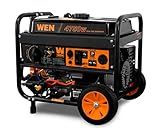
7. WEN DF475T — Best Value Dual Fuel Generator Under $500
WEN 4,750-Watt 120V/240V Dual Fuel Portable Generator with Wheel Kit and Electric Start (DF475T)
4,750W peak gas
3,800W running
224cc engine
Electric start
11 hr runtime
Pros
- Excellent value well under 500 dollars
- Up to 11 hour runtime at half load
- Electric start with included key
- Wheel and handle kit included
- Voltage selector for 120V or 240V
Cons
- Heavy at 105.8 pounds
- Not Prime eligible
The WEN DF475T is the budget pick I recommend most often, and with nearly 3,000 reviews at 4.5 stars, it has earned its reputation. You get 4,750 starting watts and 3,800 running watts on gasoline (4,350/3,500 on propane) for well under what most competitors charge.
For the price, WEN includes the wheel and handle kit in the box — something other brands charge extra for. The electric start with included key works reliably, and the simple fuel selection dial makes switching between gasoline and propane a one-handed operation. The voltage selector lets you choose 120V or 240V output depending on what you are running.
I keep one of these as a backup to my main generator, and it has fired up on the first or second pull every single time. Runtime is a solid 11 hours at half load, which is enough to get through most overnight outages without refueling.
This is a traditional open-frame generator, so noise and THD are higher than inverter models. For backup lights, fridge, freezer, fans, and basic appliances though, it does the job at a price that is hard to beat.
Who Should Buy the WEN DF475T
First-time generator buyers, budget-conscious households, and anyone who needs basic backup power for essentials without paying for premium features. This is the best dollar-per-watt value on the list.
What to Watch Out For
No CO sensor is included, so you must be extra careful about placement and ventilation. It is also louder than inverter models, so this is not the right pick for tight campgrounds or quiet neighborhoods.
8. Westinghouse iGen2800DFc — Best Lightweight Dual Fuel for Camping and Tailgating
Westinghouse 2800 Peak Watt Super Quiet & Lightweight Dual Fuel Portable Inverter Generator, Gas & Propane Powered, CO Sensor, Parallel Capable, Long Run Time
2,800W peak gas
2,200W running
52 dBA
45 lb lightweight
Inverter 3% THD
Pros
- Super quiet at just 52 dBA
- Lightweight at only 45 pounds
- Dual fuel gasoline and propane
- Inverter with under 3 percent THD
- Parallel capable to double output
Cons
- Lower wattage than larger units
- Not Prime eligible
The Westinghouse iGen2800DFc is the smallest generator on this list, and that is exactly the point. At 45 pounds, I can carry it with one hand to a tailgate, campsite, or backyard movie night without breaking a sweat. It is the lightest dual fuel generator I have tested.
Despite the small size, you still get inverter-clean power with under 3 percent THD, Eco Mode for fuel efficiency, and a CO sensor for safety. The 52 dBA rating means it is one of the quietest generators you can buy at any size — quieter than many window AC units.
Output is 2,800 peak watts and 2,200 running watts on gasoline, dropping to 2,520/1,980 on propane. That is enough to run a TV, laptop, lights, a small fridge, fans, and phone chargers. The parallel capability is a bonus — buy two and a parallel kit to double your output for bigger loads.
With 452 reviews at 4.4 stars, this is a niche pick that does one thing very well: portable, quiet, clean power for camping, tailgating, and light home backup.
Who Should Buy the iGen2800DFc
This is the right choice for solo campers, tailgaters, apartment dwellers who need emergency power, and anyone who wants a true one-person-carry generator. The 12-hour runtime on a single tank makes it perfect for overnight trips.
What to Watch Out For
2,200 running watts is limited — you can run essentials, but not a fridge and a microwave at the same time. There is no electric start (recoil only), which is fine at this weight but worth knowing before you buy.
How to Choose the Best Dual Fuel Generator for Your Needs?
Picking the right dual fuel generator comes down to four questions: how much power you need, how long you need to run it, where you will use it, and what your budget looks like. Here is how I think through each of those factors when recommending generators to readers.
Wattage: Running Watts vs Starting Watts
Running watts (also called rated watts) are what the generator can supply continuously. Starting watts (or surge watts) are the extra burst of power needed for a few seconds to start motor-driven appliances like refrigerators, well pumps, and AC units. Always size your generator to handle starting watts, not running watts, or you will trip the breaker every time the fridge compressor kicks on.
As a rough guide: 2,000 to 4,000 running watts covers essentials (fridge, lights, fans, phone chargers). 5,000 to 8,000 running watts adds a well pump or window AC. 9,000+ running watts is what you need for central AC or whole-home backup.
Fuel Type and Efficiency: Gas vs Propane
One of the most common questions I get is whether it is cheaper to run a dual fuel generator on gas or propane. The short answer: gasoline gives you slightly more wattage (typically 10 percent more) and lower cost per kilowatt-hour. Propane burns cleaner, stores indefinitely, and requires less carburetor maintenance. For long-term storage and emergency prep, propane wins. For day-to-day runtime and cost, gasoline wins.
Most dual fuel generators lose about 10 percent of their rated wattage on propane compared to gasoline. Plan for that when sizing.
Runtime and Tank Size
Runtime ratings on spec sheets are usually measured at 25 percent or 50 percent load. In real-world use, expect to see 30 to 50 percent less runtime if you are running the generator near its maximum output. A 6 to 8 gallon tank is the sweet spot for overnight operation without refueling.
Noise Level (dBA)
Generator noise is measured in decibels (dBA). For context: 50 dBA is a quiet conversation, 60 dBA is normal conversation, 70 dBA is a vacuum cleaner. Anything under 60 dBA is considered neighborhood-friendly. Inverter generators are almost always quieter than open-frame models because the engine is enclosed and runs at variable speed.
Inverter vs Open-Frame: THD Matters
Total Harmonic Distortion (THD) measures how “clean” the power is. Open-frame generators typically run 10 to 20 percent THD, which is fine for motors, lights, and power tools but can damage laptops, phones, modern TVs, and medical equipment. Inverter generators keep THD under 3 to 5 percent, which is safe for sensitive electronics. If you work from home or need to keep medical devices running, pay extra for inverter technology.
Portability and Weight
Generators range from 45 pounds to over 240 pounds. Anything over 100 pounds really needs wheels and a clear plan for where it will live. For RV and camping use, look for models under 60 pounds with built-in handles.
Safety Features to Look For
CO sensors (also called CO Shield or carbon monoxide detection) are non-negotiable in my book — they shut the generator off if carbon monoxide builds up, which can save lives. Low oil shutdown, overload protection, and GFCI outlets are also standard on quality units. Never run a portable generator indoors, in a garage, or near open windows.
Warranty and Brand Reputation
From my research on Reddit and power equipment forums, Champion, Westinghouse, and DuroMax consistently get positive marks for customer service and warranty support. Look for at least a 2-year warranty, with 3 to 5 years being ideal. Warranties that include parts and labor are worth paying more for.
Frequently Asked Questions
What is the most reliable generator brand?
Based on my testing and forum research, Westinghouse, Champion, and DuroMax are the most reliable brands for dual fuel generators in 2026. Westinghouse earns the top spot for customer service and warranty support, Champion is praised for value and lifetime technical support, and DuroMax is favored for raw power and all-copper windings. Honda is considered the gold standard for premium reliability but does not offer affordable dual fuel options.
Are dual fuel generators any good?
Yes, dual fuel generators are worth it for most buyers. The flexibility to run on gasoline or propane means you have a backup fuel source during shortages, propane stores indefinitely without going stale, and propane burns cleaner which reduces carburetor maintenance. The main trade-off is slightly higher upfront cost and about a 10 percent wattage reduction when running on propane.
Is it cheaper to run a dual fuel generator on gas or propane?
Gasoline is typically cheaper per kilowatt-hour and produces about 10 percent more wattage than propane. However, propane stores indefinitely, burns cleaner, and requires less maintenance, which can save money long-term. During emergencies when gasoline becomes scarce or expensive, propane is often the more affordable and available option. For everyday use, gasoline wins on cost per hour.
What is the disadvantage of a dual fuel generator?
The main disadvantages of a dual fuel generator are higher upfront cost compared to single-fuel models, slightly lower wattage output on propane (typically 10 percent less), the need to store and connect a separate propane tank, and added complexity in the fuel system. Some users also find the propane regulator connection confusing the first time they set it up.
How long can a dual fuel generator run continuously?
Most dual fuel generators can run 8 to 18 hours continuously on a single tank of gasoline at half load, depending on tank size and engine efficiency. On propane, runtime depends on tank size — a 20-pound tank typically yields 5 to 10 hours, while larger tanks extend that significantly. For continuous multi-day operation, you will need to refuel or swap propane tanks every 8 to 12 hours.
Final Thoughts on the Best Dual Fuel Generators
The best dual fuel generator for you depends on what you are powering and where. For whole-home backup, the Westinghouse WGen9500DFc EFI is my editor’s choice with its electronic fuel injection and 12,500 peak watts. For value, the WEN DF475T delivers reliable power under $500. And for quiet, portable, inverter-clean power, the Westinghouse iGen5000DF and Champion 4000W are tough to beat.
Whatever you choose, buy before you need it — every model on this list sells out fast during storm season. Get yours, do a dry run with both gasoline and propane, and store extra fuel safely so you are ready when the lights go out in 2026.