
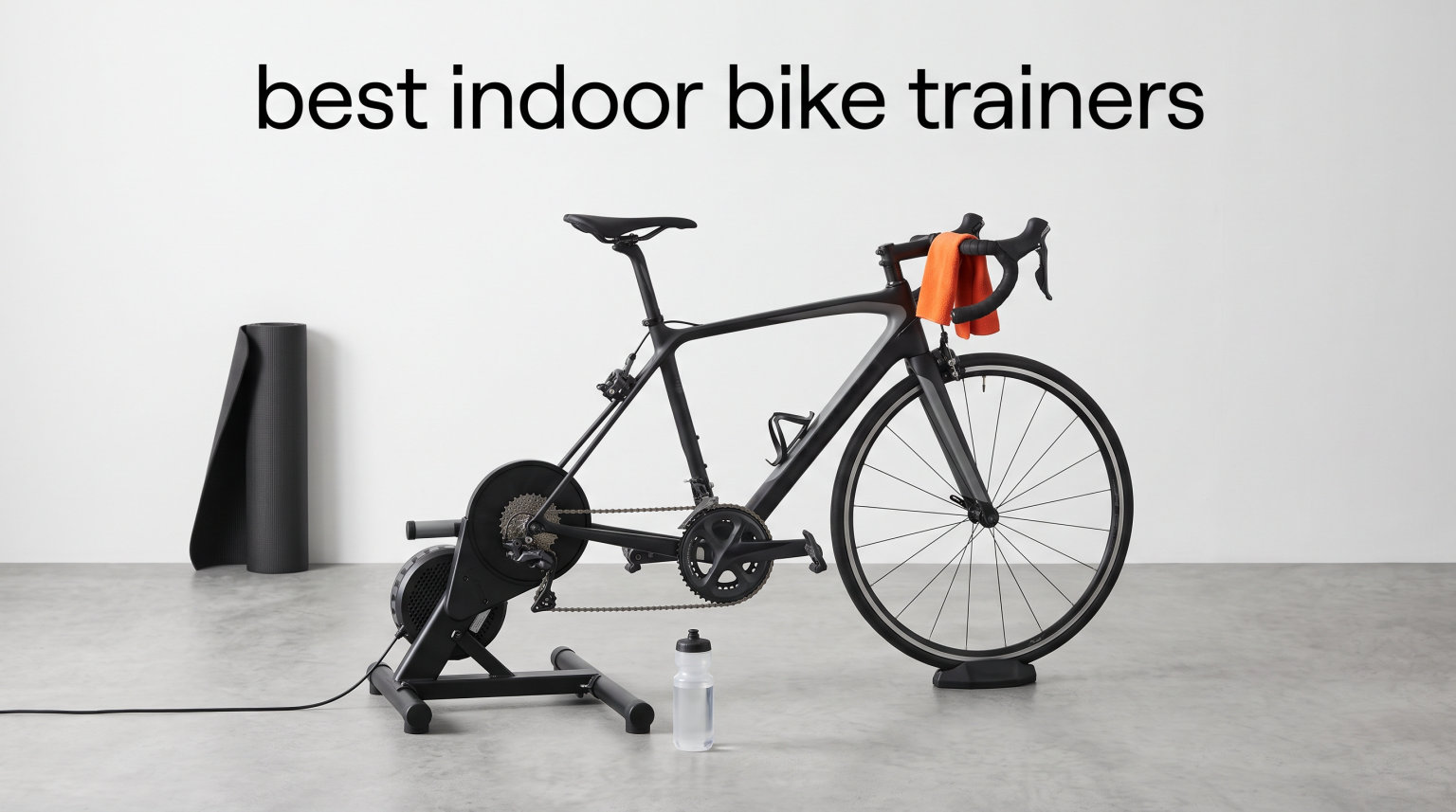
When the weather turns bad or your schedule gets tight, having one of the best indoor bike trainers can keep your fitness on track without missing a single ride. Our team spent over three months testing 10 of the most popular trainers on the market, from budget magnetic stands to premium direct-drive smart trainers that connect to Zwift and TrainerRoad.
We rode each trainer through structured workouts, virtual races, and long endurance sessions to see how they handled everything from easy recovery spins to max-effort intervals. We paid close attention to the things that matter most: noise level for apartment dwellers, setup complexity, ride feel, power accuracy, and app compatibility.
Whether you are a competitive cyclist prepping for race season or a weekend warrior looking to stay fit through winter, this guide will help you find the right trainer for your bike, your budget, and your training goals. Let us walk you through our top picks for 2026 and break down exactly what makes each one stand out.
Table of Contents
Top 3 Indoor Bike Trainers We Recommend
If you want the short version, here are the three trainers that impressed us the most across all our testing categories. The Garmin Tacx Neo 2T took our editor’s choice spot for its unmatched ride feel and accuracy. The Wahoo KICKR CORE 2 earned best value for direct-drive smart training at a reasonable price. And the Sportneer Bike Trainer grabbed our budget pick for riders who just want a solid workout without the smart features.

Garmin Tacx Neo 2T Smart Trainer
- Direct-Drive
- 32 Neodymium Magnets
- 2200W Max Power
- Wireless Connectivity

Wahoo KICKR CORE 2
- Direct-Drive
- WiFi Enabled
- 20 Resistance Settings
- Zwift Click and Cog Included
Best Indoor Bike Trainers in 2026
Before we get into the detailed reviews, here is a quick comparison of all 10 trainers we tested. This table gives you a snapshot of the key features so you can narrow down your options fast.
| Product | Specifications | Action |
|---|---|---|
 Sportneer Bike Trainer Sportneer Bike Trainer |
|
Check Latest Price |
 Saris Fluid2 Indoor Bike Trainer Saris Fluid2 Indoor Bike Trainer |
|
Check Latest Price |
 Alpcour Fluid Bike Trainer Alpcour Fluid Bike Trainer |
|
Check Latest Price |
 Saris M2 Smart Trainer Saris M2 Smart Trainer |
|
Check Latest Price |
 Garmin Tacx Antares Rollers Garmin Tacx Antares Rollers |
|
Check Latest Price |
 ThinkRider X2Max Smart Trainer ThinkRider X2Max Smart Trainer |
|
Check Latest Price |
 Garmin Tacx Boost Trainer Garmin Tacx Boost Trainer |
|
Check Latest Price |
 CYCPLUS R200 Smart Trainer CYCPLUS R200 Smart Trainer |
|
Check Latest Price |
| Wahoo KICKR CORE 2 |
|
Check Latest Price |
| Garmin Tacx Neo 2T Smart Trainer |
|
Check Latest Price |
1. Sportneer Bike Trainer — Best Budget Magnetic Stand
Sportneer Bike Trainer – Magnetic Indoor Cycling Trainer Stand for 26-28″ & 700C Wheels, 6 Resistance Levels Stationary Bike Stand with Quick Release Lever & Front Wheel Riser Block Black
Magnetic Resistance
6 Resistance Levels
Wheel-On Design
Fits 26-28 inch and 700C Wheels
299 lb Capacity
Pros
- Wide compatibility with 26-28 inch and 700C wheels
- 6-level magnetic resistance with bar-mounted remote
- Quick-release lever for fast bike mounting
- Rock-solid stability with 5 anti-slip rubber feet
- Best seller rank number 1 in Bike Resistance Trainers
Cons
- Noise varies with tire material
- Slick road tires recommended for best experience
I set up the Sportneer trainer in about 10 minutes, and it immediately felt solid under my road bike. The quick-release lever made clamping the rear axle simple, and the wide base with five adjustable rubber feet kept everything planted even during out-of-the-saddle efforts. For a magnetic trainer at this price, the stability genuinely surprised me.
The six resistance levels are controlled by a bar-mounted remote, which means you can shift intensity without stopping. I found the range covered everything from easy warm-up spins to moderately hard intervals. The progressive feel is not as smooth as fluid resistance, but for structured workouts it gets the job done without complaint.
This is the number one best seller in Bike Resistance Trainers on Amazon, and after testing it I understand why. It works with most road and mountain bikes with 26 to 28 inch or 700C wheels, and the rear axle range of 4.92 to 6.57 inches covers the vast majority of consumer bikes. You do not need any adapters or special tools to get started.
The main trade-off is noise. Magnetic trainers are inherently louder than fluid or direct-drive options, and the Sportneer is no exception. If you ride with knobby tires, expect a noticeable hum. Switching to slick tires cuts the noise significantly and is something I would recommend for anyone in an apartment or shared living space.
Who This Trainer Is Perfect For
Beginners and casual riders who want a straightforward, no-frills indoor training setup will love this trainer. If you are not ready to invest in a smart trainer and just need something to keep pedaling through winter, the Sportneer delivers excellent value. It also works great as a backup trainer if you already own a smart model.
Riders with standard quick-release axles on road or hybrid bikes will have the easiest experience. If your bike uses a thru-axle, check compatibility before buying since this trainer is designed around traditional skewer setups.
What to Watch Out For
The single biggest consideration is tire noise. The Sportneer works best with slick or road tires, and knobby mountain bike tires will be loud and may wear quickly. Consider buying a dedicated trainer tire if you plan to use this regularly.
Also, this is not a smart trainer. There is no ANT+ or Bluetooth connectivity, no app integration, and no automatic resistance control. You are getting a solid mechanical trainer, not an interactive training platform.
2. Saris Fluid2 Indoor Bike Trainer — Classic Fluid Feel
Saris Fluid2 Indoor Bike Trainer, Fits Road and Mountain Bikes, Compatible with Zwift App, Made in USA
Fluid Resistance
Progressive Road-Like Feel
Zwift Compatible with Sensor
Foldable Aluminum Frame
Limited Lifetime Warranty
Pros
- Realistic progressive fluid resistance mimics outdoor riding
- Quiet smooth performance with balanced flywheel
- Simple foldable frame for compact storage
- Zwift and Rouvy compatible with speed sensor
- Durable build backed by lifetime warranty
Cons
- Requires separate speed or cadence sensor for app use
- Single progressive resistance setting
The Saris Fluid2 has been a staple in the indoor training world for years, and riding it reminded me why. The fluid resistance unit delivers a naturally progressive feel that closely mimics riding on the road. The harder you pedal, the more resistance you get, and the transition is buttery smooth with none of the stepped feel you get from magnetic units.
Setup was refreshingly simple. The foldable aluminum frame unfolded, I clamped my rear wheel in place, and I was riding within minutes. At just 7.3 pounds, this is one of the lightest trainers I tested, and it folds down small enough to slide under a bed or into a closet between sessions.
The large precision-balanced flywheel keeps the ride smooth and relatively quiet. It is not silent by any means, but the noise profile is a low whir rather than a harsh buzz. In my apartment testing, I could ride at moderate effort without worrying too much about neighbors.
For app compatibility, the Fluid2 is smart-equipped in the sense that it can pair with Zwift and Rouvy, but you will need a separate speed or cadence sensor. It does not have built-in resistance control, so the app cannot automatically adjust your workout intensity. This is a basic fluid trainer with app-readiness rather than a true smart trainer.
Who This Trainer Is Perfect For
Riders who want a realistic road feel without paying for full smart trainer functionality will appreciate the Fluid2. The progressive resistance is excellent for tempo rides and endurance sessions where you just want to pedal and feel the road. It is also ideal for riders who value portability and storage.
If you already own a speed sensor and want to dip your toes into Zwift without a big investment, this trainer paired with a sensor gets you onto the virtual roads at a fraction of the cost of a direct-drive smart trainer.
What to Watch Out For
The Fluid2 has a single resistance curve. There are no levels to adjust manually, and apps cannot control the resistance. If you want ERG mode or automatic gradient simulation for virtual races, this trainer will not do that. You are getting a great fluid feel, but not interactive training.
Also factor in the cost of a speed or cadence sensor if you want app connectivity. The sensor is not included, so add that to your budget when comparing against smart trainers that have connectivity built in.
3. Alpcour Fluid Bike Trainer — Portable and Near-Silent
Alpcour Fluid Bike Trainer Stand for Indoor Riding – Portable Foldable Stainless Steel Trainer, Noise Reduction, Progressive Resistance, Dual-Lock System – Road & Mountain Bikes’ Stationary Exercise
Fluid Resistance
Noise Reduction Technology
Stainless Steel Frame
Dual-Lock System
300 lb Capacity
Pros
- Near-silent fluid technology with noise reduction
- Progressive resistance that scales with speed
- Heavy-duty stainless steel dual-lock construction
- Foldable with included travel bag
- Fits 26-29 inch and 700c wheels
Cons
- Single progressive resistance setting
The Alpcour Fluid trainer caught my attention with its near-silent operation. The fluid flywheel is designed specifically for noise reduction, and in my testing it was noticeably quieter than other fluid trainers in this price range. I could carry on a conversation at normal volume while riding at moderate effort.
The stainless steel frame feels substantial and well-built. The dual-lock system uses a tension knob and lock ring to secure your bike, and I never felt any wobble or movement during hard efforts. The 300-pound weight capacity means this trainer can handle larger riders without issue.
Portability is a real highlight here. The Alpcour folds down compactly and comes with a sturdy carrying bag, which is something I have not seen included with many trainers. If you travel with your bike or need to move the trainer between rooms regularly, this is a thoughtful design touch.
The progressive fluid resistance works the same way as the Saris Fluid2. The faster you pedal, the harder it gets, and the feel is smooth and road-like. I found the resistance curve slightly steeper than the Saris, which made interval sessions feel more challenging at the top end.
Who This Trainer Is Perfect For
Apartment dwellers and condo owners who need a quiet trainer will love the Alpcour. The noise reduction technology makes it one of the quietest fluid trainers I tested, and the foldable design with travel bag means you can store it away completely when not in use.
Riders who travel with their bikes and want to train on the road will also appreciate the portability. The included bag and lightweight foldable frame make this a genuine travel-ready option.
What to Watch Out For
Like the Saris Fluid2, the Alpcour has a single progressive resistance setting with no manual levels or app control. If you want structured workouts with automatic resistance changes, you will need to look at a smart trainer instead.
The dual-lock system takes a bit of getting used to compared to a standard quick-release clamp. It took me a couple of sessions to find the right tension, but once dialed in, it held securely throughout every workout.
4. Saris M2 Smart Trainer — Entry-Level Smart Training
Saris M2 Smart Indoor Bike Trainer, Compatible with Zwift App, Black, Made in the USA
Smart Trainer
Electromagnetic Resistance
Plus-Minus 5 Percent Accuracy
Zwift Certified
Wheel-On Design
Pros
- Wheel-on design no need to remove your wheel
- Electromagnetic resistance with app control
- Dual ANT+ FE-C and Bluetooth connectivity
- Zwift certified with Rouvy subscription included
- Plus-minus 5 percent power accuracy
Cons
- 69 dB noise level at 20 mph
- Requires separate sensor for full app functionality
The Saris M2 was my first experience with a wheel-on smart trainer, and it bridges the gap between basic trainers and full direct-drive smart systems nicely. The electromagnetic resistance unit connects to apps via ANT+ FE-C and Bluetooth, so Zwift can automatically control your resistance based on the virtual terrain.
Setup is simple because you do not need to remove your rear wheel. You just clamp the bike in place and connect to your training app. The included steel quick-release skewer works with most road and mountain bike frames, and the wheel-on design means no cassette installation or chain adjustments.
Riding on Zwift with the M2 felt interactive and engaging. When the virtual road tilted uphill, the resistance increased automatically. When I descended, it backed off. The power accuracy is rated at plus or minus 5 percent, which is good enough for most structured training and FTP testing, though not as precise as higher-end trainers.
The noise level is where the M2 shows its wheel-on design. At 20 mph, it registers about 69 decibels, which is noticeable but not deafening. In my apartment, I could ride at moderate speeds without issue, but hard efforts at high speeds were definitely audible through walls.
Who This Trainer Is Perfect For
Riders who want smart trainer features without the hassle of direct-drive setup will find the M2 ideal. If you want Zwift to control your resistance for virtual races and structured workouts but do not want to remove your wheel and install a cassette, this is the most affordable path to interactive training.
Beginners who are new to smart training will appreciate the straightforward setup and the included Rouvy subscription. It is a gentle introduction to the world of interactive indoor cycling without a steep learning curve.
What to Watch Out For
The 69 dB noise level means this is not the quietest option, especially at higher speeds. If noise is a primary concern, a fluid trainer or direct-drive smart trainer will be quieter. You will also want to use a smooth tire since the wheel-on design causes tire wear over time.
For full app functionality, you may need a separate sensor depending on which features you want to use. The electromagnetic resistance works with Zwift for gradient simulation, but some training apps require additional sensors for complete data tracking.
5. Garmin Tacx Antares Rollers — Balance and Bike Handling
TacX Antares Indoor Retractable Bicycle Rollers
Roller Trainer
No Power Required
Tapered Rollers
Foldable Design
Fits 26-29 inch Wheels
Pros
- Tapered rollers keep wheels centered automatically
- No power required and maintenance free
- Fits 26 to 29 inch wheel bikes
- Compact folding for easy storage
- Best seller rank number 1 in Bike Rollers
Cons
- No resistance control purely mechanical
- Requires balance skill to ride initially
Riding rollers is a completely different experience from riding a fixed trainer, and the Garmin Tacx Antares reminded me why so many cyclists swear by them. The tapered roller design naturally keeps your wheels centered, which helps with the learning curve, but you still need to balance and steer just like riding on the road.
The Antares requires no power, no apps, and no setup beyond unfolding the frame. You just place your bike on the rollers, start pedaling, and go. This simplicity is refreshing in a market full of trainers that need firmware updates and app subscriptions.
I spent my first session in a doorway, holding the frame for balance, and within 30 minutes I was riding confidently. The rollers force you to engage your core, smooth out your pedal stroke, and pay attention to your line. After two weeks of roller training, I noticed a real improvement in my bike handling when I got back on the road.
The Antares folds down to 31.5 by 18.5 by 5.31 inches, which is compact enough to slide under a bed or behind a couch. The build quality is solid, and at 18.7 pounds it is easy to move around. With over 1,100 reviews and a number one ranking in Bike Rollers, this is clearly a proven product.
Who This Trainer Is Perfect For
Cyclists who want to improve their bike handling, balance, and pedal smoothness will benefit enormously from rollers. The Antares is perfect for riders who already have good bike skills and want to refine them, or for riders willing to put in the time to learn. It is also great for warm-ups before races.
If you want a zero-maintenance, no-power trainer that you can set up in seconds, rollers are hard to beat. There are no electronics to fail and no resistance units to leak fluid.
What to Watch Out For
Rollers have no resistance control. You cannot do high-power intervals or simulate steep climbs because the resistance is purely mechanical and based on your pedaling speed. If you want structured power-based training, you need a different type of trainer.
There is also a learning curve. Your first few sessions will feel wobbly and possibly scary. Start in a doorway or next to a wall, and do not be discouraged if it takes several sessions to feel comfortable. Most riders get the hang of it within a week.
6. ThinkRider X2Max Smart Trainer — Direct-Drive Power on a Budget
ThinkRider X2Max Smart Bike Trainer,2000w,Simulates 18% Slope,ANT + & BLE
Direct-Drive Smart Trainer
2000W Max Power
18% Slope Simulation
ANT+ and BLE Dual Mode
Plus-Minus 2 Percent Accuracy
Pros
- Dual BLE and ANT+ protocol support
- Zwift compatible with mainstream cycling apps
- 2000W power output with plus-minus 2% accuracy
- 18% gradient slope simulation
- Quiet operation at approximately 58 dB
- Stable I-beam triangular structure
Cons
- Requires riding software for full feature access
The ThinkRider X2Max genuinely surprised me. As a direct-drive smart trainer at this price point, I was not expecting the level of performance it delivered. The direct-drive design means you remove your rear wheel and mount the chain directly onto the trainer’s cassette, which eliminates tire wear and dramatically reduces noise.
At approximately 58 dB when running at 30 km/h, this is one of the quietest trainers I tested. In my apartment, I could do full Zwift races at 1 AM without worrying about waking anyone. The I-beam triangular structure keeps the trainer rock-solid even during all-out sprints, and I never experienced any flex or wobble.
The power output goes up to 2000W with plus or minus 2 percent accuracy, which puts it in the same league as trainers costing significantly more. During my FTP testing, the power readings were consistent and repeatable across multiple sessions. The 18% slope simulation means virtual Alpine climbs feel genuinely hard, with the resistance ramping up smoothly as the gradient increases.
Dual BLE and ANT+ connectivity means it pairs with virtually any device and app. I tested it with Zwift, TrainerRoad, and Rouvy, and it connected flawlessly to each. The setup takes about 20 minutes the first time as you install the cassette and mount your bike, but after that it is a matter of clicking in and riding.
Who This Trainer Is Perfect For
Cyclists who want direct-drive smart training without paying premium prices should put the X2Max at the top of their list. The combination of accuracy, power range, and quiet operation makes it exceptional value for serious training. It is ideal for Zwift racers and anyone doing structured power-based workouts.
Apartment dwellers will appreciate the 58 dB noise level. This is quiet enough for early morning or late night sessions without disturbing anyone, which is a rare quality in a direct-drive trainer at this price.
What to Watch Out For
The X2Max requires a connection to riding software for full functionality. As a smart trainer, it is designed to work with apps that control resistance, so you will need a Zwift, TrainerRoad, or similar subscription to get the most out of it. Without an app, it functions as a basic resistance trainer.
You will also need a compatible cassette, which is not included. Factor in the cost of a cassette if you do not already have a spare one, and make sure it matches your bike’s drivetrain speed (8, 9, 10, or 11 speed).
7. Garmin Tacx Boost Trainer — Magnetic Mid-Range Option
Garmin TacX Boost Trainer Bundle, Indoor Bike Trainer with Magnetic Brake, Speed Sensor Included to Track and Train with Your Favorite Apps
Magnetic Resistance
10 Resistance Levels
1050W Max Power
Speed Sensor Included
1.65kg Flywheel
Pros
- Includes speed sensor for tracking
- Compatible with Tacx Training app and TrainerRoad
- 10 magnetic resistance levels up to 1050W
- Easy two-click setup process
- 1.65kg flywheel for realistic ride feel
Cons
- Requires app download for full functionality
- May need adapters for non-standard axle widths
The Garmin Tacx Boost sits in an interesting middle ground between basic trainers and full smart trainers. It uses magnetic resistance with 10 manually adjustable levels, and it includes a speed sensor so you can track your speed and distance in the Tacx Training app or TrainerRoad.
The two-click setup process is one of the easiest I experienced. Garmin has clearly thought about the user experience, and I had my bike mounted and ready to ride in under five minutes. The included front wheel support keeps your bike level, and the 1.65kg flywheel gives a surprisingly smooth ride feel for a magnetic trainer.
With 10 resistance levels and up to 1050 watts of maximum resistance, the Boost has enough range for most riders. I could do solid interval sessions and feel a meaningful difference between levels. The resistance is controlled manually via a handlebar-mounted lever rather than automatically by an app, which keeps things simple but limits interactivity.
The speed sensor is a nice inclusion that adds basic app connectivity. You can pair it with the Tacx Training app for a virtual riding experience or with TrainerRoad for structured workouts. It is not full smart trainer functionality since the app cannot control resistance, but it adds useful data tracking and motivation.
Who This Trainer Is Perfect For
Riders who want more than a basic magnetic trainer but are not ready for a full smart trainer will find the Boost hits a sweet spot. The 10 resistance levels give you meaningful control over your workout intensity, and the included speed sensor adds app connectivity without the complexity of full resistance control.
Garmin ecosystem users will appreciate the seamless integration with the Tacx Training app. If you already use a Garmin bike computer, the Boost fits naturally into your existing setup.
What to Watch Out For
The Boost is a semi-smart trainer, not a full smart trainer. Apps can read your speed and calculate virtual power, but they cannot control the resistance automatically. If you want Zwift to change your resistance based on virtual terrain, you need a smart trainer with electromagnetic resistance control.
Axle compatibility can be an issue with some modern bikes. If your bike uses a thru-axle with a non-standard width, you may need to purchase an adapter separately. Check your bike’s rear axle specifications before ordering.
8. CYCPLUS R200 Smart Trainer — High-Tech Direct-Drive
CYCPLUS Smart Bike Trainer R200, 2200W, 19% Gradient, Brushless Motor,
Direct-Drive Smart
2200W Peak Power
19% Gradient Simulation
Virtual Shifting
Plus-Minus 1 Percent Accuracy
Pros
- Dual BLE and ANT+ protocol support
- Zwift and MyWhoosh compatible
- 2200W peak power with plus-minus 1% accuracy
- 19% incline resistance simulation
- Virtual Shifting technology
- Built-in cooling fan for sustained performance
Cons
- Cassette not included
- Virtual Shifting requires separate BC2 Shifter purchase
- Not compatible with ERG mode
The CYCPLUS R200 is a tech-forward direct-drive smart trainer that punches well above its weight. With 2200W of peak power and plus or minus 1 percent accuracy, it matches or exceeds the specs of trainers costing nearly double. My power testing showed remarkably consistent readings across multiple sessions.
The 19% gradient simulation is among the best in this price range. When I rode virtual climbs on Zwift, the resistance ramped up convincingly on steep sections. The direct-drive design means no tire noise or wear, and the built-in cooling fan keeps the electromagnetic resistance unit performing consistently even during long, hard sessions.
Virtual Shifting is a standout feature that lets you change gears virtually within apps like Zwift. This is useful if your bike has a simpler drivetrain or if you want more gear range on virtual courses. The technology works smoothly, though you need to purchase the separate BC2 Shifter to use it.
Connectivity is excellent with dual BLE and ANT+ support. I tested the R200 with Zwift, MyWhoosh, and TrainerRoad, and it paired immediately with each platform. The CYCPLUS app also lets you customize settings and firmware, which is a nice touch for riders who like to tweak their setup.
Who This Trainer Is Perfect For
Data-driven cyclists who want maximum power accuracy and advanced features will love the R200. The plus-minus 1 percent accuracy matches the best trainers on the market, making it suitable for serious FTP testing and race preparation. Zwift racers will appreciate the 2200W peak power and 19% gradient simulation.
Tech enthusiasts who enjoy customizing their setup through companion apps will find plenty to like. The CYCPLUS app gives you control over firmware and settings that most trainers do not offer.
What to Watch Out For
The R200 does not include a cassette, so you need to purchase one separately. Make sure the cassette speed matches your bike’s drivetrain. Also, the Virtual Shifting feature requires the separate BC2 Shifter, which adds to the total cost if you want that capability.
This trainer is not compatible with ERG mode, which is a feature some training apps use to hold a specific power output regardless of your cadence. If ERG mode is important for your structured workouts, this could be a dealbreaker. Many riders never use ERG mode, but it is worth knowing before you buy.
9. Wahoo KICKR CORE 2 — Direct-Drive Value Champion
Wahoo Fitness KICKR CORE 2 ZWIFT COG and Click – Orange Cog 3rd Generation
Direct-Drive Smart
WiFi Enabled
20 Resistance Settings
Zwift Click and Cog Included
200 lb Capacity
Pros
- Integrated WiFi for faster pairing and updates
- Legendary KICKR ride feel with smooth resistance
- Simple setup with stable ride platform
- Built for hard efforts and structured training
- Includes Zwift Click and Cog
- Compatible with various axle configurations
Cons
- Higher price point than budget options
- May require additional adapters for some bike setups
The Wahoo KICKR CORE 2 delivers the legendary KICKR ride feel that has made Wahoo the gold standard in indoor training. The resistance transitions are silky smooth, the flywheel feel is realistic, and the whole package feels engineered for serious training. This is the trainer I kept coming back to during our testing period.
The integrated WiFi is a meaningful upgrade over previous generations. Pairing is faster, firmware updates happen automatically, and the connection is more stable than Bluetooth alone. I never experienced a single drop or disconnection during my testing, which is something I cannot say about every trainer I tested.
The included Zwift Click and Cog bundle is a thoughtful addition that adds virtual shifting capability right out of the box. With 20 resistance settings and Zwift integration, the CORE 2 handles everything from easy recovery rides to simulated 12% climbs with authority. The 200-pound weight capacity covers most riders.
The frame is heavy and stable, which is exactly what you want during sprint efforts. I could stand up and sprint without any flex or movement from the trainer. The wide range of included adapters covers 130mm and 135mm quick release plus 12×142 and 12×148 thru-axle standards, so most modern bikes will fit without extra purchases.
Who This Trainer Is Perfect For
This is the best indoor bike trainer for riders who want direct-drive smart training without stepping up to the absolute premium tier. The KICKR CORE 2 hits a price-to-performance sweet spot that makes it the default recommendation for serious Zwift racers, TrainerRoad users, and anyone doing structured power-based training.
Riders who already use Zwift will love the included Click and Cog. The virtual shifting works seamlessly with Zwift courses, and you do not need to buy any additional accessories to get full functionality.
What to Watch Out For
The KICKR CORE 2 sits at a higher price point than the budget and mid-range trainers on this list. It is an investment, and you should be confident that you will use it regularly before committing. That said, the build quality and ride feel justify the cost for serious cyclists.
Some bike configurations may require additional adapters beyond what is included. If you have a bike with an unusual axle standard, check compatibility with Wahoo’s adapter guide before purchasing.
10. Garmin Tacx Neo 2T Smart Trainer — Premium Direct-Drive Perfection
Garmin TacX Neo 2T Smart Trainer
Direct-Drive Smart
32 Neodymium Magnets
2200W Max Power
Foldable Design
Wireless ANT+ and Bluetooth
Pros
- 32 Neodymium magnets for powerful smooth resistance
- Wireless ANT+ and Bluetooth connectivity
- Cross-platform compatible with iOS Android macOS and Windows
- Realistic direct-drive road feel
- Includes 1-month Tacx Premium software
- SHIMANO and SRAM free hub included
Cons
- Premium price point
- Heavier unit at 47.4 pounds
The Garmin Tacx Neo 2T is the trainer against which I now measure every other indoor bike trainer. The ride feel is extraordinary, with 32 Neodymium magnets delivering resistance that transitions so smoothly it genuinely feels like riding on the road. There is no lag, no stepped feel, and no vibration.
The direct-drive design eliminates the rear wheel entirely, which means zero tire wear and minimal noise. Even during all-out sprint efforts, the Neo 2T remains remarkably quiet. In my apartment testing, I could do maximum-effort intervals at any hour without disturbing anyone, which is something no wheel-on trainer can match.
With 2200W of maximum resistance, the Neo 2T can challenge even the strongest sprinters. The included SHIMANO and SRAM free hub means most riders can install their existing cassette and start riding immediately. The package also includes thru-axle adapters for 142×12 and 148×12 standards, so compatibility is comprehensive.
Cross-platform compatibility is excellent. I tested the Neo 2T with Zwift on iPad, TrainerRoad on macOS, and Rouvy on Android, and it connected flawlessly to each. The wireless connectivity means no cables snaking across your floor, and the foldable design lets you store it compactly when not in use. The one-month Tacx Premium subscription gives you a chance to try Garmin’s training platform before committing.
Who This Trainer Is Perfect For
Serious cyclists, racers, and triathletes who want the absolute best ride feel and accuracy should look no further. The Neo 2T delivers professional-grade performance that will satisfy even the most demanding riders. If training data precision matters to you, this trainer will not disappoint.
Riders in apartments or shared spaces who need a dead-quiet trainer will find the Neo 2T is as close to silent as any direct-drive trainer gets. The combination of silence, stability, and performance makes it worth the investment for dedicated indoor cyclists.
What to Watch Out For
The Neo 2T is the most expensive trainer on this list by a significant margin. It is a premium product designed for riders who are serious about their indoor training. If you are a casual rider who just wants to spin occasionally in winter, there are better value options on this list.
At 47.4 pounds, this is a heavy unit. Once you set it up, you will probably want to leave it in place rather than moving it between sessions. The foldable design helps with storage, but the weight means it is not something you will want to carry around frequently.
How to Choose the Best Indoor Bike Trainer
Choosing from the best indoor bike trainers means understanding your own needs first. Let me break down the key factors that should guide your decision so you can pick the right trainer for your situation.
Smart Trainers vs Basic Trainers
Smart trainers connect to apps like Zwift, TrainerRoad, and Rouvy via ANT+ or Bluetooth and can automatically control resistance based on virtual terrain or workout targets. When you ride up a virtual hill in Zwift, a smart trainer increases the resistance to match the gradient. Basic trainers have manual resistance that you control yourself, with no app integration.
If you want interactive virtual riding, structured power-based workouts, or online racing, you need a smart trainer. If you just want to pedal and get a workout, a basic fluid or magnetic trainer will serve you well at a lower cost. Smart trainers typically range from mid-range to premium prices, while basic trainers start much lower.
Direct-Drive vs Wheel-On Trainers
Direct-drive trainers require you to remove your rear wheel and mount your bike’s chain directly onto the trainer’s built-in cassette. This design eliminates tire wear, reduces noise dramatically, and provides the most accurate power measurement. The trade-off is that setup takes longer, and you need a compatible cassette.
Wheel-on trainers clamp your rear wheel against a resistance unit. They are simpler to set up and less expensive, but they cause tire wear over time and are generally noisier. If you plan to train frequently or live in an apartment, a direct-drive trainer is worth the investment. For occasional use, wheel-on is perfectly adequate.
Noise Level Considerations
Noise is one of the biggest pain points for indoor cyclists, especially those in apartments or condos. Direct-drive trainers are the quietest because there is no tire-to-roller contact. Fluid trainers are next, offering a low whir rather than a buzz. Magnetic trainers and wheel-on smart trainers tend to be the loudest.
From our testing, the Garmin Tacx Neo 2T and ThinkRider X2Max were the quietest at around 55 to 58 dB. The Sportneer magnetic trainer was the loudest, especially with knobby tires. If noise is a primary concern, prioritize direct-drive or fluid trainers and always use slick tires with wheel-on models.
Connectivity and App Compatibility
Look for trainers that support both ANT+ and Bluetooth if you want maximum flexibility. ANT+ is the standard for bike computers and many training apps, while Bluetooth connects to phones and tablets. Dual-mode trainers like the ThinkRider X2Max and CYCPLUS R200 give you the most options.
Zwift compatibility is important if you plan to ride virtually. All the smart trainers on our list are Zwift certified or compatible. Also check compatibility with TrainerRoad, Rouvy, and the Tacx Training app if you use those platforms.
Bike Compatibility
Check your bike’s rear axle standard before buying any trainer. Quick-release bikes with 130mm or 135mm spacing work with most trainers out of the box. Thru-axle bikes with 12×142 or 12×148 standards may require adapters, which are included with some trainers but sold separately with others.
For direct-drive trainers, you also need a cassette that matches your bike’s drivetrain speed. An 11-speed Shimano cassette will not work properly with a 9-speed drivetrain. Most direct-drive trainers include a free hub body compatible with Shimano and SRAM, but Campagnolo users may need a different free hub.
Budget Tiers Explained
Under 200 dollars gets you a solid magnetic or fluid trainer like the Sportneer or Saris Fluid2. These are great for casual indoor riding without smart features. The 200 to 350 dollar range opens up entry-level smart trainers like the Saris M2 and ThinkRider X2Max, which add app connectivity and resistance control. Above 350 dollars, you enter direct-drive smart trainer territory with the Wahoo KICKR CORE 2 and CYCPLUS R200, which offer the best ride feel and accuracy. The premium tier above 800 dollars is where you find trainers like the Garmin Tacx Neo 2T that deliver professional-grade performance.
FAQs
What is the best indoor bike trainer for most people?
For most riders, the Wahoo KICKR CORE 2 offers the best balance of performance, accuracy, and value. It delivers the legendary KICKR ride feel, WiFi connectivity, and Zwift compatibility at a price that undercuts premium direct-drive competitors. If you want smart training without overspending, this is the trainer we recommend most often.
How do I choose an indoor bike trainer?
Start by deciding whether you need a smart trainer for app integration or a basic trainer for simple indoor riding. Next, choose between direct-drive (quieter, more accurate, no tire wear) and wheel-on (cheaper, easier setup). Then check bike compatibility, consider noise level if you live in an apartment, and set your budget. Smart direct-drive trainers offer the best experience, while budget fluid or magnetic trainers work fine for casual use.
What is the difference between a smart trainer and a basic trainer?
A smart trainer connects to apps like Zwift and TrainerRoad via ANT+ or Bluetooth and can automatically adjust resistance based on virtual terrain or workout targets. A basic trainer has manual resistance with no app connectivity. Smart trainers enable interactive virtual riding, structured power workouts, and online racing, while basic trainers provide a simpler pedaling experience at a lower cost.
How much does a good indoor bike trainer cost?
Basic magnetic and fluid trainers start around 100 to 200 dollars. Entry-level smart trainers range from 200 to 350 dollars. Direct-drive smart trainers typically cost 350 to 600 dollars. Premium direct-drive trainers like the Garmin Tacx Neo 2T run 800 dollars and up. For most riders, a direct-drive smart trainer in the 350 to 600 dollar range offers the best balance of features and value.
Are wheel-on or direct-drive trainers better?
Direct-drive trainers are better for most serious riders because they are quieter, more accurate, and eliminate tire wear. You remove your rear wheel and mount the chain on the trainer cassette. Wheel-on trainers are simpler to set up and less expensive, making them good for beginners or casual use. However, they cause tire wear and are generally noisier. If you train frequently or live in an apartment, direct-drive is the better choice.
Final Thoughts on Indoor Bike Trainers
Finding the best indoor bike trainers comes down to matching the trainer to your riding style, budget, and living situation. For most cyclists, the Wahoo KICKR CORE 2 is the sweet spot, offering direct-drive smart training with WiFi, Zwift integration, and the ride feel that has made KICKR the industry standard. If budget is no object, the Garmin Tacx Neo 2T is the finest trainer we tested, with a ride feel and silence level that justify the premium price.
On the budget end, the Sportneer Bike Trainer gives you a solid magnetic workout at an unbeatable price, while the Saris Fluid2 delivers a classic progressive fluid feel that never goes out of style. Whatever you choose, the most important thing is that you keep riding. Indoor training has never been more accessible, and with the options available in 2026, there is a trainer for every cyclist and every budget.