
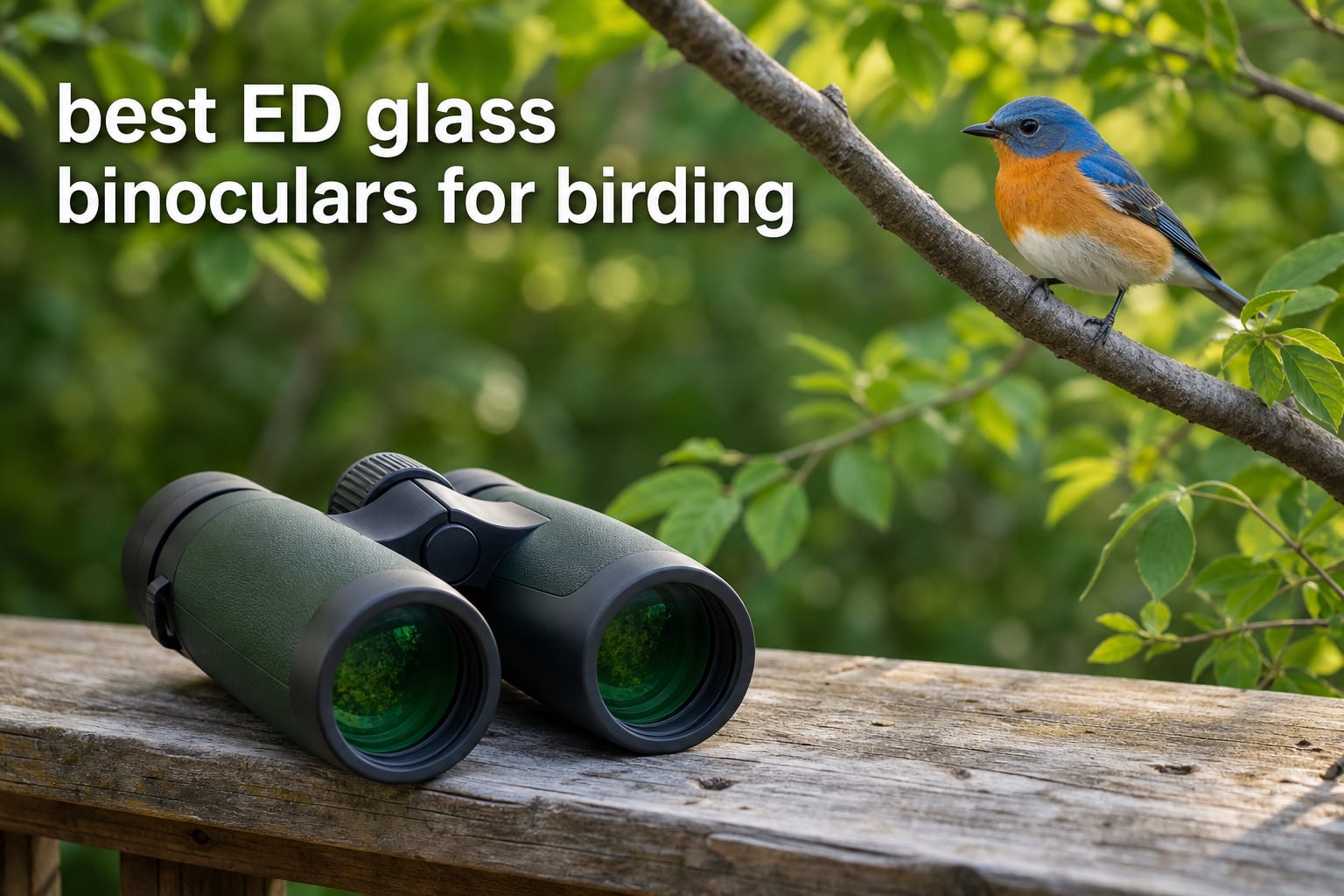
The best ED glass binoculars for birding pair extra-low-dispersion glass with a magnification you can hold steadily, a field of view wide enough to find a moving bird, and an eyepiece fit you can use for hours. For most people, that points toward an 8×42 format; in this group, the ZEISS Terra ED 8×42 stands out for its stated 88% light transmission, 16mm eye relief, waterproof body, and 25.6-ounce weight.
ED glass does one important job: it reduces chromatic aberration, the colored fringe that can show around a dark bird against a bright sky or on fine light-and-dark feather edges. It does not make every pair equally sharp, so I compare the whole specification set: coatings, prism design, field of view, eye relief, stated close focus, body weight, and weather sealing.
I reviewed all eight supplied models rather than filling this list with familiar names that were not in the product data. If wet, cold outings are part of your routine, our guide to cold weather hunting binoculars adds a useful perspective on carrying optics through rough conditions.
One practical note before choosing: forum discussions from birders repeatedly warn that more magnification can make handheld viewing shakier, while a narrow field makes a quick bird harder to acquire. That is why the 8×42 models lead this list, while the 10x, 12x, compact 6x, and 7×50 options have more specialized jobs.
Table of Contents
The top 3 picks answer most birding needs
The ZEISS is my all-weather 8×42 choice, the SVBONY combines an unusually wide listed view with 17.2mm eye relief, and the OLIMT is the lightest compact option here. Each has ED glass, but they suit very different ways of birding.
The best ED glass binoculars for birding in 2026 cover eight distinct formats
This quick overview makes the meaningful differences easier to scan. An 8×42 has a 5.25mm exit pupil by simple division, which is a forgiving handheld format; a 10×42 shows a more enlarged image but asks for steadier hands, and the large 50mm models bring more glass and more carry weight.
| Product | Specifications | Action |
|---|---|---|
 ZEISS Terra ED 8×42 ZEISS Terra ED 8×42 |
|
Check Latest Price |
 SVBONY SV202 8×42 SVBONY SV202 8×42 |
|
Check Latest Price |
 PEIKETAO ED HD 10×42 PEIKETAO ED HD 10×42 |
|
Check Latest Price |
 OLIMT 6×25 ED OLIMT 6×25 ED |
|
Check Latest Price |
 Sogries 12×50 ED Sogries 12×50 ED |
|
Check Latest Price |
 welspo 10×42 ED welspo 10×42 ED |
|
Check Latest Price |
 Three Triping 10×42 ED Three Triping 10×42 ED |
|
Check Latest Price |
 Celestron SkyMaster Pro ED 7×50 Celestron SkyMaster Pro ED 7×50 |
|
Check Latest Price |
Do not read the table as a claim that one number wins every time. Field of view may be reported in degrees, feet, or metres, and a wider number is helpful for locating birds, but focus speed, fit, glare control, and the way your hands hold the body matter in the field too.
1. ZEISS Terra ED 8×42 is the best all-weather 8×42 choice
ZEISS Terra ED Binoculars 8×42 Waterproof, and Fast Focusing with Coated Glass for Optimal Clarity in All Weather Conditions for Bird Watching, Hunting, Sightseeing, Black-Green (Black-Green)
8x42
88% light transmission
16mm eye relief
25.6 oz
Pros
- Schmidt-Pechan ED glass
- 88% stated light transmission
- Hydrophobic coating
- Fast focus wheel
Cons
- Only 12 listed reviews
- No close-focus distance stated
I would start with the Terra ED when a single full-size pair needs to cover woodland paths, open reserves, and changing weather. Its 8×42 configuration is the least demanding format in this group for following a bird from branch to branch, and the listing gives it a 5.25mm exit pupil, 16mm eye relief, and a 25.6-ounce weight.
The product specification names Schmidt-Pechan ED glass, an anti-reflective hydrophobic multi-coating, and 88% light transmission. Those are meaningful details for bird watching because color edges, contrast, and a clear front lens are more useful than a vague claim of high power.
There are only 12 listed reviews, although the supplied rating is 5.0 out of 5. I treat that small review base as a reason to weigh the published optical and handling specifications closely rather than treating the rating alone as proof of long-term performance.
The 8×42 layout is the right starting point for active birding
Eight-power magnification gives enough reach for common birding distances without the same hand-shake penalty as a 10x or 12x pair. The 42mm objectives also provide the larger 5.25mm exit pupil stated for this model, so eye placement tends to be less finicky than on a small compact binocular.
The listed 6.5-degree field of view is not the widest in this roundup, yet it should still be practical for scanning a tree line. I would prioritize it for a birder who wants a familiar full-size shape and a fast center-focus wheel rather than the smallest possible body.
The weather-ready coating makes this pair suited to exposed trails
The fiberglass-reinforced casing is specified as waterproof, and ZEISS calls out a hydrophobic multi-layer coating. In plain terms, that combination is aimed at rain, damp grass, and the smudges or droplets that can interrupt a view during a long outing.
Close-focus distance is not provided in the supplied specifications, so I would not select it specifically for feeder birds at very short range, butterflies, or dragonflies. Glasses wearers should also check their personal fit; 16mm is the listed eye relief, but face shape and eyecup position decide whether the full view is visible.
2. SVBONY SV202 8×42 is the best wide-view option for new birders
SVBONY Upgraded SV202 8×42 Binoculars for Adults, ED Binoculars for Bird Watching with Extra-Low Dispersion Objective Lens, BAK4 & FMC Optic System, 8°+Wide View Angle, IPX7 Waterproof for Cruise Ship
8x42 ED
8.12 degree view
17.2mm relief
IPX7
Pros
- Wide 8.12 degree view
- 17.2mm eye relief
- IPX7 waterproof
- Lifetime warranty
Cons
- 694g listed weight
- Some reports of color fringing
The SVBONY SV202 puts the beginner-friendly 8×42 configuration beside an 8.12-degree stated field of view. That wide view is its strongest paper advantage: when a warbler moves through cover, the first task is finding it, and a wider window gives you more room to do that.
Its extra-low-dispersion objective lens, BAK4 roof-prism system, fully multi-coated optics, and phase-correction technology are all specified by the manufacturer. The listing also calls out internal light masking, a useful design choice intended to suppress stray light that can reduce contrast.
I also like that the data is unusually clear on eyeglass-related fit: eye relief is listed at 17.2mm and the body has adjustable rotating eyecups. It has a 4.7 rating across 41 reviews, which is a larger feedback sample than the ZEISS listing but still modest enough that I would base the decision on fit and intended use first.
The extra-wide view is best when birds refuse to stay still
An 8.12-degree view is wider than the other full-size 8×42 model in this list. It is especially appealing for backyard watching, mixed flocks, and any situation in which you need to find a bird before you can study its markings.
The stated 5.2mm exit pupil is also close to the 8×42 calculation of 5.25mm. That generous viewing circle can feel more relaxed during quick glass-to-eye movements, though it does not replace good low-light coatings or correct focusing.
The IPX7 body makes this pair appropriate for wet-day routines
SVBONY specifies IPX7 waterproofing, rubber armor, and low-light performance from multi-layer coatings. For a birder walking in rain or moving between a warm vehicle and cool air, that is more useful than a water-resistant label with no stated rating.
The body weight is listed as 694 grams, so this is not a pocket binocular despite the product data calling its size compact. Close-focus distance is not stated, which leaves a gap for users who care about nearby flowers, insects, or birds at a feeder.
3. PEIKETAO Premium ED HD 10×42 is the 10x choice for eyeglass comfort
Premium ED HD Binoculars 10×42 for Adults, Waterproof & Fogproof with Magnesium Alloy Body, BAK4 Prism – High Power Binoculars for Bird Watching, Hunting, Travel & Outdoor Sports, Compact
10x42 ED
393 ft view
17.5mm relief
Argon purged
Pros
- 17.5mm eye relief
- Magnesium alloy body
- Phase-coated BAK4 prisms
- Argon purged
Cons
- Weight not listed
- Some reports of color fringing
The PEIKETAO is for the birder who knows that 10x magnification suits their hands and usual viewing distance. It combines ED glass, phase-coated BAK4 prisms, a dielectric prism coating, and a listed 393-foot field of view with a 10×42 roof-prism design.
I would not choose 10x simply because the number is larger. The gain is a more enlarged subject, but each small hand movement is enlarged too, so this format makes most sense on open ground, shorelines, raptor watching, or when you can brace your elbows.
The listed 17.5mm eye relief and large 24mm eyepieces are the notable comfort details here. They make this a sensible candidate for someone who wears glasses, although trying the eyecups with your own frames remains the only way to know whether the full field is available.
The 10x view is best when distance matters more than rapid acquisition
At a lake edge or across a field, the extra reach of 10x can help separate details on a stationary bird. The 393-foot stated field of view is still reasonably broad for a 10x configuration, but it is not a substitute for the steadier feel many people get from 8x.
This model has a tripod mount, and that is worth using for long observation sessions. A support can turn 10x into a calmer view for digiscoping attempts, distant wildlife, or watching a nest from a respectful distance.
The argon-purged build is best for changing temperatures
PEIKETAO specifies an argon-purged waterproof and fogproof body, plus a magnesium alloy chassis with rubber armor. The listing says it operates from minus 20C to 55C, a useful stated range for people who bird across distinct seasons.
Its exact weight and close-focus distance are not supplied, so neither should be guessed. Customer feedback is 4.6 from 49 reviews, and the supplied review summary notes some reports of chromatic aberration, so I would inspect color edges during the return period if clean high-contrast viewing is your priority.
4. OLIMT 6×25 is the best compact carry-anywhere pick
6×25 Compact Binoculars, Mini Pocket Small Portable Size 9.5° Wide Angle Field of View 21mm Large Eyepiece ED Glasses Bak-4 Prism Professional HD for Adults Travel Sports Cruise Birding Opera
6x25 ED
9.5 degree view
11.1 oz
16mm relief
Pros
- Only 11.1 oz
- 9.5 degree view
- ED glass and BAK-4
- Large 21mm eyepieces
Cons
- 6x has limited reach
- Water resistant not waterproof
The OLIMT 6×25 is the outlier that makes sense when carrying binoculars is the first obstacle. At a listed 11.1 ounces and 4.13 by 2.12 by 4.64 inches, it is a genuine small option for a daypack, travel bag, or a walk when a larger binocular would stay at home.
Its ED lens, BAK-4 Porro prism, and fully multi-coated optics address basic image quality, while the 9.5-degree field of view is exceptionally broad on the supplied specifications. Six-power magnification means less reach on a distant bird, yet it also creates a calmer handheld image and makes it easier to stay with nearby birds.
I see this as a companion for casual and travel birding rather than a replacement for a full-size 8×42 on demanding identification days. The 4.16mm listed exit pupil is smaller than the 8×42 choices, but it is a reasonable figure for a 25mm compact design.
The 6×25 format is best for walking, travel, and nearby birds
A 9.5-degree view is useful when a bird crosses close overhead or moves through a busy canopy. The low magnification reduces the amount of shake you see, which can make spontaneous viewing more enjoyable for new users and people who do not want to carry a tripod.
The tradeoff is plain: a small bird at a long distance will appear smaller than it does through an 8x, 10x, or 12x binocular. I would choose this model when portability and fast target finding take priority over close study of distant plumage detail.
The water-resistant body is best kept away from sustained rain
The listing calls the OLIMT water resistant, not waterproof. That distinction matters, because a brief splash is a different situation from birding in steady rain, wet marsh grass, or a soaked pack.
Twist-up eyecups and 16mm eye relief give glasses wearers an adjustment path, and the 21mm eyepieces may make the compact form feel less cramped. Its two-year warranty and 4.6 rating from 47 reviews round out the available data, while close-focus distance is not stated.
5. Sogries 12×50 is the best long-range choice with a tripod in mind
Sogries 12×50 Binoculars for Adults High Power Premium ED Glass Waterproof
12x50 ED
18mm relief
IPX7
750.6 g
Pros
- 12x long-range reach
- 18mm eye relief
- Nitrogen-filled IPX7 body
- BAK4 roof prisms
Cons
- 750.6g listed weight
- Reports of weak extreme low light
The Sogries 12×50 delivers the greatest magnification in this eight-model group. ED glass, BAK4 roof prisms, fully multi-coated anti-reflective film, and a nitrogen-filled IPX7 waterproof and fogproof body form its core specification set.
I would reserve it for distant shorebirds, raptors, whales, or broad open landscapes where the bird has room to stay in the view. Twelve-power can reveal more detail at range, but it also exaggerates vibration enough that many birders will get more useful detail from a steadier 8x or supported 10x.
The listed weight is 750.6 grams, which is substantial for a day of walking. It has a 4.17mm exit pupil and 18mm eye relief according to the product data, so its eyeglass measurement is strong even though its 5.8-degree stated field is more restrictive than the 8x models.
The 12×50 format is best for distant stationary subjects
A 12x view is most rewarding when you have time to settle your hands, lean against a post, or use support. At that point, the 50mm objective lenses and larger image can be useful for watching a bird across water without moving closer.
For dense woods or quick songbirds, I would take the opposite path and use a wider 8x view. The Sogries listing gives a field of view of 102 metres at 1,000 metres, so the view is broad for its stated configuration but still not as easy to acquire as the 8x options.
The 18mm eye relief is best for users who need more eyepiece clearance
Twist-up eyecups and 18mm eye relief are the comfort features to examine if you use glasses. That specification gives more clearance than the other listed models here, though individual frames can still block part of the view.
The product has a 4.5 rating from 160 reviews, the largest review count in the supplied list. Its review summary also reports some issues in extreme low light, so I would not interpret the 50mm objectives as a guarantee of a perfect dusk view.
6. welspo 10×42 ED is the best pick for close birds and phone sharing
Welspo 10×42 ED Binoculars for Adults, Bird Watching Binoculars with Stable Phone Adapter & Tripod, Waterproof Fogproof for Bird Watching, Hunting, Hiking and Football Games
10x42 ED
305 ft view
2.5m close focus
Phone adapter
Pros
- 2.5m close focus
- Phone adapter included
- IPX7 waterproof
- BAK4 fully coated optics
Cons
- Only 13 listed reviews
- Eye relief not stated
The welspo 10×42 is the easiest recommendation here for a buyer who specifically wants a stated close-focus figure and a smartphone adapter. Its specification lists 2.5 metres, or 8.2 feet, of close focus, alongside ED glass, BAK4 prisms, fully multi-coated optics, and a 305-foot field at 1,000 yards.
That close-focus detail matters more than many listings admit. A bird that comes to a feeder, or an insect on a nearby leaf, may fall inside the focus range of some full-size binoculars; at 2.5 metres, this model gives a real number for users whose subjects are often close.
The 10×42 format again requires a frank tradeoff: it offers a bigger image but may be harder to hold steady than an 8x. I would choose it for a person who already knows they are comfortable with 10x and wants to attach a phone for occasional recording or sharing.
The 2.5m close focus is best for feeders and small nearby subjects
Close focus tells you the nearest distance at which an optic can make a sharp image. At the listed 2.5 metres, the welspo should be more useful for a nearby bird than models in this roundup that provide no close-focus specification.
It does not mean every close subject will be easy to frame; 10x narrows the apparent working view compared with 8x. Still, for feeder birding, gardens, and a mix of birds and insects, this is a clear practical advantage in the supplied data.
The included phone adapter is best for occasional observation records
The manufacturer describes an upgraded universal adapter with a stronger clamp and quick-focus design for most smartphones. A phone attached to binoculars can help preserve a sighting or share a distant bird, though alignment takes patience and should not delay normal observation.
Its IPX7 nitrogen-purged waterproof and fogproof specification is reassuring for wet trails, and the listed weight is 1.5 pounds. The 4.5 rating comes from 13 reviews, and no eye-relief measurement is stated, so glasses wearers should not treat the twist-up eyecups as a complete fit answer.
7. Three Triping 10×42 ED is a waterproof 10×42 phone-adapter alternative
10×42 ED Binoculars for Adults High Powered with Phone Adapter, Waterproof Binoculars with ED Lenses, Super Bright Clear for Bird Watching, Hiking, Cruise Ship, Wildlife Viewing and Outdoor Activities
10x42 ED
325 ft view
16.5mm relief
Phone adapter
Pros
- 325 ft stated view
- 16.5mm eye relief
- IPX7 waterproof
- Magnesium alloy body
Cons
- Weight not stated
- Close focus not stated
Three Triping offers another 10×42 ED option, this time with a stated 325-foot field of view at 1,000 yards and 16.5mm eye relief. The specification includes fully multi-coated dielectric optics, an 18mm BAK4 prism, a magnesium body, and IPX7 waterproof and fogproof protection.
I would consider it when the ability to mount a phone and the published 16.5mm eyepiece clearance matter more than the welspo’s stated close focus. The supplied data does not state this model’s weight or close-focus distance, so it is harder to judge its carry comfort and near-subject ability before handling it.
Its 4.4 rating is based on 58 reviews, which provides more feedback than the welspo model. Still, ratings cannot tell you whether the 10x image will be steady in your hands, so that question should come before a difference of a few tenths in review score.
The 325-foot view is best for open-ground 10x birding
The 325-foot stated field of view gives a useful reference point for its 10×42 layout. I would use this format for birds across a meadow, on a distant shoreline, or perched at a distance where greater magnification can help with visible markings.
In thick foliage, an 8×42 with a broader view is usually easier to point and track. That does not make this 10×42 wrong for woodland birding; it simply makes the user’s ability to acquire a quick moving target more important.
The 16.5mm eye relief is best checked with your own glasses
The manufacturer lists adjustable rubber eyecups and 16.5mm eye relief. That is a usable figure for many people who wear glasses, but lens thickness, frame depth, and the position of the eyecups all affect whether the outside edge of the field disappears.
The product data does not list a close-focus number, body weight, or tripod mount. I would use it as an all-purpose weather-sealed 10×42 only if its grip and focus wheel feel secure in person, rather than assuming a magnesium enclosure answers every handling question.
8. Celestron SkyMaster Pro ED 7×50 is the best large-aperture Porro option
Celestron – SkyMaster Pro ED 7×50 Binocular – Astronomy Binocular with ED Glass – Large Aperture for Long Distance Viewing – Fully Multi-Coated XLT Coating – Tripod Adaptable – Carrying Case Included
7x50 ED
409 ft view
20.8mm relief
2.76 lb
Pros
- 20.8mm eye relief
- ED objective lenses
- XLT coatings
- Waterproof nitrogen-purged body
Cons
- 2.76 lb listed weight
- Individual focus design
The Celestron SkyMaster Pro ED 7×50 comes from an astronomy-oriented design, but its large objectives, moderate 7x magnification, ED objectives, and 409-foot listed field can also serve a bird watcher who wants a bright, relaxed view from a stable location. It is the only Porro-prism model in this roundup that is built around a 50mm objective lens.
The limiting factor is mass: the supplied weight is 2.76 pounds. That is not a casual neck-carry option for every hiker, but it may suit deck viewing, a fixed backyard spot, a vehicle-based outing, or tripod-assisted observation where the large optics are not carried far.
Its 20.8mm eye relief is the longest listed measurement in this group, and the 7x magnification is forgiving for handheld viewing. The tradeoff is individual focus rather than a center-focus wheel, which asks you to set each eyepiece rather than quickly turning one shared control as a bird changes distance.
The 7×50 format is best for a wide, relaxed stationary view
Lower 7x magnification makes image shake less conspicuous than in 10x or 12x binoculars. The listing reports a 409-foot field of view and XLT multi-coatings for light transmission, a combination that can be pleasant for scanning larger scenes.
This does not automatically make it the best choice for every dawn outing. Its listed exit pupil is 6.4mm, but the larger physical body and 2.76-pound weight should be considered alongside that number before treating aperture as the only low-light measure.
The individual-focus system is best for steady-distance observation
Individual focus can be fine when the subject stays at roughly one distance, such as a distant shoreline, a broad landscape, or astronomical viewing. It is less convenient when you switch repeatedly between a nearby bird and a far perch, since both sides may need attention.
The SkyMaster Pro ED is waterproof and nitrogen purged, includes a carrying case, and accepts 1.25-inch astronomical eyepiece filters. Its supplied rating is 4.0 from 207 reviews, so I would regard its specialized design and focus method as more important decision points than its larger review count.
The right buying guide begins with ED glass and magnification
ED glass means extra-low-dispersion glass. It bends different wavelengths of light more closely toward the same focal point, reducing the purple or green color fringing called chromatic aberration and helping fine feather boundaries look cleaner against a bright background.
That benefit is real, but ED is one part of the optical system. Coatings, prism quality, optical alignment, the size of the usable sharp area, and glare control also shape what you see, so I do not treat an ED label as a blank check for image quality.
An 8×42 is the best first format for most bird watching
In 8×42, the first number is magnification and the second is the objective-lens diameter in millimetres. An 8×42 makes the bird appear eight times closer and uses 42mm front lenses; this category includes the ZEISS Terra ED and SVBONY SV202.
Many forum contributors favor 8×32 or 8×42 as a first serious birding binocular because 8x is easier to hold steady and the view is usually easier to aim than a 10x. That advice matches the supplied product data, where both 8×42 choices combine broad fields with a near-5.25mm exit pupil.
A 10×42 is the best format when you can hold more magnification steady
A 10×42 shows a distant bird larger, which can help in open settings. It also narrows the view compared with the leading 8x choices and makes hand movement more noticeable, so it can slow you down in a canopy or when a bird flies across the frame.
The PEIKETAO, welspo, and Three Triping entries are all 10×42 models, but their data points answer different needs: 17.5mm listed eye relief, a 2.5m close-focus figure, or a 325-foot field of view. Choose the concrete trait you will use rather than buying 10x just for the larger number.
The exit-pupil calculation explains why some views feel easier to enter
Exit pupil is objective diameter divided by magnification. A 42mm objective divided by 8x produces 5.25mm; 42 divided by 10 produces 4.2mm, so an 8×42 generally offers a larger circle of light for your eye to meet.
A larger exit pupil can make quick eye placement more forgiving, especially when lifting binoculars in a hurry. It does not by itself promise a brighter real-world image, because coatings, ambient light, and your own pupil size also matter.
A wide field of view is the best aid for finding a moving bird
Field of view describes how much scene is visible at a given distance. A wider field can make it easier to locate a bird and follow it, while a narrower field can be workable for distant, slower targets where magnification is more useful.
Compare like with like whenever possible: manufacturers may state degrees, feet at 1,000 yards, or metres at 1,000 metres. In this list, the OLIMT reports 9.5 degrees, the SVBONY reports 8.12 degrees, and the Celestron reports 409 feet, so their figures should be read with their formats in mind rather than forced into one ranking.
Eye relief is the best measurement for avoiding a cropped view with glasses
Eye relief is the distance between the eyepiece and your eye at which the entire field can be seen. People who wear glasses often need more of it, and adjustable twist-up eyecups let users set the correct distance for their own face.
Among products with a stated measurement, the Celestron has 20.8mm, the Sogries has 18mm, the PEIKETAO has 17.5mm, and the SVBONY has 17.2mm. Numbers are an excellent screen, but a personal fit check remains necessary because frames can sit at different distances from the eye.
Close focus is the best specification for feeder birds and insects
Close focus distance tells you how near a subject can be before the binocular stops forming a sharp image. A good close-focus figure is useful for a bird that visits a feeder, a butterfly, or a dragonfly; it does not replace a broad field for finding a bird farther away.
Only the welspo listing supplies a number here: 2.5 metres or 8.2 feet. Where a listing does not name close focus, I would not assume that it suits near-field nature study, even if the main birding specifications look strong.
Waterproofing is the best protection for rain and wet vegetation
For bird watching outdoors, waterproof and fogproof construction is worth seeking when rain, wet trails, spray, or fast temperature changes are normal. IPX7 is a stated waterproof grade on the SVBONY, Sogries, welspo, and Three Triping models, while the ZEISS and Celestron are described as waterproof and the OLIMT is only water resistant.
Nitrogen or argon purging is intended to help prevent internal fogging. Wipe exterior lenses carefully, keep lens caps on during transport, and let a wet binocular dry before sealing it in a case; weather sealing helps, but basic care still protects the optics.
Roof and Porro prisms answer different handling needs
Roof-prism binoculars are commonly straighter and easier to pack, and seven of these eight models use that design. The OLIMT and Celestron are Porro-prism entries, with the Celestron’s 7×50 body being much larger and more purpose-specific.
Neither prism shape automatically settles image quality. I look for the complete design: ED objectives, BAK4 or specified prism materials, phase correction where listed for roof prisms, lens coatings, a comfortable grip, and an honest match between the binocular’s size and the birding I actually do.
These common birding questions have direct answers
Is 8×42 or 10×42 better for birding?
An 8×42 is better for most birders because its wider, steadier view makes moving birds easier to find. A 10×42 is better for distant birds in open areas if you can hold the extra magnification steadily or use support.
What binoculars do bird watchers recommend?
Bird watchers commonly favor an 8×32 or 8×42 for a first serious pair because it balances reach, field of view, and handheld steadiness. From this list, the ZEISS Terra ED 8×42 and SVBONY SV202 8×42 fit that general format, while the right choice still depends on fit and weather use.
What does 8×42 mean on binoculars?
The 8 means the binocular magnifies eight times, and the 42 means each objective lens is 42 millimetres across. Dividing 42 by 8 gives a 5.25mm exit pupil, which helps explain why this format is comfortable for fast handheld viewing.
What is a good close focus distance for birding binoculars?
A close-focus distance around 2.5 metres, or 8.2 feet, is useful for nearby feeder birds, butterflies, and insects. The welspo 10×42 is the one model in this group with a stated 2.5m close-focus specification; do not assume an unstated figure.
Do I need waterproof binoculars for birding?
Waterproof binoculars are a sensible choice if you bird in rain, damp vegetation, coastal spray, or changing temperatures. IPX7-rated models add a clearly stated level of protection, while water-resistant models are better reserved for lighter exposure.
The ZEISS Terra ED 8×42 is the best all-round starting recommendation
For the best ED glass binoculars for birding, I would begin with an 8×42 unless your usual viewing has a clear need for compact travel carry, long-distance 10x or 12x reach, or a large 7×50 view. The ZEISS Terra ED has the strongest all-weather 8×42 specification mix here, while the SVBONY’s wider listed field and longer stated eye relief make it a compelling alternative.
Choose the OLIMT if low carry weight is what gets binoculars out of the house, choose a 10×42 after confirming you can hold it steadily, and consider the large Celestron only when its weight and individual focus suit your setting. The right 2026 choice is the one whose field, eyecups, focus distance, and weather protection match the birds and places you visit most.