
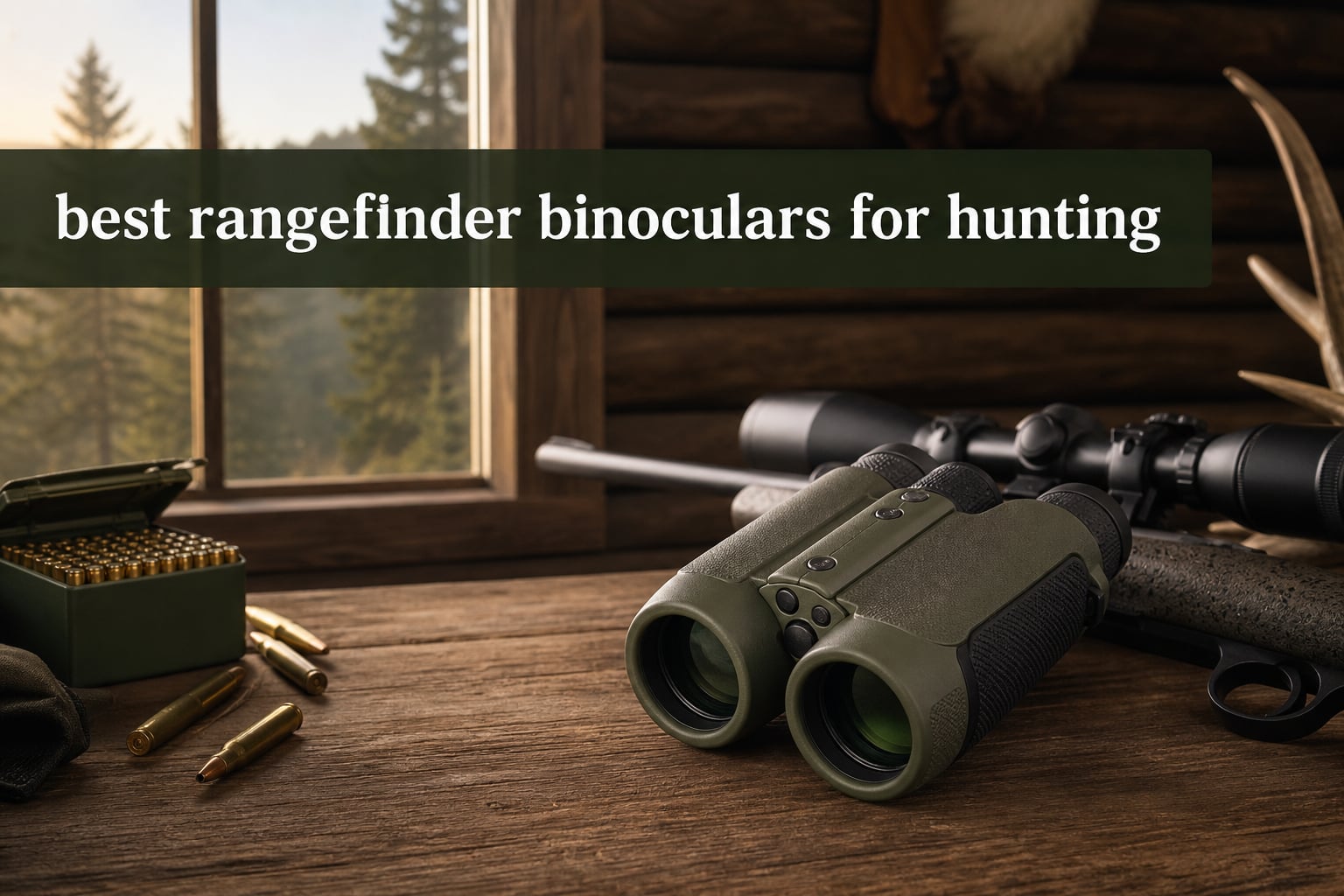
Carrying a separate rangefinder and binoculars means extra weight on your pack and one more thing to fumble with when a trophy buck steps out at 400 yards. The best rangefinder binoculars for hunting solve this problem by combining premium glass and laser ranging into a single optic. Our team spent months comparing models from Vortex, Leupold, Leica, Bushnell, and more to find which ones actually perform in the field.
Rangefinder binoculars work by emitting an invisible laser beam that bounces off your target and returns to a sensor inside the optic. The internal processor calculates the time of flight and gives you a distance reading, often with angle compensation for uphill and downhill shots. This means you get exact yardage without lowering your binoculars to grab a separate device.
The advantage is obvious for hunters who cover serious ground. Instead of packing two pieces of glass, you carry one tool that handles both spotting and ranging. That saves weight, saves time during critical moments, and keeps your hands free when you need them most. Whether you are chasing elk in the Rockies or whitetails in thick timber, having distance data the instant you spot game changes how you hunt.
Not every model is worth your hard-earned money though. Some have excellent glass but weak ranging performance in fog and rain. Others range beautifully but feel like bricks around your neck after a ten-mile day. We dug into the details on nine of the most talked-about options to help you make the right call for your hunting style and budget.
Prices range from budget-friendly options under $300 all the way to premium European glass pushing $1,800. The good news is that the rangefinding binoculars market has matured significantly by 2026, and you no longer need to spend a fortune to get reliable performance. Let us break down what is worth your attention.
Table of Contents
Top 3 Picks for Best Rangefinder Binoculars for Hunting
Before we get into the full breakdown, here are our three standout picks based on real-world hunting performance, value, and user feedback from the field.

Vortex Fury HD 5000 10×42
- 5000 Yard Range
- HCD Angle Comp
- XR HD Optics
- VIP Lifetime Warranty

Bushnell Fusion X 10x42mm
- ActivSync Display
- ARC Technology
- IPX7 Waterproof
- Bullet Drop Compensation
Best Rangefinder Binoculars for Hunting in 2026: Full Lineup
Here is a quick comparison of all nine models we tested and researched. Each one brings something different to the table, from ultra-budget entry points to premium European optics. Scroll through the table below to compare key features at a glance, then read the individual reviews for the full picture.
| Product | Specifications | Action |
|---|---|---|
| Vortex Fury HD 5000 10×42 |
|
Check Latest Price |
 Leupold BX-4 Range HD TBR/W 10×42 Leupold BX-4 Range HD TBR/W 10×42 |
|
Check Latest Price |
 SIG SAUER Canyon 10x42mm SIG SAUER Canyon 10x42mm |
|
Check Latest Price |
| Bushnell Fusion X 10x42mm |
|
Check Latest Price |
 Nikon LaserForce 10×42 Nikon LaserForce 10×42 |
|
Check Latest Price |
 Astra Optix 10×42 2600 Yard Astra Optix 10×42 2600 Yard |
|
Check Latest Price |
| Halo Optics K2000 10×42 |
|
Check Latest Price |
 Leica Geovid R Gen 2022 10×42 Leica Geovid R Gen 2022 10×42 |
|
Check Latest Price |
 YINMONE 10×42 Rangefinder Binoculars YINMONE 10×42 Rangefinder Binoculars |
|
Check Latest Price |
1. Vortex Fury HD 5000 10×42 — Best Overall Performance
Vortex Fury HD 5000 10×42 Laser Rangefinding Binoculars
10x42mm
5000yd Reflective Range
Red OLED Display
916 Grams
Roof Prism
Pros
- HD optics with XR fully multi-coated lenses
- HCD mode for angle compensated distance
- LOS mode for long range precision
- Dielectric phase-corrected prisms
- Nitrogen purged waterproof and fogproof
- Unlimited VIP Lifetime Warranty
Cons
- Not Prime eligible
- Heavier than some competitors at 916g
When hunters on forums like Rokslide and Reddit ask which rangefinding binoculars deliver the best bang for the buck, the Vortex Fury HD 5000 comes up more than almost any other model. I can see why after looking at the specs and user feedback. You get a 5000-yard reflective range, angle-compensated HCD mode, and XR fully multi-coated HD lenses in a package that feels built for abuse.
The HCD mode is what makes this binocular special for hunters. It gives you the horizontal distance you actually need for shooting, accounting for the angle of your shot automatically. For hunters working mountain terrain or elevated stands, this is the number that matters for ethical shot placement. The LOS mode handles long-distance situations where you want the straight-line distance instead.
What really seals the deal is the VIP Warranty from Vortex. It is unlimited, unconditional, and lifetime. If you drop them off a cliff or submerge them in a river, Vortex replaces them. That kind of backing is rare in optics and gives serious peace of mind when you are miles from the trailhead.
The glass quality is genuinely impressive for this price tier. Dielectric phase-corrected prisms deliver bright, sharp images even during those critical last-light minutes when deer are moving. With 384 reviews averaging 4.8 stars and 87 percent giving five stars, the user consensus matches what the specs promise.
Who Should Buy the Vortex Fury HD 5000
This is the model I would recommend to most hunters without hesitation. If you want one optic that does everything well without jumping to European glass territory, the Fury HD 5000 hits the sweet spot. The lifetime warranty and proven track record make it a safe investment for someone buying their first pair of rangefinding binos.
Bowhunters and rifle hunters alike benefit from the dual HCD and LOS modes. The HCD mode covers your typical hunting shots, while LOS gives you the raw distance for extreme long-range scenarios. You are not locked into one mode regardless of what you are hunting.
Where the Fury HD 5000 Falls Short
The weight sits at 916 grams, which is noticeable on all-day hunts but not unusual for rangefinder binoculars. It is also not Prime eligible, so you will need to factor in shipping time. Some users on Reddit mentioned the lack of a built-in ballistic calculator compared to pricier options like the SIG Kilo or Leica Geovid Pro.
If you need a full ballistic solver that pairs with a Kestrel or gives you holdover in MOA or MILS, you will need to look at higher-end models. The Fury HD 5000 gives you angle-compensated distance but stops short of running full firing solutions.
2. Leupold BX-4 Range HD TBR/W 10x42mm — Premium Ballistics in a Solid Package
Leupold BX-4 Range HD TBR/W 10x42mm Range-Finding Binocular Shadow Gray (182883)
10x42mm
TBR/W Technology
Elite Optical System
Porro Prism
Red OLED Display
Pros
- True Ballistic Range/Wind technology
- Elite Optical System for light transmission
- Guard-ion hydrophobic lens coating
- Ballistically calculated ranges for uphill and downhill
- Bright red OLED display
- 100% waterproof and fogproof
Cons
- Porro prism design is bulkier than roof prism
- Premium price point
- Limited review count of 21
Leupold built the BX-4 Range HD for hunters who want serious ballistic computation built right into their binoculars. The TBR/W technology is the standout feature here, standing for True Ballistic Range and Wind. It goes beyond simple angle compensation by calculating ballistically correct ranges that account for your specific ammunition and trajectory.
I appreciate that Leupold did not stop at the rangefinder. The Elite Optical System delivers excellent light transmission, and the Guard-ion lens coating repels water and dirt. That coating is a practical touch that keeps your glass usable in nasty weather when other optics are smearing and fogging up.
The 92 percent five-star rating from a small but enthusiastic reviewer base tells me the hunters who buy these are genuinely impressed. When you factor in the lifetime performance guarantee from Leupold, the investment feels more secure than many competitors offering only a one-year warranty.
One thing to note is the Porro prism design. While Porro prisms can deliver excellent optical performance, they typically make for a bulkier binocular compared to roof prism models. If you are used to the slim profile of roof prism optics, the BX-4 will feel a bit wider in your hands.
Who Should Buy the Leupold BX-4 Range HD
This is a strong pick for hunters who shoot at longer ranges and want ballistic data, not just raw distance. The TBR/W system calculates holdover based on your ballistic profile, which is genuinely useful for shots past 300 yards where bullet drop becomes significant. If you hunt open country where long shots are common, this feature earns its keep.
Leupold loyalists will also appreciate the build quality and warranty backing. These are binoculars you can pass down to the next generation if you take care of them. The Guard-ion coating alone saves you from constantly wiping lenses in the field.
Where the BX-4 Range HD Falls Short
With only 21 reviews on Amazon, the social proof is thin compared to the Vortex Fury HD 5000 with its 384 reviews. That said, the reviews that do exist are overwhelmingly positive. The Porro prism design is also wider than roof prism alternatives, which some hunters find less comfortable for all-day carry.
The price sits above the Vortex Fury HD 5000, which means you are paying more for the TBR/W ballistic system. If you do not shoot past 300 yards, that extra capability may go unused and the Vortex becomes the smarter buy.
3. SIG SAUER Canyon 10x42mm — Advanced DSP Technology at a Fair Price
SIG SAUER Canyon 10x42mm Laser Rangefinding Binoculars
10x42mm
4000yd Reflective Range
1500yd Deer Range
Lightwave DSP
8 Ballistic Groups
Pros
- Lightwave DSP Technology for fast ranging
- 4000yd reflective and 1500yd deer range
- Scan mode updates 4x per second
- 8 onboard ballistic groups
- Archery Mode for bowhunters
- SpectraCoat anti-reflection coatings
Cons
- Low stock availability often an issue
- Not Prime eligible
- Lower rating at 4.4 vs competitors
SIG SAUER has made serious waves in the optics world over the past few years, and the Canyon 10x42mm brings their rangefinding technology into a binocular platform. The Lightwave DSP Technology is the headline feature, using digital signal processing to filter out noise and deliver fast, accurate readings even in challenging conditions.
The scan mode on these binoculars is impressive. It updates four times per second, which means you can track a moving animal or sweep across a ridgeline and get near-continuous distance readings. For spot-and-stalk hunters who need to range multiple animals quickly, this is a practical advantage over single-shot ranging systems.
SIG packed eight onboard ballistic groups into the Canyon, giving you holdover data without needing to pair with a phone or Kestrel. The Angle Modified Range mode handles uphill and downhill shots, and the dedicated Archery Mode makes these a legitimate option for bowhunters who want one optic for everything.
The SpectraCoat anti-reflection coatings on the lenses help with light transmission, though some users noted the glass quality does not quite match the Vortex Fury HD 5000 in side-by-side comparisons. Still, for a mid-tier option under $800, the feature set is aggressive.
Who Should Buy the SIG SAUER Canyon
Hunters who value ranging speed will love the four-times-per-second scan mode. If you hunt situations where you need to range animals quickly at varying distances, the continuous scanning capability saves valuable seconds. The eight ballistic groups also make this a solid choice for hunters who reload and want holdover data in the field.
Bowhunters should pay special attention here. The dedicated Archery Mode calculates angle-compensated distance specifically for steep-angle bow shots, which is exactly what treestand hunters and western bowhunters need.
Where the SIG Canyon Falls Short
The 4.4-star rating is lower than the Vortex Fury and Leupold BX-4, which both sit at 4.8 stars. Some users reported occasional ranging inconsistencies on non-reflective targets in poor weather. Stock availability is also a recurring problem, with listings frequently showing only a handful of units remaining.
The lack of Bluetooth connectivity means you cannot update ballistic profiles through an app like you can with higher-end SIG models such as the Kilo series. If app integration matters to you, the Canyon may feel limited compared to pricier SIG alternatives.
4. Bushnell Fusion X 10x42mm — Best Value for the Money
Bushnell Fusion X 10x42mm Ranging Binoculars, ARC Technology
10x42mm
700yd Measuring Range
ActivSync Display
ARC Technology
IPX7 Waterproof
35 Ounces
Pros
- ActivSync auto-adjusting black-to-red display
- ARC Technology with angle compensation
- IPX7 waterproof submersible at 1 meter
- Bullet Drop Compensation modes
- High-Definition Optical System
- Prime eligible and great value
Cons
- 700 yard measuring range is lower than competitors
- HDOS glass quality trails premium options
- 35 ounce weight is on the heavier side
For hunters who want rangefinding binoculars without emptying their bank account, the Bushnell Fusion X is where I would start looking. The feature set punches well above its price class, starting with the ActivSync Display that automatically switches between black and red illumination based on lighting conditions. That adaptive display is something I normally associate with optics costing twice as much.
The ARC Technology handles angle compensation, giving you true horizontal distance for uphill and downhill shots. Bushnell pairs this with Bullet Drop Compensation modes that translate your distance into holdover data. For hunters shooting flat-shooting calibers inside 400 yards, this combination covers most real-world hunting scenarios.
The IPX7 waterproof rating is a standout at this price point. These binoculars can survive being submerged at one meter for 30 minutes, which is more protection than many budget rangefinders offer. If you hunt in rainy climates or near water, this durability matters.
The main trade-off is the 700-yard measuring range, which is notably shorter than the 1900 to 5000-yard ranges on other models in this roundup. For most deer and elk hunting situations, 700 yards covers the distances you actually need. But if you hunt open country where shots beyond 700 yards are realistic, this limitation could matter.
Who Should Buy the Bushnell Fusion X
This is my pick for the hunter who wants capable rangefinding binoculars without spending four figures. If your typical shots are inside 500 yards and you hunt in variable weather conditions, the Fusion X delivers the features you need at a price that makes sense. The Prime eligibility also means fast shipping.
First-time rangefinder binocular buyers should seriously consider this model. You get angle compensation, bullet drop data, a waterproof housing, and an adaptive display without the premium markup. It is an excellent entry point into the rangefinding binoculars category.
Where the Fusion X Falls Short
The 700-yard range is the obvious limitation. Hunters who regularly glass and range animals at extended distances will find themselves wanting more reach. The High-Definition Optical System is decent but does not match the glass quality of the Vortex Fury or Nikon LaserForce in side-by-side tests.
At 35 ounces, these are not lightweight binoculars. For hunters who prioritize a light pack for backcountry hunts, the weight adds up over a long day. The HDOS glass also shows more chromatic aberration at the edges of the image compared to premium options.
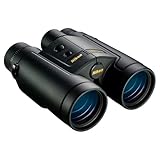
5. Nikon LaserForce 10×42 — ED Glass and Proven Ranging
Nikon LaserForce 10×42 Rangefinder Binocular – 10-1900 Yard Range Waterproof Fogproof Precision Distance Measuring Hunting Binoculars – Fully Multicoated Lenses, Bright Display – Tripod Adaptable
10x42mm
10-1900yd Range
ED Glass
Nikon ID Technology
30.9 Ounces
Roof Prism
Pros
- Extra-low dispersion ED glass for clarity
- Nikon ID Technology for horizontal distance
- Angle compensation up to plus or minus 89 degrees
- Fully multicoated optics
- Shock-resistant rubber-armored metal body
- Prime eligible
Cons
- Lowest rating in batch at 4.0 stars
- 16 percent one-star reviews indicate reliability concerns
- Only 1 year warranty
Nikon brings serious optical credentials to the rangefinder binocular market with the LaserForce. The standout here is the extra-low dispersion ED glass, which reduces chromatic aberration and delivers noticeably sharper images than standard glass. For hunters who glass extensively, that edge-to-edge clarity is a real advantage during long spotting sessions.
The Nikon ID Technology handles angle compensation, giving you the horizontal distance you need for accurate shot placement on angled shots. The system works across an impressive plus or minus 89-degree range, covering everything from steep mountain shots to nearly vertical bowhunting scenarios.
The 10 to 1900-yard ranging range covers practical hunting distances well. You can range reflective targets out to nearly a mile and still get reliable readings on deer and elk at ethical shooting distances. The fully multicoated optics pair with the ED glass to produce bright, high-resolution images.
However, the review profile gives me pause. With 126 reviews averaging 4.0 stars, this is the lowest-rated model in our roundup. Sixteen percent of reviewers left one-star ratings, which suggests some quality control or durability issues. Nikon backs these with only a one-year limited warranty, which is the shortest coverage in the group.
Who Should Buy the Nikon LaserForce
Optical purists who prioritize glass quality above all else will appreciate the ED glass in the LaserForce. If your hunting style involves hours of glassing and you want the sharpest image possible at this price point, Nikon delivers on the optical front. The angle compensation range is also the widest in this roundup.
Hunters who already own Nikon optics and want consistency across their gear lineup will find the LaserForce familiar in feel and operation. The rubber-armored metal body feels solid and handles rough terrain without complaint.
Where the LaserForce Falls Short
The 4.0-star rating with 16 percent one-star reviews is a real concern. Multiple users reported issues ranging from ranging accuracy problems to display failures. The one-year warranty provides minimal protection compared to the lifetime warranties offered by Vortex and Leupold.
At 30.9 ounces, the LaserForce is not light. The fully multicoated optics are good, but Nikon does not include a ballistic calculator or app connectivity. You get angle-compensated distance only, with no holdover or wind data.
6. Astra Optix 10×42 Rangefinder Binoculars — Budget Option with Big Range Claims
Astra Optix Laser Rangefinder Binoculars 10×42 for Hunting, Shooting & Golf – 2600 Yard Range, Built-in Ballistics, HD LCD Display, Fast 0.1s ±1 Yard Accuracy (2600 Yard Version)
10x42mm
2600yd Reflective Range
950yd Deer Range
Ballistics Mode
Lifetime Warranty
860 Grams
Pros
- Ultra-fast 0.15 second ranging speeds
- 2600yd reflective and 950yd deer range
- 4 reticle options with high transmission LCD
- Silver coated prisms for light transmission
- Multiple modes including archery and golf
- Lifetime warranty included
Cons
- 4.1 star rating suggests quality inconsistencies
- Only 59 percent five-star reviews
- Newer brand with limited track record
Astra Optix is a newer player in the rangefinder binocular space, and they are making aggressive claims with this model. The 2600-yard reflective range and 950-yard deer range put these in the conversation with optics costing significantly more. The 0.15-second ranging speed is also among the fastest in this roundup.
The feature list is loaded for the price. You get Ballistics Mode, Scan Mode, Horizontal Angle Corrected Mode, Angle Mode with line of sight, Archery Mode, Gun Mode, and even Golf Mode. That versatility makes these binoculars appealing to hunters who also shoot targets or play golf and want one optic for everything.
The high transmission LCD display offers over 40 percent more light transmission than standard LCDs according to Astra, and the silver-coated prisms help with resolution and brightness. Four reticle options let you customize the display to your preference, which is a nice touch at this price level.
The lifetime warranty is a strong selling point for a brand without a long-established reputation. It suggests Astra is willing to stand behind their product even as a newcomer. With 229 reviews, there is more social proof here than some of the premium European options in this roundup.
Who Should Buy the Astra Optix
Budget-conscious hunters who want maximum ranging distance per dollar should look here. The 950-yard deer range and 0.15-second ranging speed are impressive specifications for a sub-$500 optic. If you hunt open terrain where long-distance ranging matters and your budget is tight, these deserve serious consideration.
The multiple mode options also make this a versatile pick for hunters who participate in different shooting sports. The Archery Mode, Gun Mode, and Golf Mode cover a wide range of use cases, making these a do-it-all optic for the multi-discipline shooter.
Where the Astra Optix Falls Short
The 4.1-star rating with only 59 percent five-star reviews indicates some inconsistency in performance. Several users reported ranging accuracy issues or build quality concerns. As a newer brand, Astra does not have the decades of reputation that Vortex, Leupold, or Leica bring to the table.
The glass quality, while serviceable, does not match premium options. The all-glass optical system with fully multi-coated lenses is adequate but not exceptional. Hunters who prioritize optical clarity above ranging capability may find the image quality leaves something to be desired compared to ED glass options.
7. Halo Optics K2000 10×42 — Budget Pick with Solid Core Features
Halo Optics K2000 Rangefinder Binoculars 10x 42mm
10x42mm
Angle Intelligence
Magnesium Chassis
IPX7 Waterproof
Scan Mode
2 Pounds
Pros
- Angle Intelligence for true horizontal distance
- Durable lightweight magnesium chassis
- IPX7 waterproof and fogproof rating
- Fully multi-coated optics
- Scan Mode for continuous ranging
- Ergonomic no-slip design
Cons
- Limited 54 reviews on Amazon
- Lower five-star percentage than competitors
- Basic feature set without ballistic calculator
The Halo Optics K2000 earns its budget pick designation by delivering the core features hunters need without unnecessary add-ons that drive up the price. Angle Intelligence calculates the true horizontal distance to targets at any elevation, which is the single most important ranging feature for ethical hunting shots. That functionality alone justifies the purchase for most hunters.
The magnesium chassis is a pleasant surprise at this price point. Magnesium is lighter and more rigid than the polycarbonate bodies found on many budget binoculars. At 2 pounds, these are manageable for all-day carry, and the IPX7 waterproof and fogproof rating means they can handle serious weather.
Scan Mode lets you range continuously as you sweep across terrain, which is useful for getting distances to multiple landmarks or animals in quick succession. The fully multi-coated optics are not going to challenge premium European glass, but they deliver serviceable image quality for the price.
The ergonomic no-slip design is well-executed. These binoculars feel secure in your hands even with gloves on or in wet conditions. That grip quality matters more than people realize when you are reaching for your binoculars during a critical moment.
Who Should Buy the Halo Optics K2000
This is my recommendation for the first-time rangefinder binocular buyer who wants to test the waters without a major investment. You get angle-compensated distance, waterproof construction, and a lightweight chassis for less than many standalone rangefinders cost. If you are upgrading from a basic rangefinder and want to consolidate your gear, this is an affordable entry point.
Hunters on a strict budget who refuse to compromise on angle compensation should look here first. The Angle Intelligence feature is the core capability that matters most for ethical shooting, and Halo delivers it without padding the price with features you may never use.
Where the K2000 Falls Short
The feature set is basic compared to competitors. There is no ballistic calculator, no Bluetooth connectivity, and no multiple reticle options. You get angle-compensated distance and scan mode, which covers most hunting needs, but shooters who want holdover data will need to calculate it separately.
With only 54 reviews, the social proof is limited. The 59 percent five-star rating is lower than premium options, suggesting some users encountered issues. The glass quality is adequate but not exceptional, and low-light performance trails the Vortex Fury and Leupold BX-4 noticeably.
8. Leica Geovid R Gen 2022 10×42 — Premium European Glass Experience
LEICA Geovid R Gen 2022 Compact Lightweight Hunting Bird Watching Rangefinder Binoculars with Carrying Strap Incuded, 10×42
10x42mm
2000yd Range
EHR Ballistics Function
Roof Prism
Compact Lightweight
Premium Glass
Pros
- Premium Leica glass with unmatched color fidelity
- EHR ballistics function for ethical shot placement
- Up to 2000 yard measurement range
- Compact and lightweight premium design
- Outstanding field of view
- Includes cordura case and full accessory package
Cons
- Highest price in the roundup
- Only 30 reviews limited social proof
- 16 percent one-star reviews on Amazon
Leica is the name that comes up whenever hunters discuss the absolute best optics money can buy. The Geovid R Gen 2022 brings that legendary glass quality into a rangefinder binocular platform. The color fidelity and image detail are immediately apparent when you look through these compared to mid-tier options.
The EHR ballistics function stands for Equivalent Horizontal Range, which gives you the ethically correct distance for angled shots. Leica designed this specifically for hunters who need to know the true shooting distance for clean kills on uphill and downhill game. The 2000-yard measurement range covers any practical hunting scenario.
What sets the Geovid apart is the optical experience. The natural color reproduction, edge-to-edge sharpness, and detail resolution are what you expect from Leica. For hunters who spend hours glassing, that image quality reduces eye strain and helps you spot animals that would blend into the background through lesser optics.
The included accessory package is generous. You get a contoured neoprene carrying strap, front lens cover, eyepiece caps, a cordura case, and a battery. Leica treats this as a complete package rather than making you buy accessories separately, which adds value to the premium price.
Who Should Buy the Leica Geovid R
Hunters who prioritize optical quality above all else and have the budget to back it up should look no further. If you have looked through Leica, Swarovski, or Zeiss optics and cannot go back to standard glass, the Geovid R is your entry point into rangefinder binoculars from a premium European brand.
Western hunters who glass for hours each day will benefit most from the superior image quality. The reduced eye fatigue from looking through genuinely excellent glass is a real advantage during multi-day hunts. The compact and lightweight design also makes these more packable than you might expect from premium optics.
Where the Geovid R Falls Short
The price is the obvious barrier. At the top of this roundup in terms of cost, the Geovid R is a significant investment that not every hunter can justify. The 30-review count is thin compared to the Vortex Fury’s 384 reviews, though the five-star reviews are enthusiastic about the glass quality.
Notably, 16 percent of reviewers left one-star ratings, which suggests some quality control or expectation issues. The EHR function provides angle-compensated distance but does not include a full ballistic calculator with customizable profiles. If you want Applied Ballistics integration, you need to step up to the Geovid Pro series at an even higher price.
9. YINMONE 10×42 Rangefinder Binoculars — Ultra-Budget Option for Casual Hunters
YINMONE 10×42 Laser Rangefinder Binoculars for Hunting Range Finder 2500Yds
10x42mm
2000yd Range
0.15s Ranging
BAK4 Prism
Speed Tracking
IPX7 Waterproof
Pros
- PXA plus UBX plus BAK4 prism for bright sharp images
- 2000 yard ranging capability
- Real-time speed tracking feature
- IPX7 waterproof housing for harsh weather
- Low-light optimization for dusk and dawn
- Lightest and most affordable option
Cons
- Only 13 reviews very limited social proof
- Newer brand with minimal market history
- Glass quality trails established optics brands
The YINMONE 10×42 is the most affordable option in this roundup, and honestly, the specifications are surprisingly competitive for the price. You get a 2000-yard range, BAK4 prisms with multi-coated lenses, and 0.15-second ranging speed. For hunters dipping their toes into rangefinder binoculars on a tight budget, this is worth a look.
The PXA plus UBX plus BAK4 prism system is designed to deliver bright, sharp images. While this is not premium European glass, it is serviceable for hunters who need functional optics without the premium markup. The multi-coated lenses help with light transmission for those critical dawn and dusk hunting periods.
One feature that stands out is the real-time speed tracking. This is an unusual capability at this price point, and while most hunters will not use it, it is there if you need it. The IPX7 waterproof rating means these can handle rain and accidental submersion, which is impressive for the price.
The low-light optimization is specifically tuned for dusk and dawn usage, which is when most game animals are active. That practical focus on real hunting conditions rather than just impressive-sounding specs on paper suggests the designers actually thought about how hunters use these optics.
Who Should Buy the YINMONE Rangefinder Binoculars
Casual hunters or those on the tightest budget who still want rangefinding capability in their binoculars should consider this option. If you hunt a few times a year and want to try combining your optics without a major financial commitment, the YINMONE lets you test the concept. The 4.6-star rating from early reviewers is encouraging.
This is also a reasonable backup pair or a loaner for hunting partners who show up without rangefinding optics. At this price, you are not worried about handing them to a friend or tossing them in a pack without a second thought.
Where the YINMONE Falls Short
With only 13 reviews, the social proof is extremely thin. YINMONE is a newer brand with minimal market history, which means long-term durability is an open question. The glass quality, while acceptable for the price, is noticeably below what you get from Vortex, Leupold, or Leica.
The warranty and customer support situation is unclear compared to established brands with well-known lifetime warranties. If something goes wrong, you may not have the same recourse that Vortex or Leupold customers enjoy. For hunters who rely on their optics for serious backcountry hunts, that uncertainty is worth weighing.
Buying Guide: How to Choose Rangefinder Binoculars for Hunting
Choosing the right rangefinder binoculars comes down to understanding which features matter for your specific hunting style. The market has expanded significantly in 2026, with options ranging from under $300 to over $1,800. Here is what you need to know to make an informed decision.
Magnification and Objective Lens Size
Every model in this roundup features 10x42mm configuration, and that is no accident. Ten-power magnification is the sweet spot for hunting binoculars because it provides enough detail for identifying animals at distance without the hand shake that comes with higher magnification. The 42mm objective lenses gather enough light for dawn and dusk hunting when game is most active.
Eight-power binoculars offer a wider field of view but less detail at distance. Twelve-power options magnify more but require steadier hands or tripod support. For most hunters, 10×42 is the right balance of detail, field of view, and stability.
Ranging Capability: Reflective Versus Real-World Range
This is where marketing numbers can mislead you. Manufacturers advertise maximum reflective range, which is the distance you can range a highly reflective target like a building under ideal conditions. What matters for hunting is the deer or elk range, which is typically 40 to 60 percent of the reflective range.
For example, the Vortex Fury HD 5000 advertises a 5000-yard reflective range, but real-world deer-range performance is closer to 1500 to 2000 yards depending on conditions. Focus on the deer and elk ranging numbers when comparing models, as those reflect the distances you actually need for ethical hunting shots.
Ballistic Calculator and Angle Compensation
Angle compensation is non-negotiable for hunters. Whether brands call it HCD, TBR, ARC, or EHR, the function does the same thing: it calculates the horizontal distance for angled shots. Without angle compensation, a 400-yard shot at a 30-degree angle will read 400 yards when the true shooting distance is closer to 346 yards. That difference matters for shot placement.
A full ballistic calculator goes further by computing holdover based on your specific ammunition trajectory. Models like the Leupold BX-4 with TBR/W and the SIG Canyon with eight ballistic groups give you holdover data in the field. If you shoot past 400 yards, this feature is worth the investment. If your shots are inside 300 yards, simple angle compensation is sufficient.
Glass Quality and Lens Coatings
Glass quality is the factor that separates adequate optics from exceptional ones. Extra-low dispersion glass, like the ED glass in the Nikon LaserForce, reduces chromatic aberration and produces sharper images. Fully multi-coated lenses improve light transmission, which directly impacts how well you can see during the critical first and last light periods.
Premium European brands like Leica use proprietary glass formulations and coatings that produce noticeably better color fidelity and resolution. The difference is most apparent during extended glassing sessions, where superior glass reduces eye fatigue and helps you pick out animals blending into their surroundings.
Weight and Packability
Rangefinder binoculars are heavier than standard binoculars because of the internal electronics and laser components. Weights in this roundup range from roughly 30 to 38 ounces. That extra weight is noticeable on all-day hunts and multi-day backcountry trips.
If you cover serious miles on foot, weight matters more than you might think. A lighter pair of rangefinder binoculars around a bino harness saves your neck and shoulders over a ten-mile day. Consider the magnesium chassis options like the Halo K2000 if weight is a primary concern.
Battery Life and Cold Weather Performance
Battery life is a practical concern that forum users on Reddit frequently raise. Cold weather drains batteries faster, which is problematic for late-season hunters working in freezing temperatures. Carry spare batteries in an inside pocket where your body heat keeps them warm.
Most rangefinder binoculars use CR2 or similar batteries. Check the expected battery life in the manufacturer specifications, and note that scan mode drains batteries significantly faster than single-shot ranging. Auto-shutoff features, like the one on the Nikon LaserForce, help conserve power.
Weatherproofing and Durability
Hunting happens in bad weather. Look for IPX7 waterproof ratings at minimum, which means the optic can survive submersion at one meter for 30 minutes. Nitrogen or argon purging prevents internal fogging when moving between temperature extremes, which is critical for cold morning hunts.
Rubber armor protects against drops and provides grip in wet conditions. The warranty matters here too, as even the best-built optics can fail. Vortex with their unlimited VIP Warranty and Leupold with their lifetime guarantee offer the best long-term protection.
Bluetooth and App Connectivity
Bluetooth connectivity lets you sync your binoculars with a smartphone app or external ballistic device like a Kestrel. This feature is found on higher-end models like the SIG Kilo series and allows you to update ballistic profiles, download environmental data, and get more sophisticated firing solutions.
None of the models in this roundup include Bluetooth, as that feature typically appears on more expensive tiers. If app connectivity is important to you, consider stepping up to the SIG Kilo 10K HDX or Leica Geovid Pro series, which offer full Applied Ballistics integration.
Warranty Considerations
Optics are an investment, and the warranty tells you how confident the manufacturer is in their product. Vortex offers the most comprehensive coverage with their unlimited, unconditional VIP Warranty. Leupold provides a lifetime performance guarantee. Astra Optix and Halo offer lifetime warranties as newer brands trying to build trust.
Nikon’s one-year limited warranty is the shortest in this roundup and is a significant drawback relative to competitors. Leica’s warranty varies by region but generally provides solid European-level coverage. Consider the warranty as part of the total value calculation, not just the sticker price.
FAQs
How much do rangefinder binoculars cost?
Rangefinder binoculars range from approximately $260 for budget models like the YINMONE 10×42 to over $1,800 for premium European glass like the Leica Geovid R. The sweet spot for most hunters sits between $500 and $1,000, where you find options like the Vortex Fury HD 5000 and Bushnell Fusion X that deliver excellent performance without the premium markup.
Are rangefinder binoculars better than separate optics?
For most hunters, rangefinder binoculars are worth the investment because they eliminate the need to carry and switch between two separate devices. You get distance data instantly without lowering your binoculars, which saves critical seconds during a shot opportunity. However, dedicated rangefinders can offer longer range and more ballistic features at a lower combined cost if you already own quality binoculars.
What are the best rangefinder binoculars for hunting?
The Vortex Fury HD 5000 is our top pick for most hunters thanks to its 5000-yard range, angle-compensated HCD mode, HD optics, and unlimited lifetime VIP Warranty. For budget-conscious hunters, the Bushnell Fusion X delivers excellent value with ActivSync display and ARC technology. The Leica Geovid R is the premium choice for hunters who prioritize optical quality above all else.
What to look for in rangefinder binoculars?
Focus on angle compensation capability, real-world deer ranging distance rather than reflective range numbers, glass quality with fully multi-coated lenses, waterproof and fogproof construction, and warranty coverage. A ballistic calculator is valuable if you shoot past 400 yards. Weight matters for mobile hunters, and 10x42mm is the ideal magnification configuration for most hunting applications.
Final Thoughts on the Best Rangefinder Binoculars for Hunting
Finding the best rangefinder binoculars for hunting comes down to matching the optic to your hunting style, budget, and the distances you actually shoot. For most hunters, the Vortex Fury HD 5000 is the clear winner with its unbeatable combination of HD optics, 5000-yard range, angle compensation, and lifetime VIP Warranty.
If budget is your primary concern, the Bushnell Fusion X delivers remarkable value with its ActivSync display and ARC technology. Hunters who want premium European glass should look at the Leica Geovid R, while the Halo Optics K2000 and YINMONE options serve the entry-level market well for under $300.
Whatever you choose, investing in rangefinding binoculars is one of the most practical upgrades you can make to your hunting kit. Having distance data the instant you spot game changes how you hunt and improves your shot placement in the field. Pick the model that fits your needs and get after it this season.