
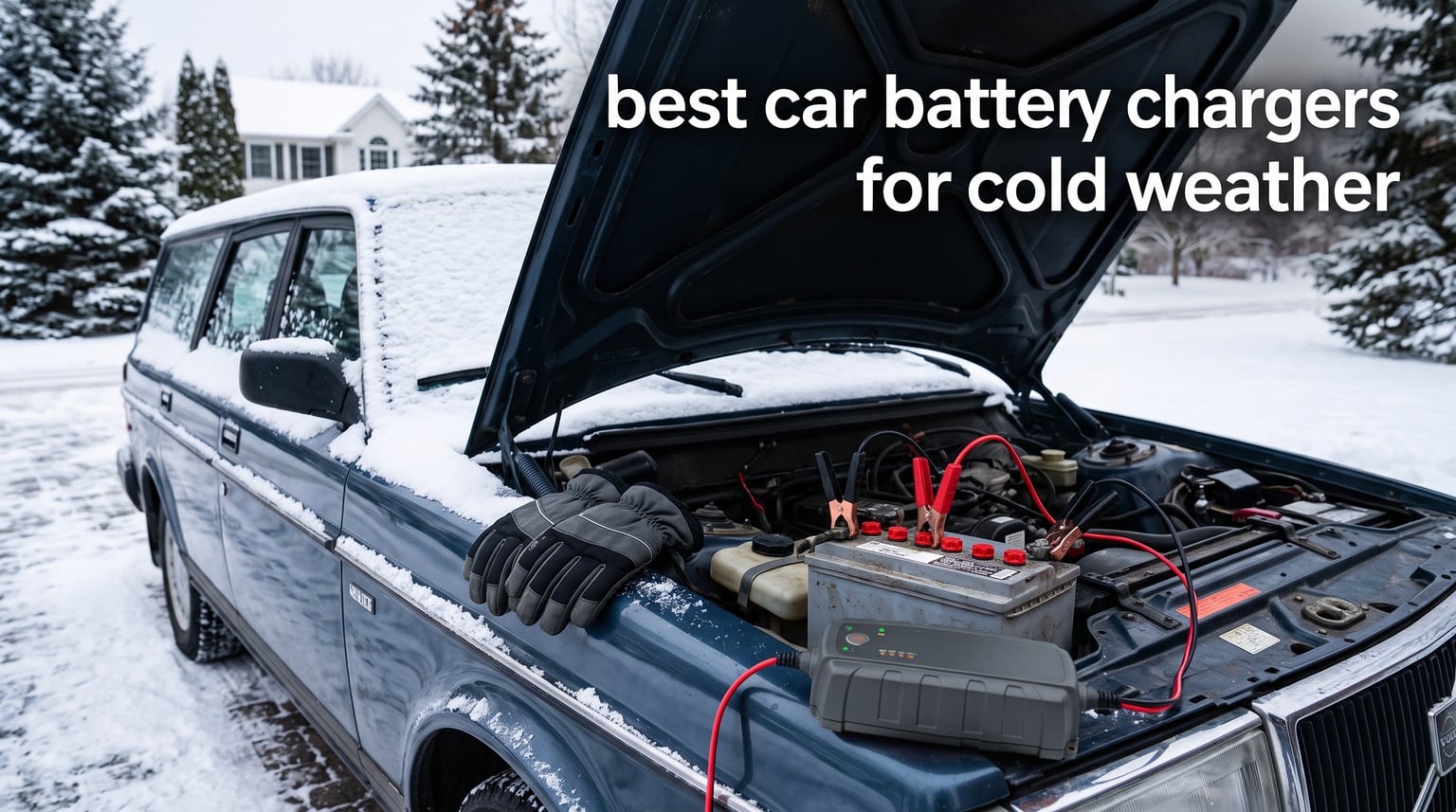
The best car battery chargers for cold weather do more than add charge: they match the battery’s chemistry, control the charging cycle, and, in the strongest cases here, account for temperature. Cold weather reduces the available capacity of a starting battery and raises resistance, so a vehicle that seemed fine on a mild day can struggle after a night outside.
Yes, car battery chargers can work in the cold, but the charger and the battery have separate limits. A winter mode or temperature compensation is a useful documented feature, while a claim that a unit will operate at an extreme temperature needs an actual stated rating; I do not treat one as proof of the other.
I compared the 12 available chargers by their stated voltage range, amperage, supported battery types, winter-related functions, safety features, and maintain capability. If your emergency plan still has a gap after the battery is handled, pair this guide with our winter emergency car kit guide; a charger needs household AC power and is not a roadside jump pack.
Outdoor parking, short trips, and a parasitic draw are the recurring winter problems people describe. The practical answer is usually a smart battery maintainer connected while the vehicle is safely parked, plus a battery in good enough condition to accept a charge; no charger can repair every frozen, damaged, or fully failed battery.
Table of Contents
Top 3 Picks Answer Most Winter Charging Needs
Battery Tender takes the editor’s choice for its 8-amp or 2-amp selection, IP65 housing, and support for lead-acid, AGM, gel, and LiFePO4 batteries. PZ.P is the best value for drivers who need 12V and 24V charging with stated temperature compensation, while the AIYONFEI is the compact pick for a 12V vehicle that needs automatic seasonal compensation and a display.

Car Battery Chargers for Cold Weather in 2026 at a Glance
The table below is a fast way to narrow the field. Read the battery-type wording closely, especially if your vehicle has an AGM or lithium battery, and remember that a 24V function is unnecessary for most passenger cars but useful for some trucks, RVs, boats, and equipment.
| Product | Specifications | Action |
|---|---|---|
| Battery Tender Power Tender |
|
Check Latest Price |
 SYLVANIA Smart Charger SYLVANIA Smart Charger |
|
Check Latest Price |
 PZ.P 15A Smart Charger PZ.P 15A Smart Charger |
|
Check Latest Price |
 Noone 20A Smart Charger Noone 20A Smart Charger |
|
Check Latest Price |
 NEXPEAK NC215 NEXPEAK NC215 |
|
Check Latest Price |
 PCHH Heavy Duty Charger PCHH Heavy Duty Charger |
|
Check Latest Price |
 yourheey Heavy Duty Charger yourheey Heavy Duty Charger |
|
Check Latest Price |
 E-FAST 25A Smart Charger E-FAST 25A Smart Charger |
|
Check Latest Price |
 AIYONFEI 8A Smart Charger AIYONFEI 8A Smart Charger |
|
Check Latest Price |
 YDBAO 10A Smart Charger YDBAO 10A Smart Charger |
|
Check Latest Price |
 E-FAST 20A Smart Charger E-FAST 20A Smart Charger |
|
Check Latest Price |
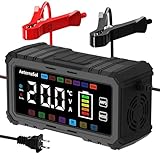 AeternaSol 20A Smart Charger AeternaSol 20A Smart Charger |
|
Check Latest Price |
1. Battery Tender Power Tender Is the Best All-Around Maintainer
Battery Tender Power Tender 8 AMP / 2 AMP 12V Battery Charger and Maintainer – Fast Charging, Power Supply, IP65 Weather Resistant – Compatible with Lead Acid, AGM, Gel, & Lithium – 022-1005-DL-WH
12V
8A fast or 2A maintain
IP65 housing
Pros
- 8A or 2A selection
- IP65 weather resistance
- Supports AGM gel and LiFePO4
- Sparkproof protection
Cons
- 12V only
- 27 listed reviews
The Power Tender makes the most sense for a driver who wants one 12V unit for regular charging and winter storage. Its 8-amp setting is for faster charging, while the 2-amp setting is intended for safe long-term maintenance, so you do not need a separate basic battery tender for each job.
Its stated compatibility covers sealed and flooded lead-acid, AGM, gel, and LiFePO4 batteries. The IP65-rated housing, sparkproof technology, reverse-hookup protection, and automatic operation are the traits I would prioritize for a charger that may live near a cold garage door.
Its strongest fit is mixed-vehicle 12V ownership
This is a sensible match when a household has a car, motorcycle, lawn equipment, or a marine battery, provided each is a 12V battery. The included alligator clips and ring terminals give you choices for a temporary connection or a more convenient stored-vehicle setup.
Its limitation is that it does not cover 24V systems
Drivers with a 24V truck, equipment, or battery bank need a dual-voltage charger instead. The product listing says weather resistant, not that it has a stated sub-zero operating rating, so keep expectations separate from an extreme-cold certification.
2. SYLVANIA Smart Charger Is the Simplest Dedicated Cold-Mode Choice
SYLVANIA – Smart Charger – Heavy-Duty, Portable Car Battery Charger – Makes Car Charging Easy – Use as Battery Maintainer – 6V or 12V Voltage Output – 6 AMP
6V or 12V
6A output
9-stage cold mode
Pros
- Dedicated cold-weather mode
- Backlit LCD
- 6V and 12V support
- Automatic float mode
Cons
- 6A output
- limited listed availability
SYLVANIA explicitly lists a cold weather charging mode, which puts this 6-amp charger near the top for someone who wants a plain-language winter setting. The nine-stage automatic process charges, checks, and then moves into float maintenance rather than continually pushing current.
The large backlit LCD shows voltage and the charging process, which is helpful when daylight is short and a battery is tucked into an engine bay. A single-button layout also keeps mode selection less intimidating than units with several current settings.
Its strongest fit is visible, low-fuss winter maintenance
Choose it for a 6V or 12V battery when you value the cold-weather setting and display more than outright speed. The automatic float mode is relevant for a car that sits, a seasonal motorcycle, or a battery that loses charge through an accessory draw.
Its tradeoff is a modest 6-amp charging rate
Six amps is enough for patient maintenance and routine recovery, but a larger battery may take longer than on a 15-amp or 20-amp model. Confirm the battery voltage before connecting; a 12V charger cannot substitute for a 24V system.
3. PZ.P 15A Smart Charger Is the Best Value for 12V and 24V
PZP 15-Amp 12V/24V Smart Battery Charger, Maintainer & Trickle Charger for LiFePO4, Lead Acid Batteries – Fully Automatic 9-Stage Charging w/Temp Compensation for Motorcycle Car Truck Lawnmower Boat
12V 15A or 24V 8A
9-stage
Temp compensation
Pros
- 12V and 24V support
- LiFePO4 and lead-acid support
- Temperature compensation
- Color status screen
Cons
- Cannot charge totally dead batteries
- few manual controls
PZ.P combines a 15-amp 12V charge rate with 24V charging at 8 amps, making it one of the more flexible options on this list. Its stated temperature compensation is directly relevant to cold weather battery care because the charging system adjusts with temperature rather than treating every garage the same.
The unit also lists nine-stage charging, automatic trickle or float operation, reverse-polarity protection, and a color LED screen. It supports LiFePO4 and lead-acid batteries, including AGM, gel, SLA, and flooded types, so it is a practical match for drivers with varied equipment.
Its strongest fit is a driver with more than one battery voltage
This is the model I would shortlist for a 12V car plus 24V equipment, boat, or truck application. Real-time display data can help you check progress without guessing from a single colored light.
Its boundary is a battery with no usable voltage
The listing says it cannot activate or charge a totally dead battery. If a battery has been frozen, swollen, damaged, or shows no viable voltage, stop and have the battery evaluated rather than relying on repair claims.
4. Noone 20A Smart Charger Is the Most Feature-Heavy Winter Option
NOONE 10A/20A Smart Battery Charger – 12V/24V Fully Automatic Maintainer
12V or 24V
20A
Winter mode and 50A boost
Pros
- Winter and maintainer modes
- 12V and 24V operation
- Smart heat control
- 50A engine boost
Cons
- Boost needs AC power
- not a roadside device
The Noone charger packages auto, quick, Li-Iron, maintainer, and winter modes in one unit. Its smart heat control is a useful stated feature for preventing unexpected shutdowns, and its 20-amp rating gives it more recovery potential than a small maintainer.
It is also ETL certified and lists nine layers of safety protection, including reverse polarity, overcharge, and overheat protection. The 50-amp engine boost start is a five-second AC-powered assist for a 12V battery, not a replacement for an independent jump starter.
Its strongest fit is garage charging with several use cases
Use this type of charger if you need a winter setting but also want quick charging, maintenance, and battery-type modes. It supports 12V and 24V use, which expands its role beyond a single car.
Its key limitation is dependence on an outlet
Because the engine-start feature requires AC power, it will not help when a car is stranded away from an outlet. For roadside readiness, keep separate starting equipment in the vehicle and see our winter solar chargers guide for a different off-grid charging context.
5. NEXPEAK NC215 Is a Clear 15A Temperature-Compensated Charger
NEXPEAK NC215 15-Amp Battery Charger, Trickle Charger Car Battery Charger 12V 24V LiFePO4 Lead Acid Portable 9-Stage Smart Battery Maintainer w/Temp Compensation for Car Truck Lawn Mower Boat Marine
12V 15A or 24V 8A
9-stage
Temperature compensation
Pros
- 15A 12V charging
- 12V and 24V capability
- Sunlight-visible screen
- LiFePO4 support
Cons
- Cannot charge 0V batteries
- bright housing shows dirt
NEXPEAK NC215 has a familiar smart-charger formula: 15 amps at 12V, 8 amps at 24V, nine charging stages, and temperature compensation. The large color LED screen is designed to remain visible in sunlight, useful if the only available charging spot is outside a garage.
Its compatibility includes LiFePO4 and lead-acid types, and the stated protections include temperature compensation, reverse protection, and fireproof material. The pulse-repair function is for restoring lost battery performance, but it should not be read as a guarantee that an old battery will recover.
Its strongest fit is outdoor-accessible progress monitoring
The readable display and dual-voltage support suit someone who wants to check voltage and charging status at a glance. It also works across automotive, marine, and deep-cycle applications listed by the manufacturer.
Its limit is a fully depleted battery
The charger cannot activate or charge a totally dead 0V battery. This distinction matters in cold conditions, when a battery may be weak from age or discharge rather than merely low on charge.
6. PCHH Heavy Duty Charger Is the Lead-Acid Workhorse
PCHH 12V 24V Car Battery Charger Heavy Duty, 0-15A Automatic Battery Maintainer, Smart Trickle Charger with Auto Shutoffs, Repair, Winter Mode, for Automotive Car Truck Motorcycle Lawn Mower Boat AGM
12V or 24V
15A
Winter mode and repair
Pros
- Heavy-duty construction
- Automatic 12V or 24V detection
- Winter mode
- Three-year warranty
Cons
- Not for lithium batteries
- 12.4-pound unit
The PCHH is built around lead-acid work rather than light portability. It has a copper coil with metal and ABS casing, automatic 12V or 24V detection, auto-off and maintain modes, a winter mode, and a repair mode for batteries above 3V.
Its compatible lead-acid list is broad: AGM, gel, wet or flooded, EFB, calcium, maintenance-free, and deep-cycle types. Ring terminals or clamps are included, which is useful if one vehicle will receive repeated seasonal maintenance.
Its strongest fit is a larger lead-acid fleet
Consider this one for cars, trucks, RVs, boats, lawn equipment, and motorcycles that use the specified lead-acid battery families. The stated three-year warranty and sturdy format favor a fixed garage setup over a glove-box solution.
Its deciding restriction is no lithium compatibility
The manual says it is not suitable for lithium batteries, so do not select it for LiFePO4. At 12.4 pounds, it is also a charger you will likely store on a bench rather than carry around frequently.
7. yourheey Heavy Duty Charger Is the Stated Sub-Zero Lead-Acid Pick
2026 Upgraded 12V/24V 0-20A Heavy Duty Battery Charger/Maintainer with Auto Shutoff, Repair & Winter Mode, 10 Modes & Color Screen for Car, Truck, Motorcycle, RV, Boat, Lawn Mower, Deep Cycle Chargers
12V or 24V
20A
Winter mode stated to -4F
Pros
- Stated -4F winter mode
- 20A output
- Auto voltage detection
- Pulse repair
Cons
- Not for lithium batteries
- fast mode needs 30Ah battery
This yourheey heavy-duty charger stands out because its listing gives a specific winter-mode figure: sub-zero temperatures down to -4F. That is more useful evidence than a generic all-weather label, though it does not establish performance at the colder -20F and below conditions that some northern drivers report.
It auto-detects 12V or 24V systems and lists 20 amps, constant-voltage and constant-current modes, aluminum-alloy housing, and pulse repair for batteries as low as 3V. The listed battery types are lead-acid varieties including AGM, gel, flooded, EFB, calcium, and deep-cycle.
Its strongest fit is cold-region lead-acid charging above its stated floor
This is a strong candidate for a driver who wants a documented sub-zero winter setting and needs more output than a maintainer. The automatic voltage detection reduces one setup decision when working across compatible vehicles.
Its boundaries are lithium use and severe Arctic claims
It is not compatible with lithium or LiFePO4 batteries. Its stated -4F winter figure should not be extended to colder temperatures without manufacturer confirmation; at much lower temperatures, bring a removable battery indoors only if its maker permits it.
8. E-FAST 25A Smart Charger Is the Fastest Adjustable Option
E-FAST 25A Smart Car Battery Charger, 12V/24V Automatic Automotive Battery Maintainer & Desulfator with 200s Booster Mode – Adjustable Amp Trickle Charger for Lead-Acid, AGM, Gel, LiFePO4
12V or 24V
25A adjustable
Automatic seasonal mode
Pros
- 25A maximum output
- Five selectable current levels
- LiFePO4 support
- UL certified
Cons
- Booster is 12V only
- one-year warranty
E-FAST offers the highest stated charge rate in this group at 25 amps for 12V systems and 15 amps for 24V, with selectable 2A, 8A, 20A, 25A, and Auto settings. That adjustability lets you choose a gentler rate for maintenance instead of treating every battery like a large, discharged one.
The charger has an automatic winter or summer mode based on ambient temperature, eight-stage charging, repair mode, active cooling, and UL certification. It supports lead-acid families as well as LiFePO4, making it more flexible than the heavy lead-acid-only units.
Its strongest fit is controlled higher-amperage charging
This model makes sense for a larger compatible battery that needs more than maintenance charging, while still giving you lower settings. The aluminum housing and cooling fan address heat management during charging, not a stated lower operating-temperature threshold.
Its caution is that high current is not always the right current
Follow the battery manufacturer’s charging guidance and choose a rate appropriate to battery capacity. Its 200-second booster feature works only with 12V batteries and still needs an outlet, so it is not a portable emergency starter.
9. AIYONFEI 8A Smart Charger Is the Compact 12V Seasonal Maintainer
AIYONFEI 12V Battery Charger 8-Amp Smart Trickle Charger, Red
12V 8A
Automatic seasonal compensation
LCD
Pros
- Automatic winter and summer modes
- 12V battery range 2Ah to 150Ah
- LCD monitoring
- UL certified
Cons
- 12V only
- repair mode excludes LiFePO4
AIYONFEI is a compact 8-amp choice for a 12V battery and lists automatic winter and summer modes with temperature compensation. Its backlit LCD reports voltage, current, and charging status, giving a useful second check beyond whether the charger is simply plugged in.
It supports LiFePO4, AGM, gel, EFB, VRLA, and flooded lead-acid batteries for normal charging, with a stated 2Ah to 150Ah capacity range. A motorcycle or trickle setting makes it a natural candidate for seasonal vehicles as well as a car.
Its strongest fit is a small-to-medium 12V storage routine
Choose it when you need a straightforward charger-maintainer with automatic seasonal compensation and you do not have a 24V system. The fireproof ABS material, cooling system, and listed safety protections add useful layers for unattended maintenance within the product instructions.
Its important distinction is repair-mode compatibility
Although it supports LiFePO4 charging, the listing says desulfation mode is not for LiFePO4. It also cannot handle completely depleted or damaged batteries, so assess a suspect battery before leaving it connected.
10. YDBAO 10A Smart Charger Is the Popular 12V Display Option
Battery Charger 10A 12V Fully Automatic Smart Car Battery Charger with LCD Display & Temperature Compensation for Car Motorcycle Vans
12V 10A
Five modes
Automatic temperature compensation
Pros
- 10A compact charging
- Five selectable modes
- LCD data display
- UL certified
Cons
- 12V only
- listing advises against over-12-hour unattended use
The YDBAO combines charging, maintaining, and trickle functions in a 10-amp 12V unit. Its LCD displays voltage, current, battery level, temperature, and seasonal-mode information, while the selectable modes cover Auto, AGM or gel or LiFePO4, wet, motorcycle, and pulse use.
It lists automatic temperature compensation, eight protection layers, and CE, FCC, and UL certifications. With a large review sample in the supplied data, it is a reasonable straightforward choice for a vehicle that needs a bit more charging current than an 8-amp unit.
Its strongest fit is a 12V owner who wants mode visibility
The screen and named battery settings make it easier to confirm that you selected an appropriate mode. This is useful with AGM or lithium batteries, but the vehicle manual and battery label remain the final compatibility check.
Its limitation is the manufacturer’s unattended-use guidance
The listing does not recommend unattended operation beyond 12 hours. That makes it less suited to a set-and-forget all-winter setup than a charger whose instructions specifically allow extended maintenance.
11. E-FAST 20A Smart Charger Is a Versatile Dual-Voltage Alternative
E-FAST Battery Charger 0-20A 12/24V Lifepo4 Lead Acid Automatic Smart Car Battery Charger, Trickle & Pulse Repair, Automobile Battery Maintainer for Car Truck Motorcycle Lawn Mower Boat
12V or 24V
20A
7-stage pulse repair
Pros
- 20A dual-voltage charging
- LiFePO4 and lead-acid support
- Seven-stage process
- Real-time display
Cons
- Cannot activate dead batteries
- no jump-start function
The second E-FAST model provides 20-amp 12V or 24V charging with a seven-stage sequence that includes desulfurization, trickle, constant current, constant voltage, detection, compensation, and float stages. It is positioned as an all-in-one charger, maintainer, trickle charger, and desulfator.
Its compatible types include LiFePO4, AGM, gel, and lead-acid batteries, and the display shows live voltage, current, and temperature. Multiple stated protections cover reverse polarity, overheating, overcurrent, overvoltage, and short circuits.
Its strongest fit is a dual-voltage battery collection
This is useful for a home that has a passenger vehicle plus a truck, boat, mower, motorcycle, or RV with compatible batteries. The seven-stage approach gives it a maintenance role after charge recovery, not only a fast-charge role.
Its limitation is that pulse repair cannot create a healthy battery
The listing says it cannot activate dead batteries, repair damaged batteries, or jump-start a car. Treat a pulse function as battery-care support, not a substitute for a load test or a replacement when a battery is at end of life.
12. AeternaSol 20A Smart Charger Is the Adjustable Dual-Voltage Pick
AeternaSol 20A Smart Car Battery Charger 12V/24V Battery Charger, Automatic Battery Maintainer Desulfator Compatible with LiFePO4, AGM, Gel, Lead-Acid, Trickle Charger for Truck, Motorcycle, RV, Boat
12V or 24V
20A adjustable
Winter and summer modes
Pros
- Five current settings
- Auto 12V or 24V recognition
- Temperature compensation
- LiFePO4 support
Cons
- Lower listed review count
- needs correct battery mode
AeternaSol gives you five current selections—2A, 6A, 10A, 15A, and 20A—alongside 12V or 24V auto-recognition. It also lists winter and summer modes with temperature compensation, pulse repair, a cooling fan, and continuous safety monitoring.
Compatibility spans LiFePO4, AGM, gel, SLA, wet lead-acid, and related applications such as trucks, SUVs, boats, RVs, and motorcycles. The 200-second booster mode is intended for targeted emergency charging, but it is not a no-outlet jump solution.
Its strongest fit is a user who wants to set charging current
The several current options can be helpful when battery capacity varies across your vehicles. The automatic voltage recognition reduces the chance of choosing 12V versus 24V incorrectly, but you should still select the correct battery chemistry mode before connection.
Its caution is that it cannot revive every low-voltage battery
The listing warns that excessively low-voltage or damaged batteries cannot be charged. Its lower review count compared with several picks above also means I would lean on the documented specifications and proper setup rather than assumptions about long-term behavior.
Choose a Cold-Weather Charger by Temperature, Battery Type, and Routine
Start with the battery label, not the charger’s headline amperage. Verify whether the battery is 12V or 24V and whether it is flooded lead-acid, AGM, gel, EFB, or LiFePO4; a charger may support some of these types and exclude others, especially in repair mode.
Next, distinguish a winter mode from an extreme-cold rating. A winter mode or automatic temperature compensation means the charger is designed to alter its charging behavior with ambient temperature, but only the yourheey listing in this group states a specific sub-zero winter figure, -4F.
Cold weather changes both the battery and the charging decision
A battery should not be charged when frozen. If the case is bulging, cracked, leaking, or suspected to be frozen, do not connect a charger; let the battery thaw in a safe ventilated area and have it inspected according to the battery maker’s direction.
There is no universal air temperature where every car battery becomes unsafe to charge because chemistry, battery condition, and charger instructions differ. Below freezing, check the charger manual and battery maker’s directions; in severe cold, a charger that merely has a winter mode may not be enough for outdoor use.
Amperage sets charging pace, not battery health
A 2-amp setting is generally aimed at gentle maintenance, while 6 to 10 amps suits routine charging and 15 to 25 amps can shorten recovery time for compatible larger batteries. More amps are not automatically better: use the rate allowed by the battery manufacturer and allow the smart charger to finish its cycle.
For a car parked for weeks, the maintain or float phase matters more than the headline maximum. This phase monitors the battery and supplies charge as needed, unlike an old-style constant trickle charger that may continue feeding current without the same automatic control.
A charger, maintainer, and trickle charger serve different roles
A battery charger restores charge to a low battery. A battery maintainer is designed to monitor a stored battery and switch to a float or maintenance phase after charging, while “trickle charger” is often used loosely but can describe a lower, continuous output device.
For winter car storage, I would choose a smart maintainer function rather than leave a basic constant-output charger connected. Follow the product instructions, use a dry protected outlet, and inspect clamps, leads, and the battery periodically.
Safe connection starts with the charger unplugged
- Park in a ventilated area, switch the vehicle off, and inspect the battery for damage, leakage, or signs of freezing.
- Set the charger for the correct voltage and battery chemistry before connecting if the model requires it.
- With the charger unplugged, attach the positive clamp to the positive battery terminal, then attach the negative clamp as instructed by the charger or vehicle manual.
- Plug the charger into a protected AC outlet and confirm its display or indicator shows the expected charging state.
- When finished, unplug AC power first, then remove the negative clamp followed by the positive clamp.
Keep sparks and open flames away from a charging battery, and do not run an extension cord through standing water or a pinched door. Reverse-polarity protection is valuable, but it is not permission to skip the connection check.
Winter storage works best as a short repeatable routine
- Charge the battery fully before storage and clean corrosion from the terminals with an appropriate method.
- Connect a compatible smart maintainer if the vehicle will sit and an outlet can be used safely.
- Check the charger’s indicator and the battery condition on a regular schedule rather than assuming the setup is fault-free.
- Address parasitic draw, such as an accessory or module, if the battery repeatedly falls behind despite proper maintenance.
- Use a block heater for engine warming when appropriate to the vehicle and climate; it does not charge the battery and a battery charger does not warm engine oil.
Drivers in very cold regions often use both tools for different jobs. Cold-weather battery technology also affects devices beyond cars, as our guide to cold weather battery technology illustrates, but do not apply charging rules from one chemistry or device to another.
For a car parked outside without convenient AC power, reduce the load first: avoid very short trips when possible, have the battery tested, and investigate parasitic drain. A solar panel is a separate option where its output, placement, and winter sunlight are adequate; it will not match a wall-powered charger’s behavior in every location.
Weather resistance is not permission to charge in unsafe conditions
An IP65 housing such as the Battery Tender’s is designed for dust and water resistance, yet charging equipment should still be placed and used as its manual directs. Keep connections dry, avoid snowmelt puddles, and do not charge a visibly compromised battery.
Forum reports from Alaska and the Canadian Prairies point to the same lesson: some ordinary chargers stop functioning in extreme cold, while users specifically praise purpose-built cold-weather solutions. That is useful context, not a substitute for a product’s stated operating limits.
Cold-Weather Charger Questions Have Straight Answers
Do car battery chargers work in the cold?
Yes, many car battery chargers work in cold conditions, especially units with winter modes or temperature compensation. The battery must not be frozen or damaged, and the charger’s instructions may set a lower operating limit. A weather-resistant housing and a cold mode do not automatically prove extreme-cold operation.
What temperature is too cold to charge a battery?
A frozen battery should not be charged. There is no single safe air-temperature cutoff for every battery and charger, so check both manuals below freezing. Of the products compared here, the yourheey listing states winter-mode operation to -4F; do not assume other models share that limit.
How do you keep a car battery charged in cold weather?
Fully charge the battery, correct any parasitic drain, and use a compatible smart maintainer during extended parking when safe AC power is available. Inspect the battery and connections regularly. A block heater warms the engine but does not charge the battery.
Can you leave a trickle charger on all winter?
Leave a battery connected only to a smart charger or maintainer whose instructions allow extended maintenance mode. A basic continuous trickle charger can overcharge a battery. Use the correct voltage and chemistry setting, keep the setup dry, and check it periodically.
The Best Choice Matches Your Battery and Winter Parking Setup
For most 12V owners, the Battery Tender Power Tender is the balanced pick because it pairs 8-amp charging with 2-amp maintenance, weather resistance, and broad stated chemistry support. Choose SYLVANIA for a dedicated cold-weather mode, PZ.P or NEXPEAK for temperature-compensated 12V and 24V charging, and yourheey when its stated -4F winter-mode figure fits a lead-acid application.
The best car battery chargers for cold weather in 2026 are smart, correctly matched to the battery, and used before the battery is deeply discharged. Pick your compatible model, read its manual before the first freeze, and make battery maintenance part of your winter routine.